Author: Mark
Norm, I hardly knew ya
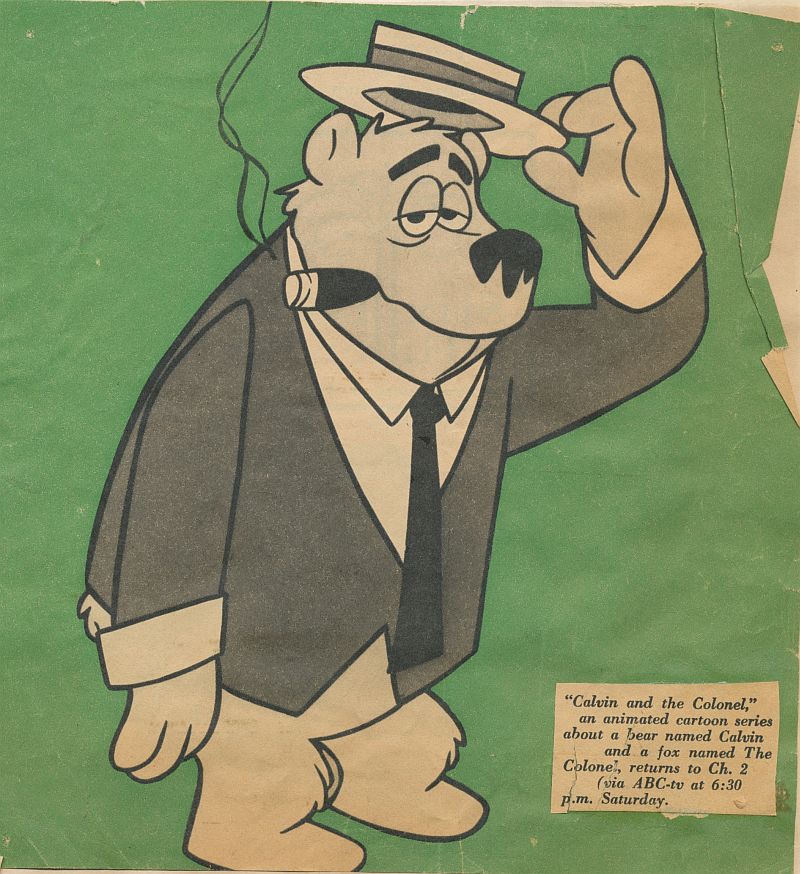 Norm Gottfredson, who had the upstairs office when he was part owner of Fred Calvert Productions
  , earned my awe and respect. I didn’t realize until later that he was Floyd Gottfredson’s son, or I would have been even MORE impressed with him. You see, I lived at Fred Calvert’s studio for a couple of months in the summer of 1968, when his studio was in North Hollywood. I talked to Norm about animation a little bit, and I’m sure he saw how starry-eyed I was about the business. Norm wouldn’t let me talk very long to him, and indicated that time was money, he was doing layout on some sub-contracted George of the Jungle episodes, and they needed to be done quickly. Norm’s office was beautifully decorated with many storyboard drawings, character roughs, and colorful paintings, that made me want to stay and browse! Fred Calvert Productions was a non-union shop in the midst of union studios, which sub-contracted a lot of work from Hanna-Barbera, Jay Ward and the Children’s Television Workshop. Fred’s wife, Kimi, also had an office there and worked very diligently and hard for the studio. Floyd Gottfredson, in an interview with Malcolm Willits in the early 1970s, said this about his son: “My oldest son is an art director, artist, and part owner of Fred Calvert Productions, in Los Angeles. They produce industrial films, commercials, and animation entertainment films, among which are some sub-contracted Bullwinkle cartoons. (Actually, Floyd assumed that working for Jay Ward meant Bullwinkle, but by then George of the Jungle was the going series.)” This is the only mention I have in print of Norm’s career by his famous dad. If I had been a little bit more bold, I would have asked Norm if Floyd approved of his going into the animation business, how they got along when Norm was a kid, and whether Floyd got Norm any summer jobs at the Disney studio. (Maybe one of my readers will know the answers.) Norm had quite a long resume, evidently starting at TV Spots, Inc. in 1951 as an art director! He evidently started at the top. He art directed King Leonardo and His Short Subjects in 1960, Calvin and the Colonel in 1962, both for TV Spots. By 1963, he was doing layout on the Funny Company series where he probably worked with John Sparey, and in 1966 did storyboard and layout on the “Super 6” series for Depatie-Freleng, their first TV cartoon. By the time I met him when he was partners with Fred Calvert, Norm was doing layout on anything that Fred rounded up, George of the Jungle, Wacky Races, Three Musketeers, etc. Norm was an all-around artist who could draw practically anything and did! One of the last series he worked on with Fred was Emergency Plus-4, where he did layout, with Kimi Calvert doing the art direction. After 1973, Norm worked on an odd series called Drawing Power, a strange live-action/animation combination show, produced by Kim and Gifford in New York. Norm was an animator on the show, in which an actor named Bob Kaliban played “Pop”, an old animator who entertains children with his magical drawing board, and thus encourages youngsters to draw. It had very crude, chroma-key special effects, but was a novel-toon series. Norm when on to work as a timing director on Disney’s Adventures of the Gummi Bears in 1985, Galaxy High School in 1986, Denver, the Last Dinosaur in 1989 and Widget the World Watcher for Bill Kroyer in 1991, where he was animation director. In addition, Norm did layout and design on many TV commercials for all sorts of clients, including of course, the Kellogg’s Leo Burnett stable, Green Giant, etc. Norm, Kimi, Iwao Takamoto and Fred Calvert were all very serious-minded people to whom animation was a nuts-and-bolts kind of business, in which a Sally Sargent, Emergency Plus-4, I Am The Greatest or George of the Jungle, were all pretty much the same thing. Just get ’em out, get ’em done and do ’em non-Union so we don’t have to pay benefits or health and welfare. When I met Duane Crowther at Fred’s studio, he was just the opposite of all the rest of the studio. Duane seemed to have a good time with his animation, and was easy to talk to.
I wish I could have talked to Norm Gottfredson a lot more, but being a real neophyte at the time, I was not encouraged to “take up his time”. He was a real talent, and admired by many people, but became part of the faceless army of TV animation enablers. As a timing director and animation director, he no doubt greased the wheels for the ultimate non-Union production, “overseas”. Norm, I hardly knew ya, but I was saddened to read of your passing on July 16th, in the Union paper. It’s interesting that The Pegboard only printed your activity with Union shops for the most part, never mentioning Fred Calvert.
I noticed that Joan-Ellen “Joanie” Gerber passed away on August 22. Joanie was a voice-over actor who did some of the “Lady Bugs of the Evening” voices on “Shinbone Alley” back in 1969, the feature film where I got my first scene of professional animation to do. She did voices on a lot of the same shows that Norm Gottfredson worked on, such as “Super 6”. One of her first jobs was on the TV cartoon version of “Beany and Cecil” for Bob Clampett in 1959. She did voices on “Heidi’s Song”, for Hanna-Barbera, the “Jokebook” show for H-B, Tex Avery’s “Kwicky Koala” for H-B, the revived Chipmunks series in 1984 and many many more. Read her career listing on IMDB. Her most recent credit was for Tony Cervone and Spike Brandt’s “Duck Dodgers” series. I never had the chance to work closely with Joanie, but she must have been in demand, she worked a long time in one of the few animation jobs that can’t be out-sourced, the voices! She did a lot of baby voices, old lady voices and teenage girls as well. Maybe she will get a longer obit later on. This one: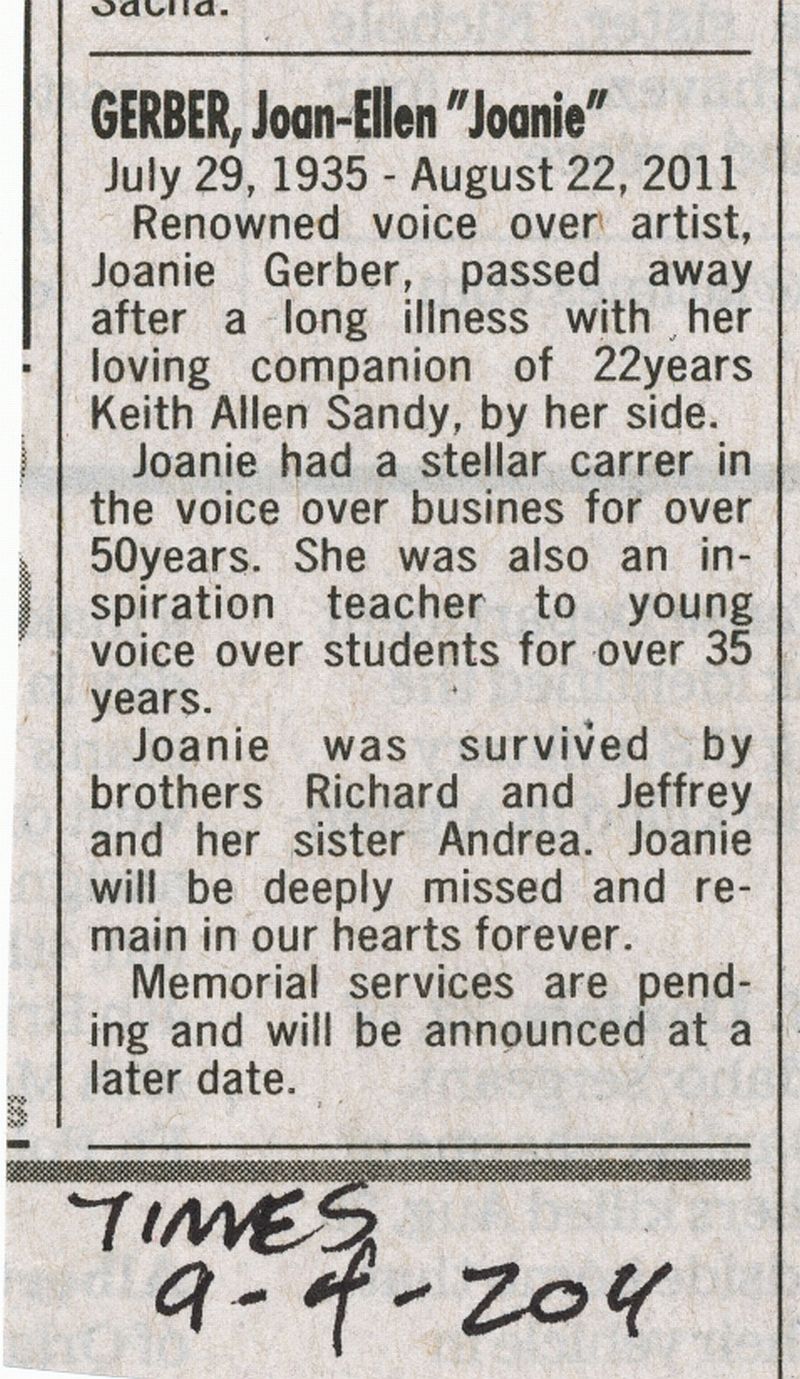 seems so puny.
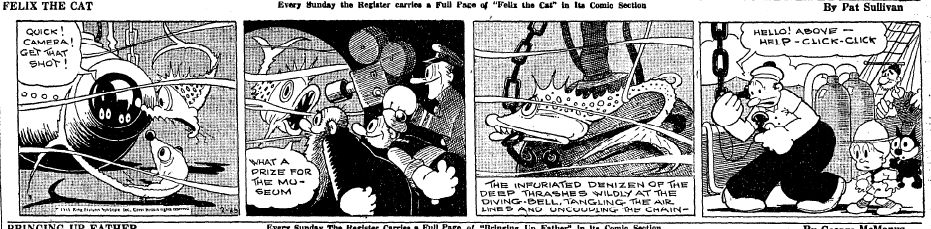
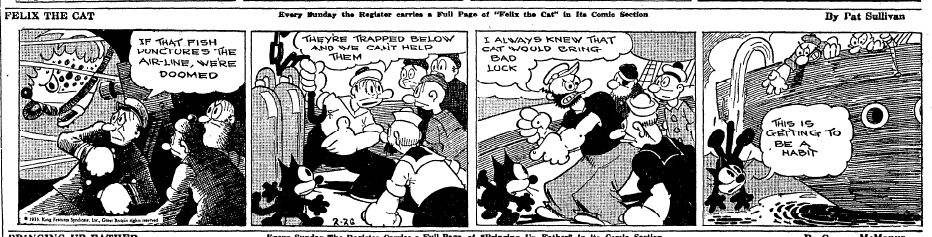
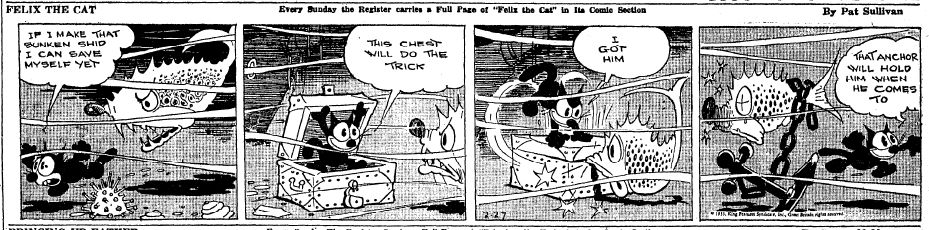
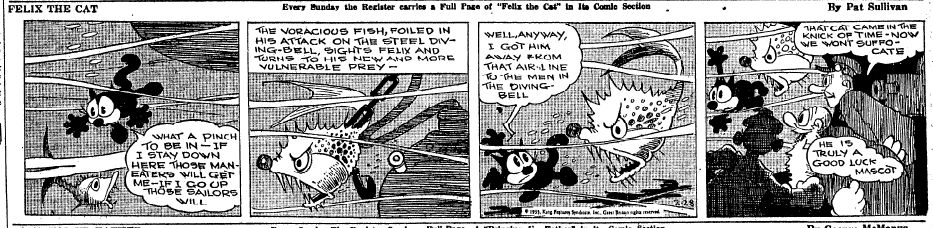
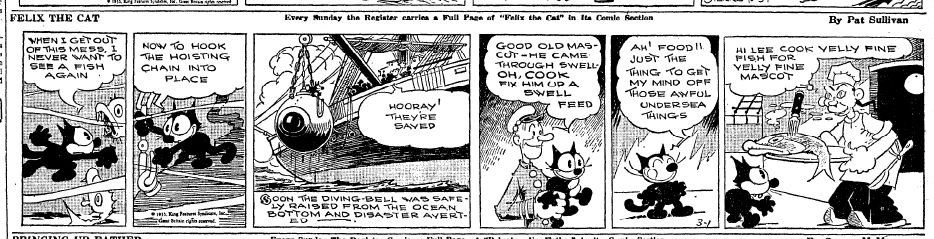
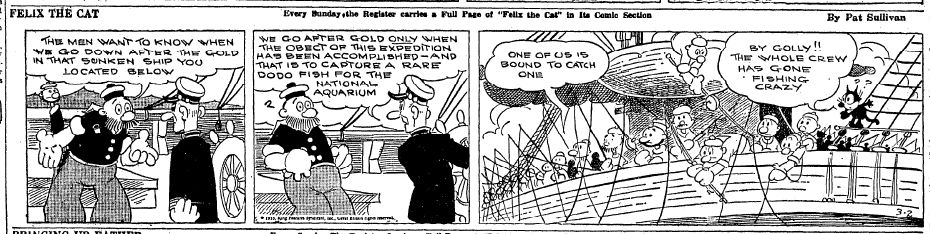

Felix from 2-25 to 3-3-1935, has Felix once more defending his reputation as a good luck mascot by rescuing the sailors from their marooned diving-bell under the ocean. After fighting off monster fish for days, Felix is presented with still ANOTHER fish for his dinner! In the Sunday, Felix is still in Dreamland, and in another Winsor McCay swipe, rides away on a “Night-mare”!
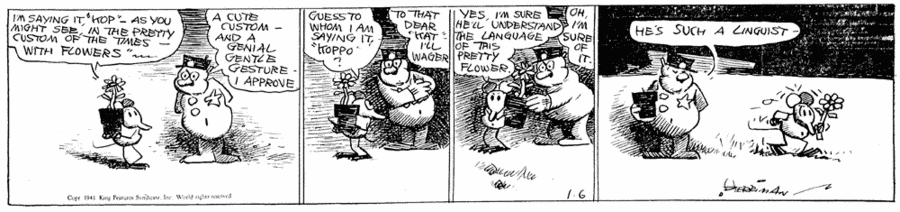
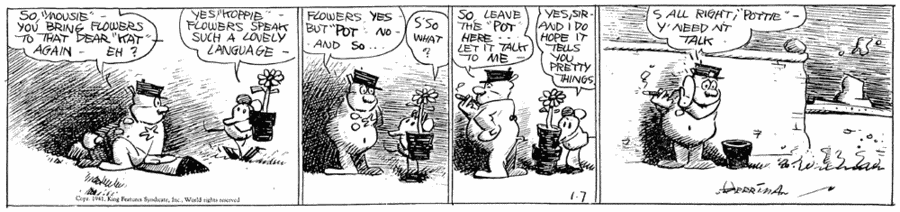
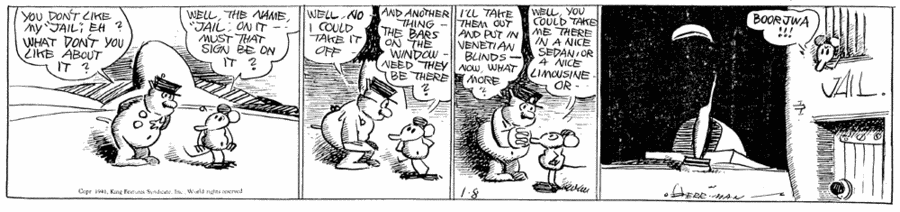

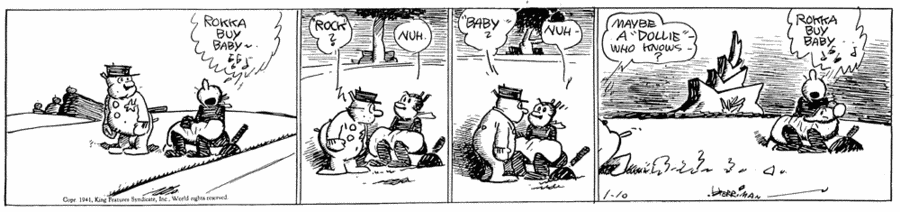
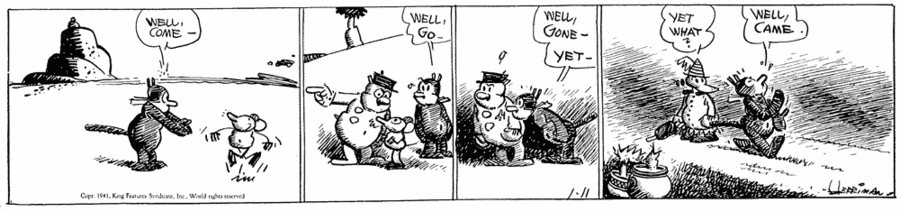
Krazy is from 1-6 to 1-11-1941 this time. Ignatz tries to take a flower in a pot to Krazy a coupla times, but the Pupp manages to keep the pot. In the 11-8, Ignatz suggests improvements to the “Jail”, which he is imprisoned for suggesting. “Boorjwa”, exclaims Ignatz, one of my Grandma’s favorite words. Mrs. Kwakk-Wakk figures in the strips for the rest of the week, nearly getting caught in her own web of gossip.
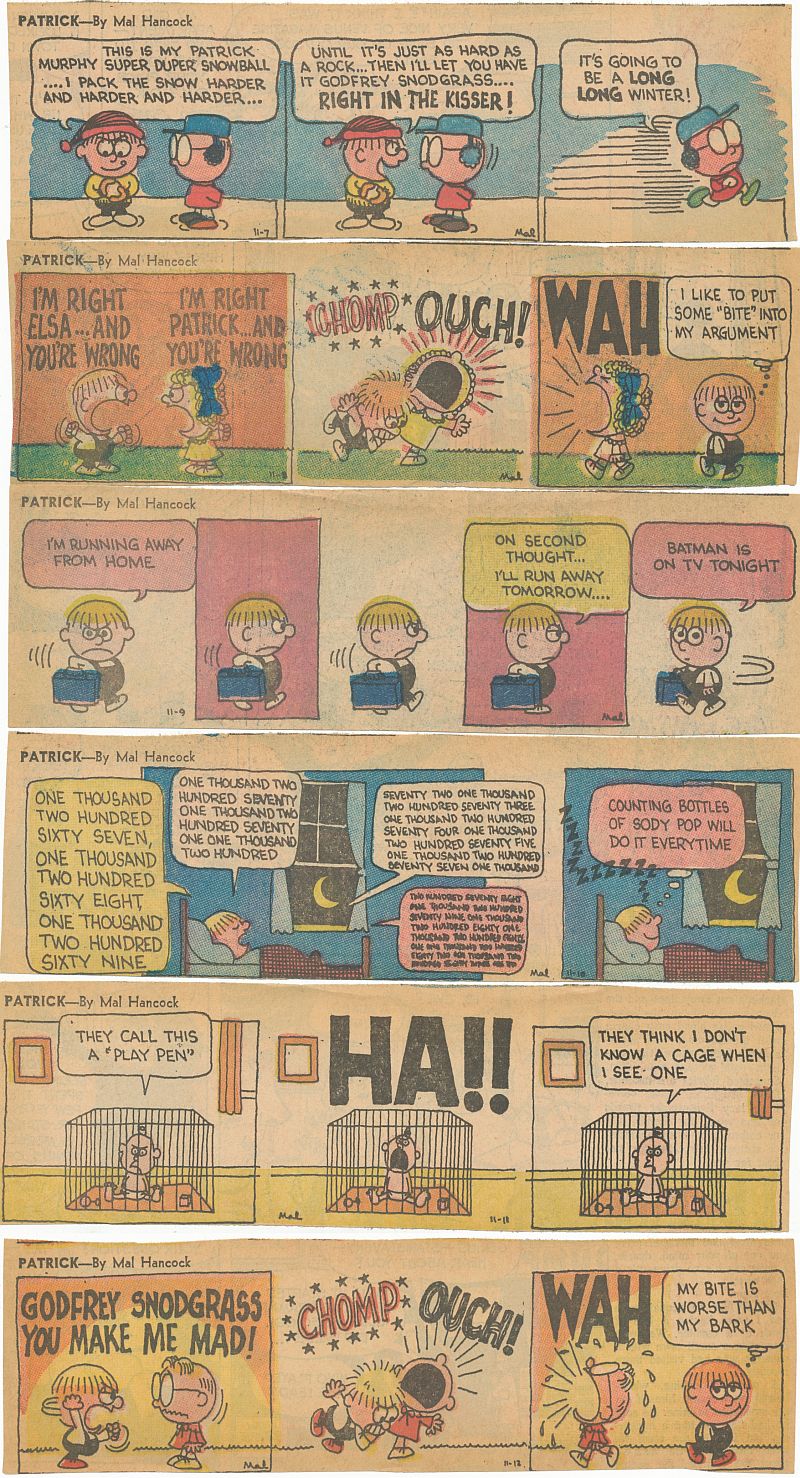
Patrick is clearly labelled this time, from 11-7 to 11-12-1966. Patrick is quite a “biter” this week, sinking his teeth into Elsa and Godfrey. The 11-11 strip features the debut of Patrick’s new little brother in his playpen. He will make several more appearances in the strips to come, always confined to the pen. Watch for him! Soon!
Special Post to “Yowp”
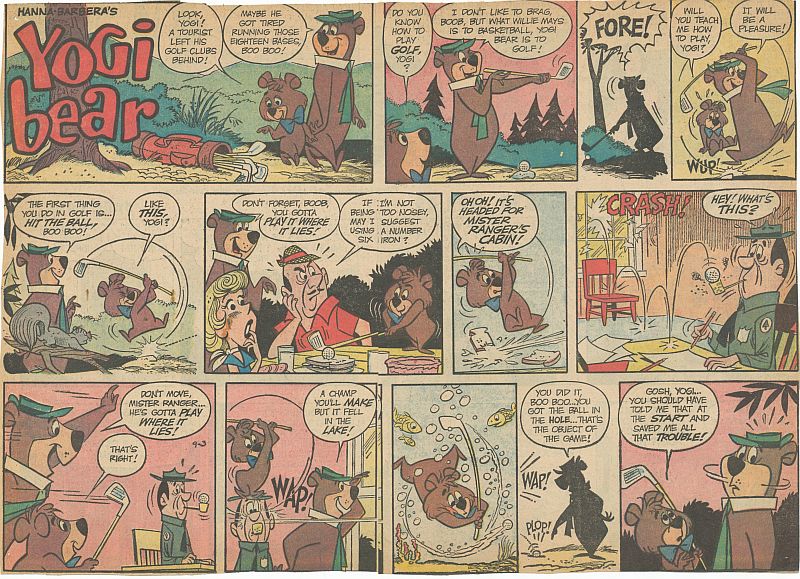
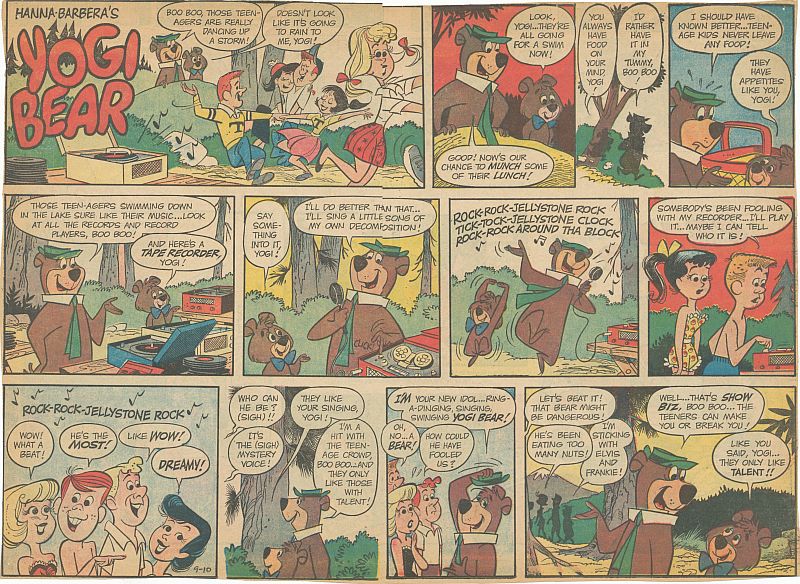

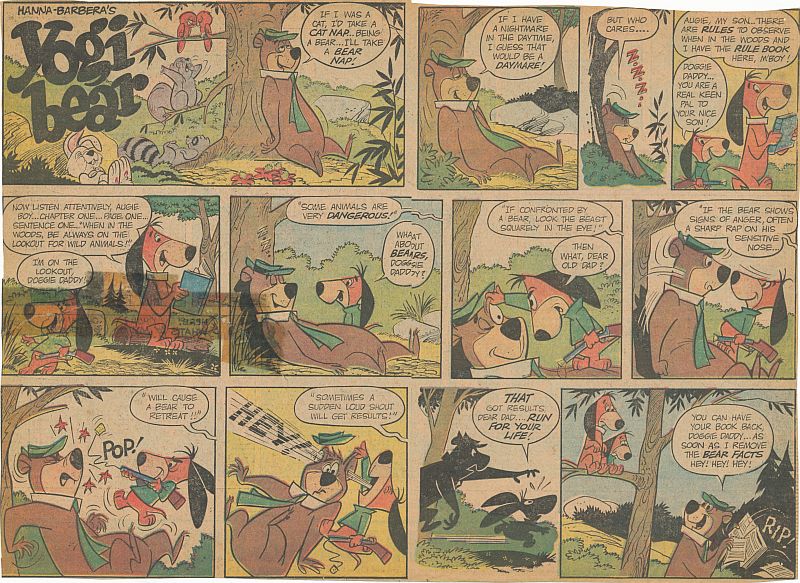
If you click on the link to Yowp’s blog on the right hand side of the screen, you will see that the cartoon dog has posted the September, 1961 Yogi Bear Sunday comic strips, all drawn by Harvey Eisenberg. His scans lack color and the top tier, since these were all originally half-page strips. I delved into the old clipping files and came up with the same strips, clipped from the St. Louis Post-Dispatch fifty years ago. They were published on Sept. 3rd, 10th, 17th and 24th, 1961. Please click on the thumbnails above to see them at larger sizes. Please excuse the slightly mismatched halves of the strips. These were pretty large, so I had to scan them in two parts and piece them together, sometimes I don’t get it perfect. The strip from 9-24 with Augie Doggie has some masking tape stains in the 5th panel. That’s a good tip for all you strip collectors, don’t repair your strips with highly acid tapes like Scotch cellophane or masking tape, they will discolor the material they are holding together. If you like the early Hanna-Barbera characters, you will enjoy Yowp’s blog. Yowp has some good background comments on these strips, so go over there and read them. If any visitors from Yowp’s blog are reading this, stick around! Go through the archives and enjoy some old strips, as well as some articles on animated cartoons of the past. I hope to be back soon with a “regular” post.
Goodbye, Corny
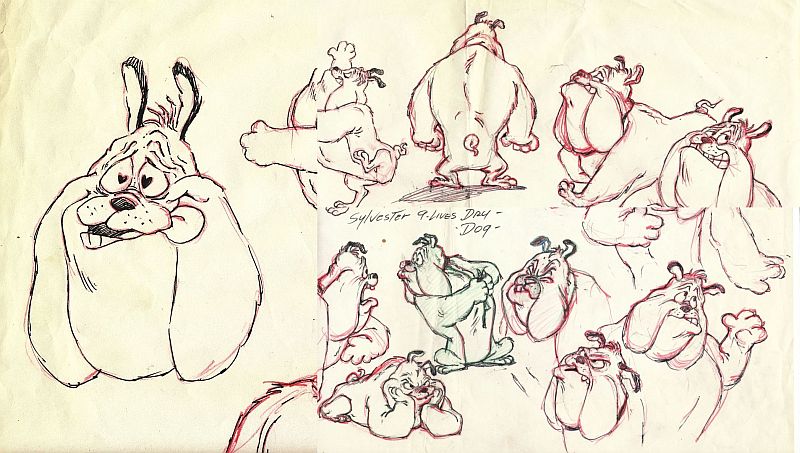
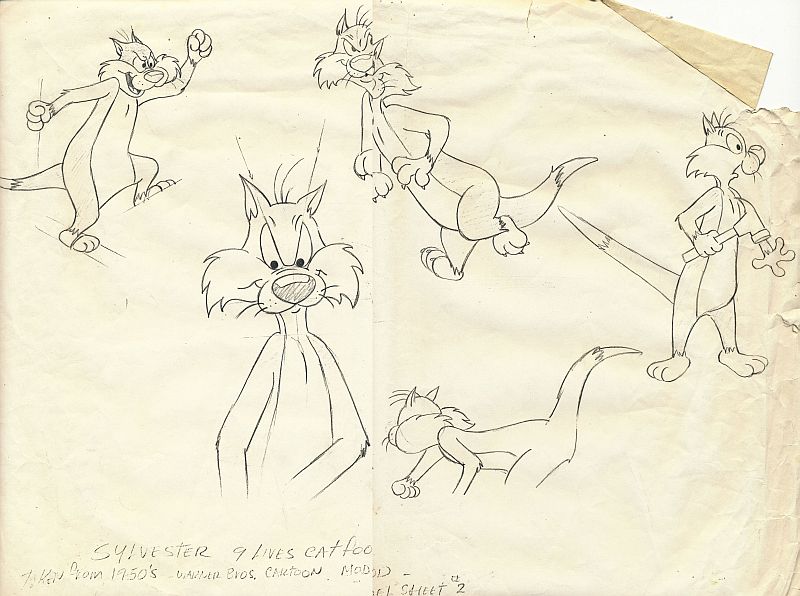
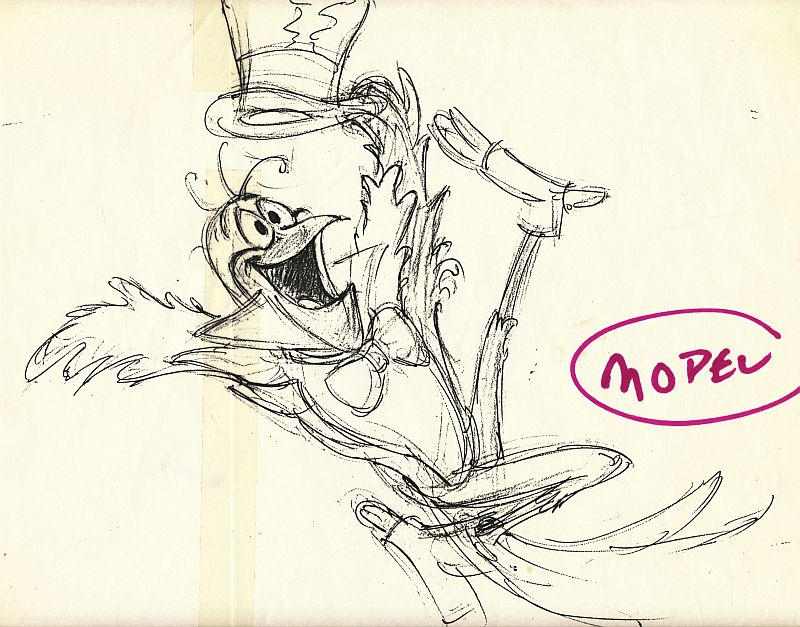
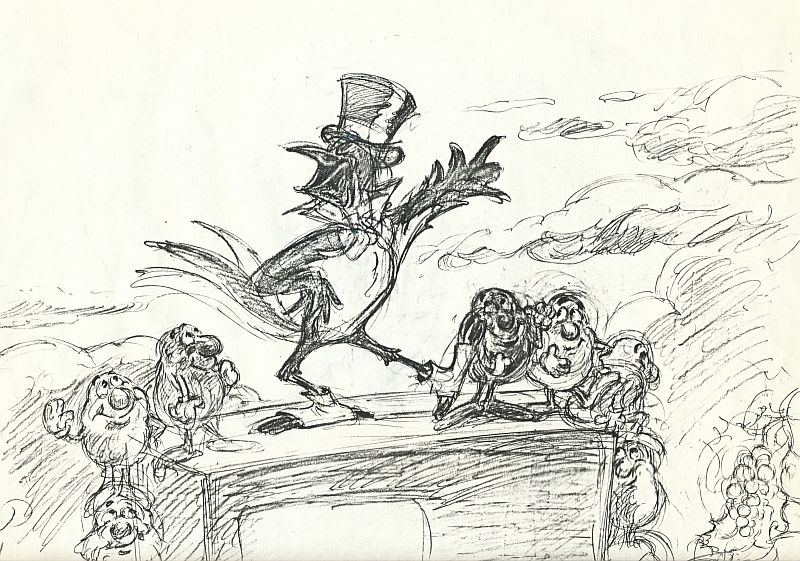
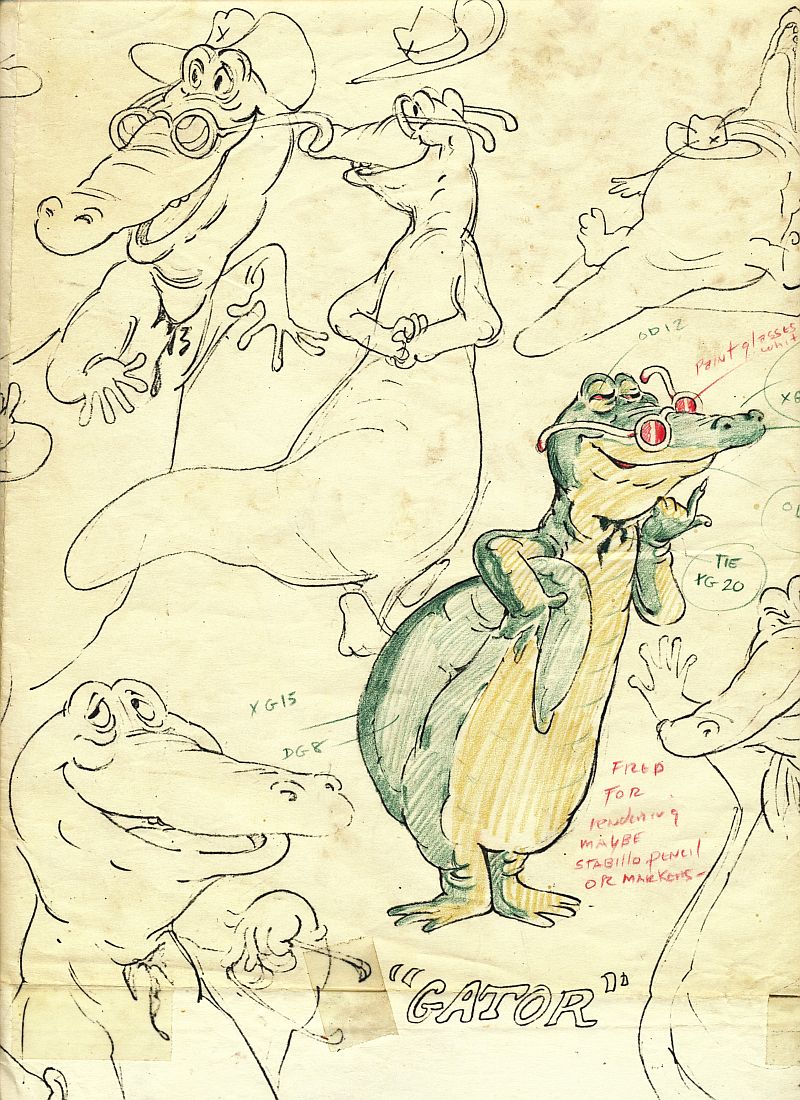
My old friend and “Drawing God” Cornelius Cole III, passed away August 8th, 2011. I’ve known Corny so long that I can’t remember exactly when we first met. I could have seen him for the first time picking up freelance layout from Fred Calvert, but I remember him best from the old Duck Soup Produckions studio on Main St. in Santa Monica. Corny had his own little studio on the same floor with Duck Soup which he called “Corny Films”. I think that Duane Crowther was his business partner for awhile. I’ve reproduced some of the model sheets and drawings that Corny produced for Duck Soup and Murakami-Wolf Films in the 1970s and 1980s. Duane directed a whole series of Nine Lives Dry Cat Food commercials with Sylvester the cat. Corny did the models for the spots on Sylvester and Marc Anthony (the bulldog). He did the rough models in ball point pen and clean ups in graphite. Corny could work both rough and tight, but he preferred rough. Corny always worked with an inking board in his lap, never on a light board. He preferred to do layout that way. Duane and Corny would sometimes fight over Corny’s 3 and 4 field pan layouts for the Sylvester and Froot Loops commercials. It seems Corny had a hard time drawing within a 12-field cut-off and let his pen range far outside the field to the right and left, sometimes even north and south! Corny would attach little pieces of paper to the top and bottom of an animation sheet to allow for his lines to escape the bonds of the field edge. We who had to animate to these layouts would often have to reduce the drawings mechanically so that they WOULD fit within a 12 field TV cut-off. The compositions looked a bit patchy sometimes after we got through making them fit. Also, Corny usually drew his layouts in ball point pen, with a lot of lines. We animators had to boil down all those beautiful pen lines down to one, hard, unforgiving graphite line for our character drawings. They never had the liveliness of Corny’s original drawings, but we had to have a good line for Kunimi, the great Duck Soup inker, to work from. (Kunimi was such a good artist that she could take a “pen haystack” like Corny or Duane would draw, and make a beautiful single line cleanup from the rough, right on cel!) The mockingbird that you see upstairs with a top hat was designed for a Kellogg’s Raisin Bran commercial, those little blobs in the layout are raisins. The Gator character was a Corny Cole design for Fred Wolf. I’ve forgotten now which product it was for, but Fred really liked this character, it lasted for several commercials. Here:  is a rooster character that Corny designed for a Duck Soup Froot Loops commercial. He was an inventor with a German accent, loosely patterned on Albert Einstein. It’s a good example of Corny’s rough pen style. We had a good time trying to animate overlap on the very loose shapes that Corny drew for his comb. Corny loved to tell stories about his time at Warner Bros. with Chuck Jones. Many of those stories can be read over at Michael Barrier’s website, look for his interview with Corny. Corny especially liked telling me about the Daffy Duck storyboard he fashioned for Chuck, which the great director rejected, saying “this is not MY Daffy Duck.” Corny disliked the lofty tone of this remark and told Chuck where he could shove his Daffy Duck. Corny always praised Friz Freleng’s timing and downgraded Chuck’s. But evidently, he really admired them both, judging from the interview. Corny always was trying to loosen up the atmosphere at whatever studio he was working for. At Duck Soup, he frequently lured the animators out into the Santa Monica surf for a body surfing lesson. I went along for one such outing with Bob Seeley, Mel Sommer and a few other folks and swam a bit out to sea with Corny leading the way. I tried to float in on a wave, but when it hit the sand, I was tumbled about like the rinse cycle on a high speed washing machine. I emerged from the surf, with quite a few cuts and gashes through my skin. Corny laughed at my extreme surfing naivete, but did it in a sympathetic way. This is my best memory of Corny, he was a regular guy, but he was never lofty, never authoritarian. There was a real warmth to the man, he was just great to be around. He drew so well that he could fit in to any studio, any production. He was still teaching drawing at Cal Arts up to the time he left us. A few years ago, at a 2005 Annie Awards ceremony, I saw Corny for the first time in many years, sitting in the audience. He said “hello”, almost as if it had been 10 minutes since I’d seen him last, not nearly 10 years. I couldn’t help noticing how slowly he walked up to the stage to receive his Winsor McCay award. The great surfer had foot trouble, according to Bob Kurtz. It was a real thrill to see Corny be recognized by his peers for what he did best, draw! Corny was never too reverent about the animation industry, and never held cartoons in very high esteem. He loved fine art. You know, I don’t know if I ever saw any oil paintings that he produced, so I don’t know what his grasp of color and light amounted to, but I always loved his detailed figure drawings. The poses always were full of action, seeming to fly through the air over the great space of the long pieces of paper that they were drawn upon. Corny made a few animated films of his own, including a great anti-Richard Nixon piece that he worked on for over a decade. I hope the family takes good care of his films and drawings. Please don’t turn them over to the ASIFA archives! We need to remember Corny for a long, long time.
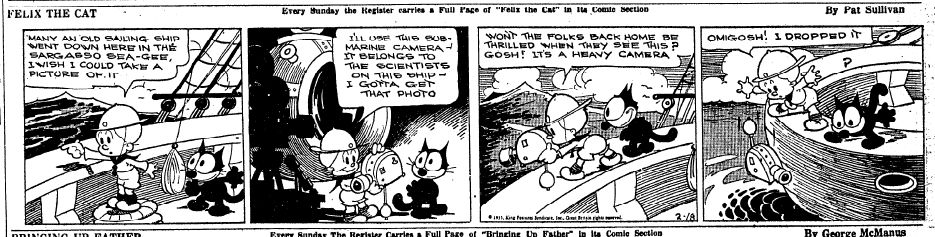
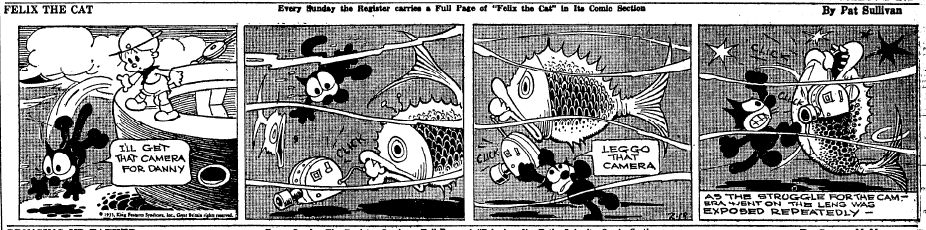
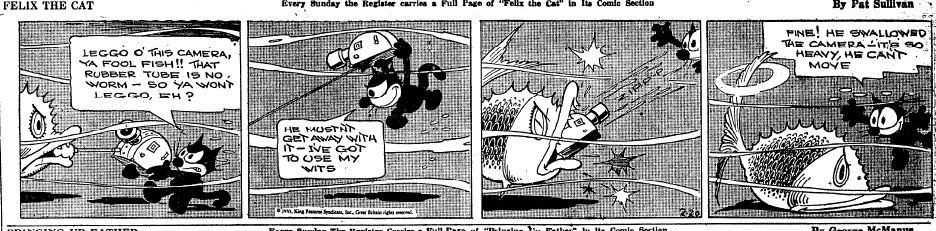
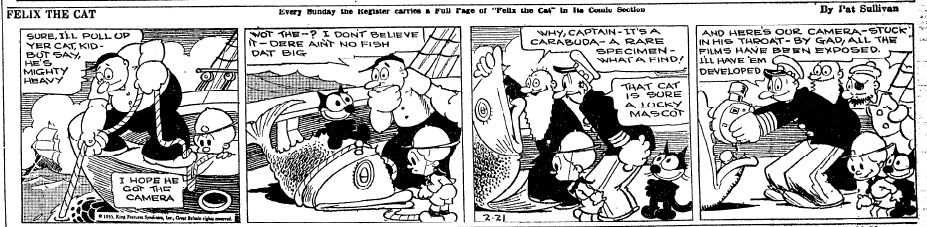
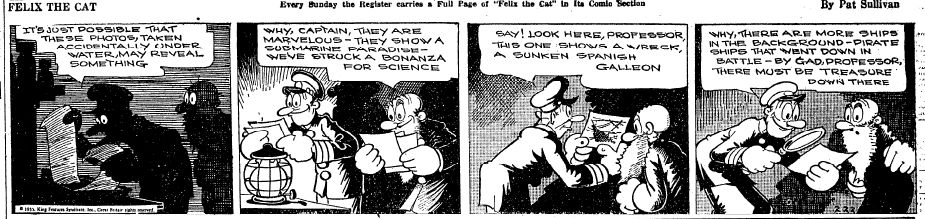
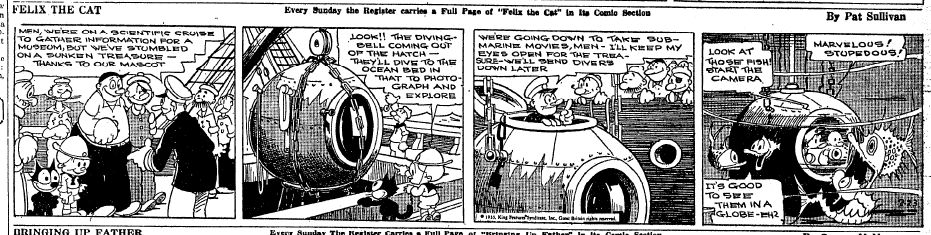
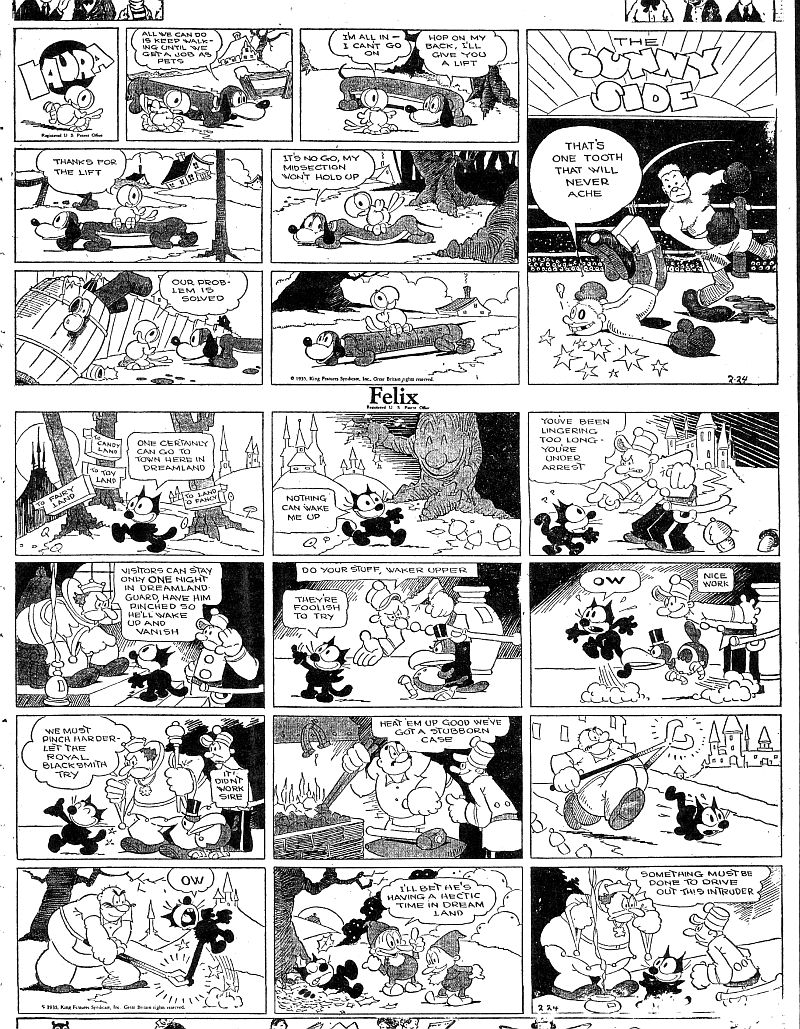
Felix (from 2-18 to 2-24-1935) is an accidental underwater explorer this time. In going after Danny’s camera, Felix punches out a Carabuda fish which swallows the valuable instrument. When Felix and the fish are hauled up, the Captain develops the film and finds some photographs of sunken treasure ships. Some of the crew descend for another look in a diving bell, and the fish remark that it’s good to see humans in a globe for a change. In the Sunday, Felix continues his adventures in Dreamland, and the King of Dreamland pulls several mean tricks on the little cat to try to wake him up. I wonder if McCay contemplated a lawsuit over this story?
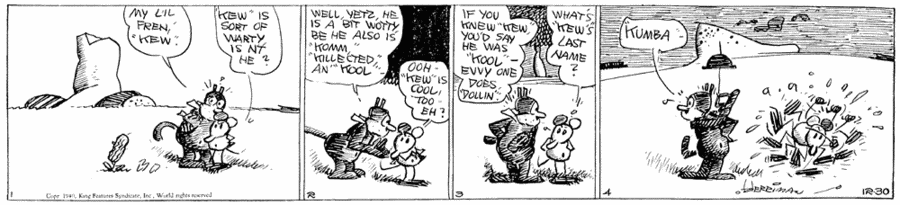
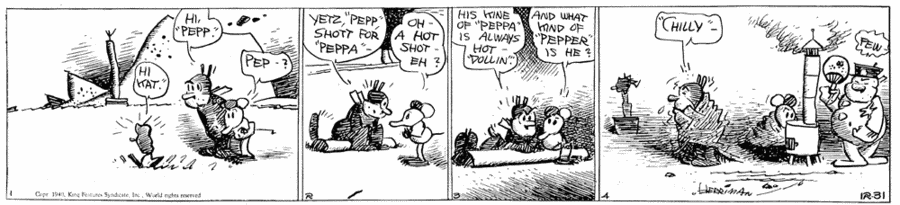
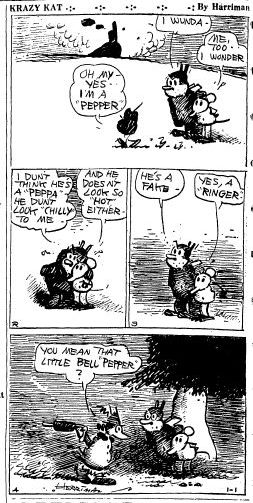
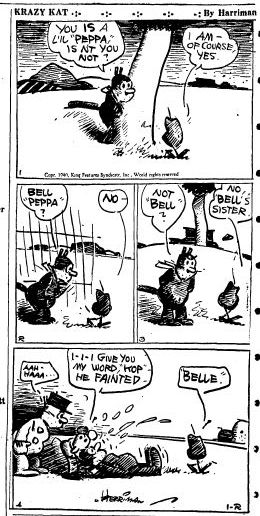
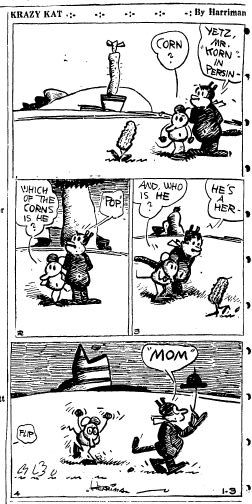
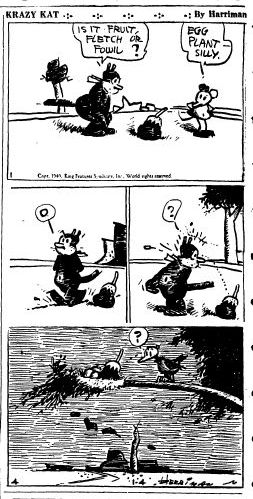
Krazy (12-30-1940 t0 1-4-1941) is for vegetarians this time. All the gags are about cucumbers, chili peppers, bell peppers and topped off with an eggplant gag in the 1-4. The 1941 strips came from a different source than the 1940s and are arranged vertically. I think the strip looks good either way, but I prefer the horizontal layout, preferably 8 columns wide, which I can’t do on this dad-blasted computee!
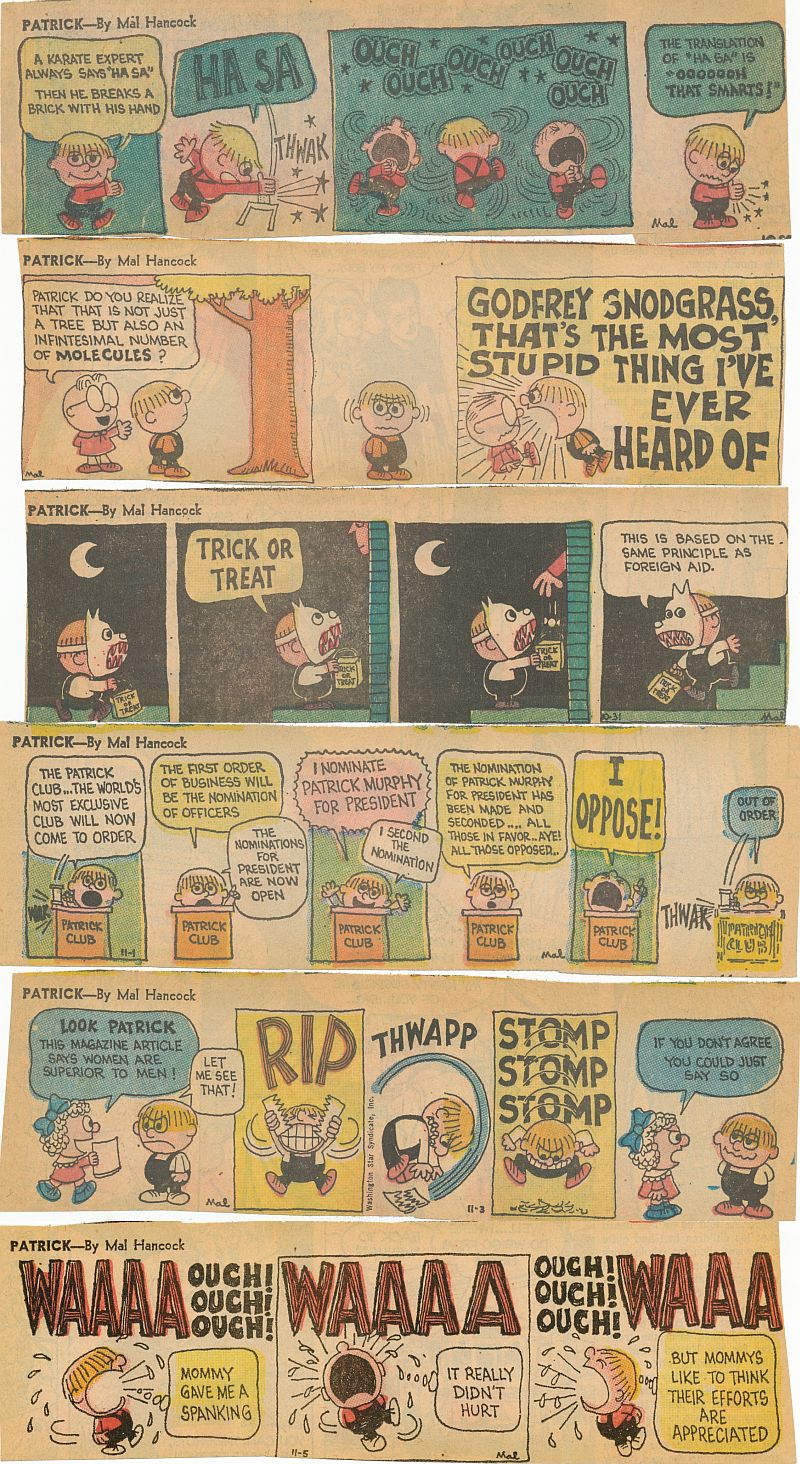
Patrick (from 10-28 to 11-5-1966) has a reference to the Hanna-Barbera cartoon, “Quick Draw McGraw” in the 10-28. Patrick steals Quick Draw’s signature line, “Ooh, that smarts!” You will notice that the Post-Dispatch starts printing the dates on the Halloween and subsequent strips. Now I won’t have to speculate so much on the days these were originally printed. I love the acting that Patrick puts on for his Mommy’s benefit in the 11-5. Enjoy the comics, my readers! I will write again soon.
Cat Comics Return!
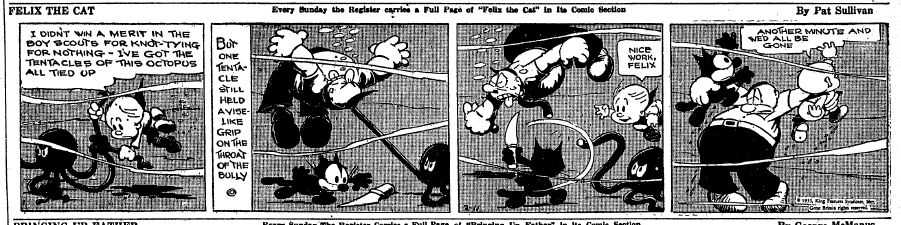
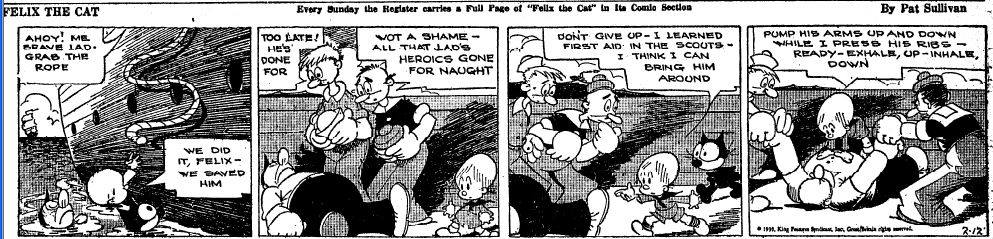

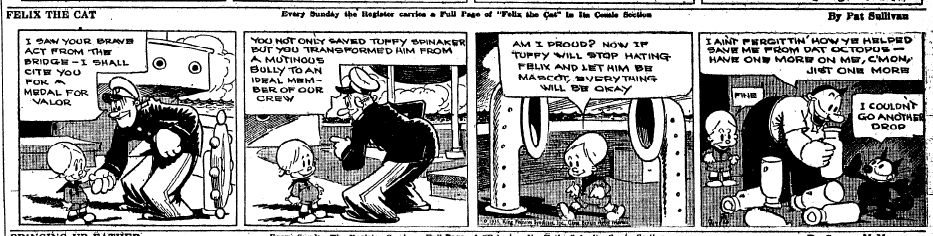
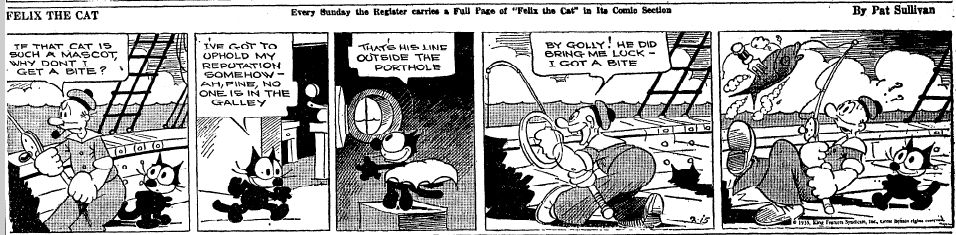
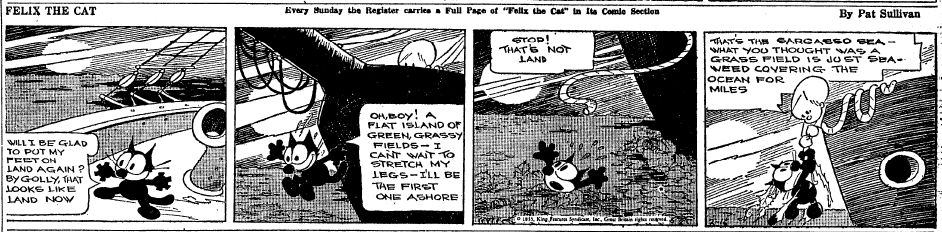

I’m not neglecting Cats for Bears, just did a special post for Yowp’s blog last time. Here are the Felix strips from 2-11 to 2-17-1935. The tough sailor’s name turns out to be “Tuffy Spinaker”, and he turns out to be a forgiving sort, rewarding Felix and Danny for saving him from the Octopus. Last week, the Octopus had “feelers”, this week it’s “tentacles” (see 2-11). Felix is fooled into thinking the Sargasso Sea is a patch of land in the 2-16. In the Sunday page, Felix solves his “Little Nemo” problem by taking a draught of the Rip Van Winkle potion. He’ll be in Dreamland for twenty years now, or maybe not.
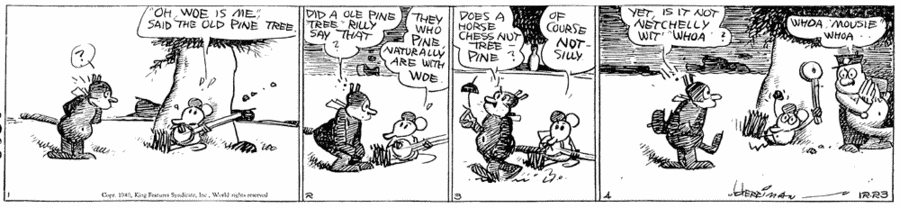

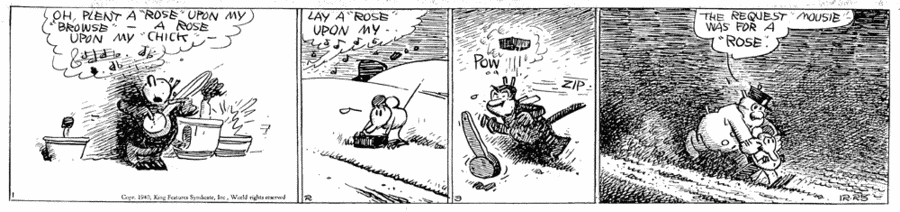
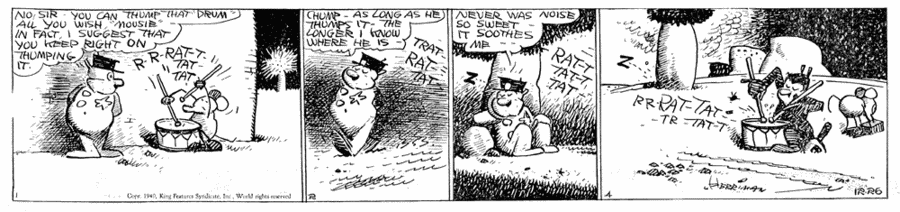
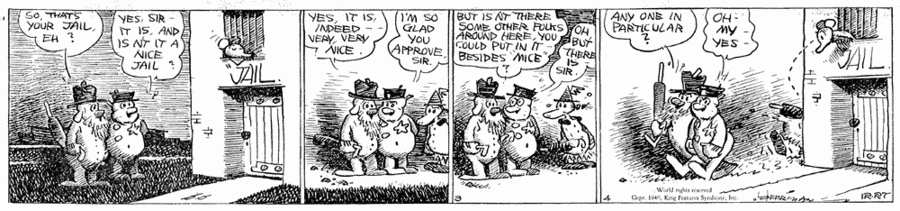
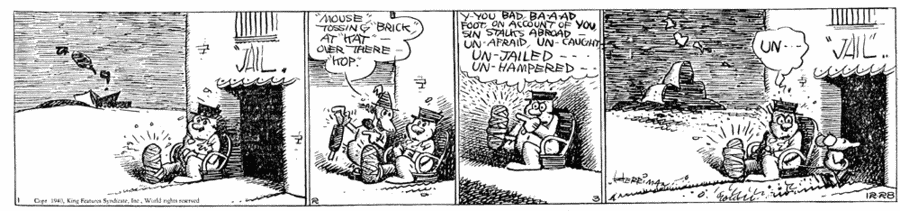
Krazy is from 12-23 to 12-28-1940 this time. For the first two days, Offissa Pupp manages to suppress Ignatz’s reactions to Krazy’s bad puns, but KK gets a Christmas Brick in the 12-25. I’m not sure to who Pupp is referring in the 12-27, when his visitor asks him who should be in the Jail besides “mice”. Is Pupp referring to Mrs. Kwakk-Wakk, who beats a hasty retreat in the last panel, or Krazy, or ?? If it IS Mrs. Kwakk-Wakk who is potential Jail-bait, what has she done that’s against the Law? She mainly gossips and is a busybody. In the 12-28, Ignatz puts himself in Jail, as Offissa is suffering from gout, perhaps he had too much Christmas cheer.
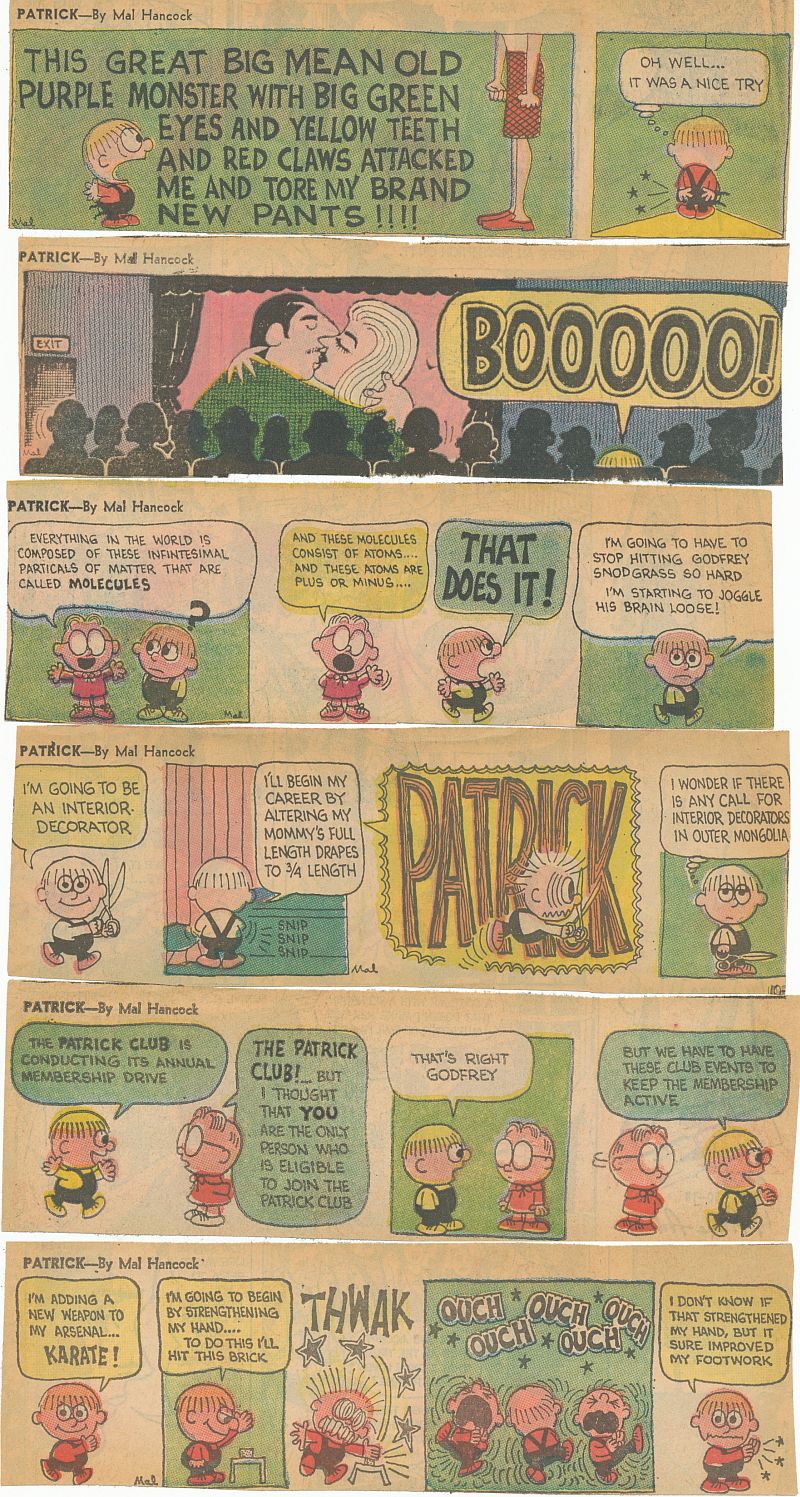
Patrick is from 10-20 to 10-27-1966 this time, with a strip or two missing. Patrick’s behavior in the movie theater in the 10-21 was probably considered eccentric back in 1966, but today with all the cell phone and texting going on, probably no one would notice. I like the “animation” in the fourth panel of the 10-27 as Patrick practices Karate. I’ll try to post more often this month, now that my energy is coming back. See you soon!
An Answer To Yowp
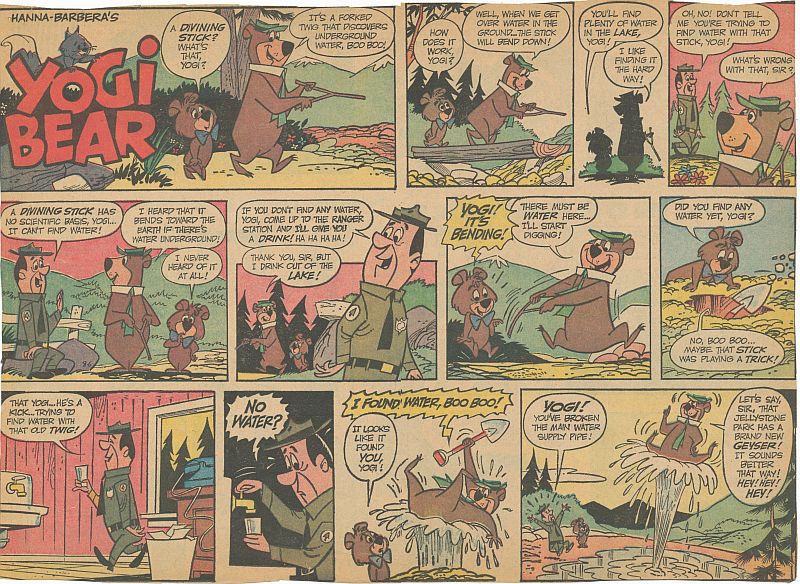
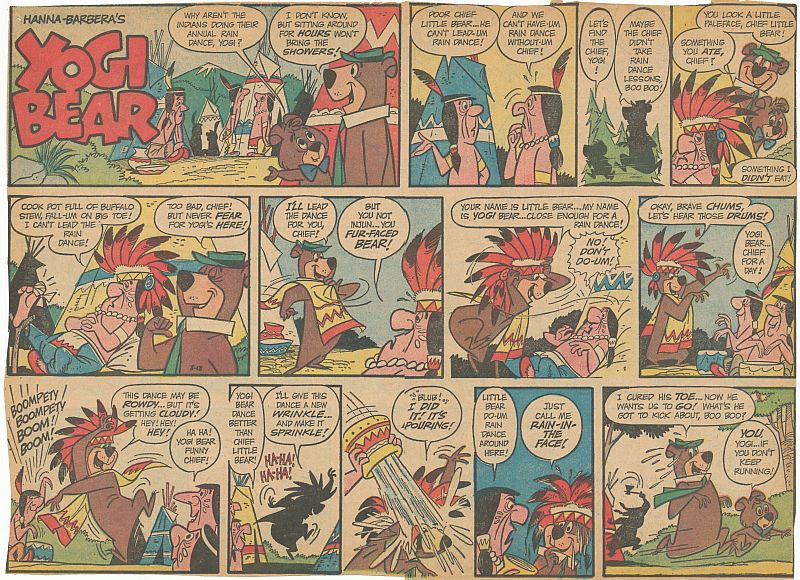
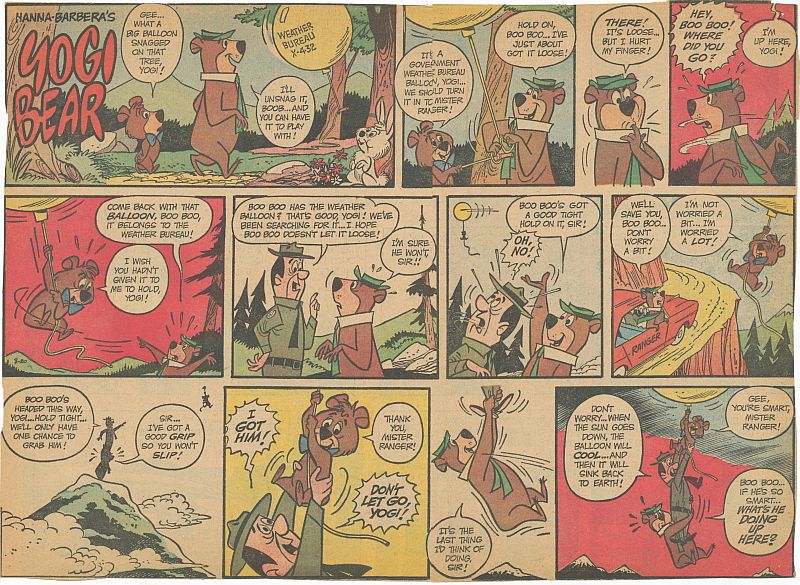
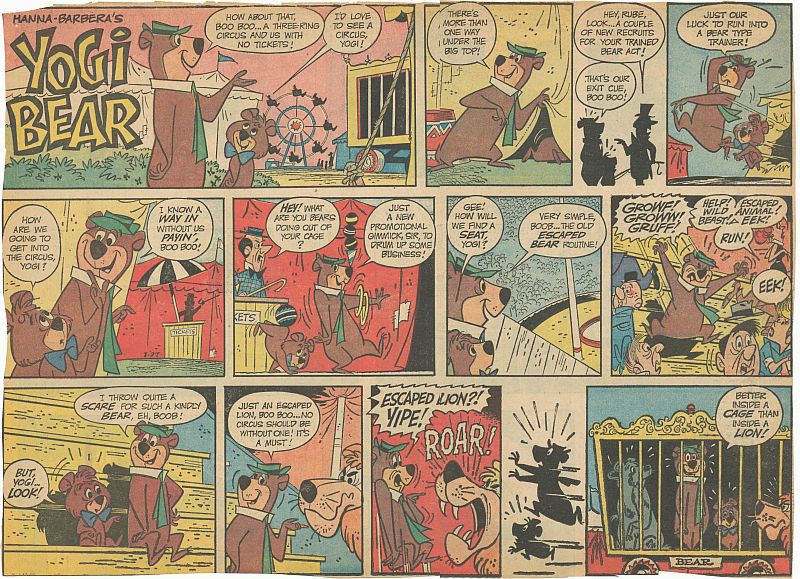
Well, here’s a “special extra” post, y’all! I really love Yowp’s blog, which is in my blogroll at the right hand side of this page. The cartoon dog does a unique and well-researched blog devoted to the early TV programs of the Hanna-Barbera studio. These cartoons, especially, Huckleberry Hound, Yogi Bear and Quick Draw McGraw were well-loved by my brother and I back in the late 1950s and early 1960s when they first aired on St. Louis television. The subject really doesn’t “fit” the Catblog, which is devoted to early animated cartoons and comic strips of the 1930s and 1940s for the most part (except “Patrick”). At the risk of incurring the wrath of Yowp (and getting dog-bit), the Cat dug into his files of old comic strip clippings and came up with the Yogi Bear Sunday pages of 8-6, 8-13, 8-20 and 8-27-1961, of which Yowp couldn’t find good copies for the current post on his blog. Here they are, the original half page versions in color, drawn by the late, the great Harvey Eisenberg, one of the most accomplished cartoon draughtsmen of animation (and comics). He was the layout man on most of the best Tom and Jerry MGM cartoons of the 1940s, and starting in about 1947, started drawing comic books, first the “Red Rabbit” and “Foxy Fagan” books, co-produced by Joe Barbera. Then Harvey took over the “Our Gang with Tom and Jerry” comic book for Dell, and did the lead Tom and Jerry story artwork, and illustrated a lot of other stories in the book, such as Droopy, Spike and Tyke, The Adventures of Tom and even Flip and Dip on rare occasions! I’m not going to make this a long-winded screed, but I’ve offered Yowp help with the Yogi Bear Sunday pages he posts from time to time, and Yowp just growled and wasn’t having any. This time I couldn’t resist posting these strips which I cut out of the St. Louis Post-Dispatch in that friendly year of 1961. Enjoy, if you can, and Yowp, down boy, I hope you will enjoy them too!
A Howard Beckerman Comic Strip?
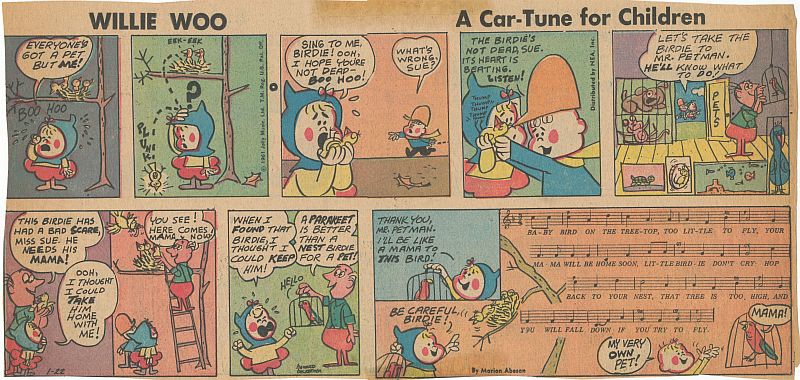
Hello again, readers! I’m a lot better than I was at the last posting, fever is gone, and I’m breathing better. I can walk now, not quite as far, but I’m walking. I’m also doing some household chores like gardening and cleaning floors. Since I took all the antibiotics, I’m not quite as crabby as I was when I was “under the influence”. I’m hoping that my lung will be completely clear very soon. Today’s lead strip is “Willie Woo” by the New York animator, historian and occasional columnist, Howard Beckerman. It was syndicated by NEA in 1961, this episode is from Jan. 22nd. I saved this strip from an out of town paper because I liked the style, it reminds me of Gene Deitch and Bobe Cannon. Howard Beckerman did not compose the music in this episode, but bought it from Marion Abeson. There aren’t too many comic strips that had sheet music printed into them: “Willie Woo” seems to have been an “activity” strip for children, probably had games and puzzles worked in to the strip at times. I have no idea how long NEA syndicated the strip or how successful it was. It’s one of the few strips actually drawn by an animator. Except for Floyd Gottfredson, Walt Scott, Harvey Eisenberg, Hank Ketcham, Walt Kelly, George Baker, Fred Harman, Gus Arriola and Gene Hazelton, it’s hard for me to remember how many cartoonists who started out as animators migrated into the newspaper comics. There are many animators who drew comic BOOKS, and I don’t include Winsor McCay in this, because he started in newspaper comics. So with “Willie Woo”, Howard Beckerman joins a very select few who cracked a difficult market. Howard has his own website at www.howardbeckerman.com , but there is no information on “Willie Woo”. If any readers can add to this story, feel free to comment.
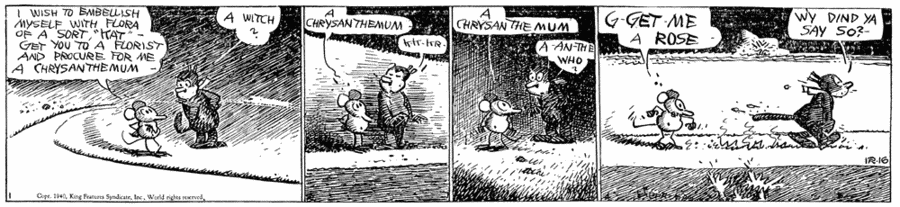
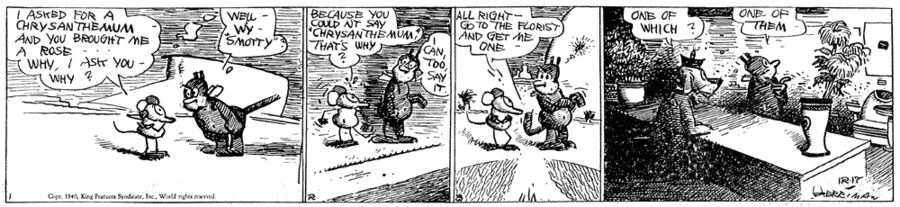

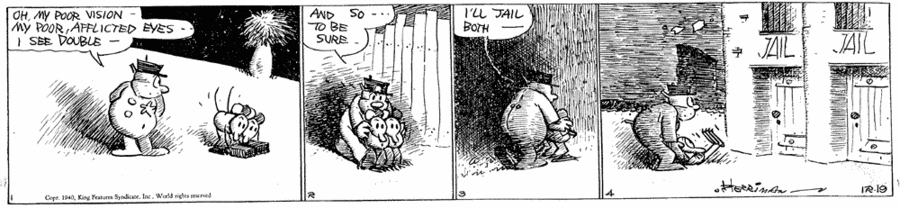
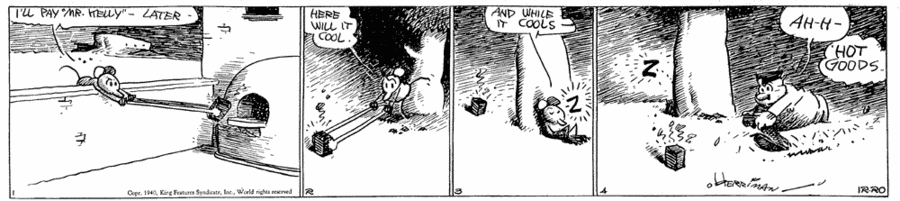
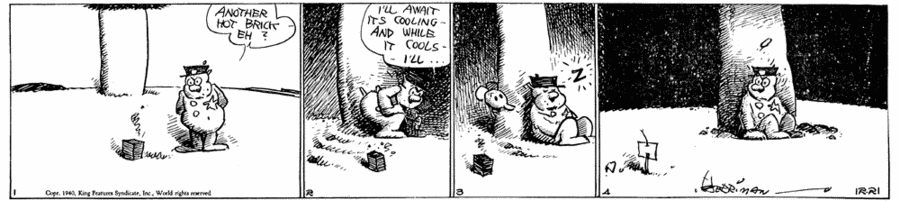
Krazy is from 12-16 to 12-21-1940. The week consists of three two-day continuities, the first has the Kat unable to say “chrysanthemum”, the second has Pupp seeing double Ignatzs after smoking a bad cigar and the third has Pupp trying to grab a fresh hot brick away from Ignatz. I wonder what kind of “tobacco” was IN the Offissa’s stogie?

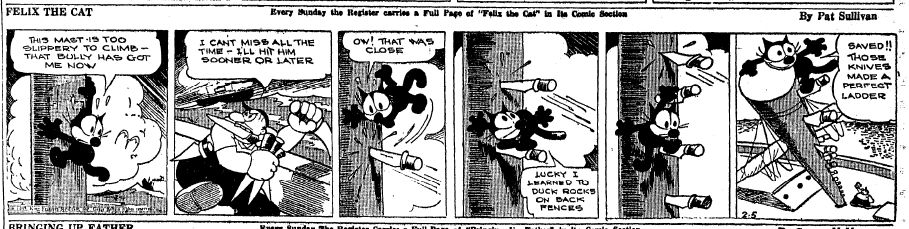
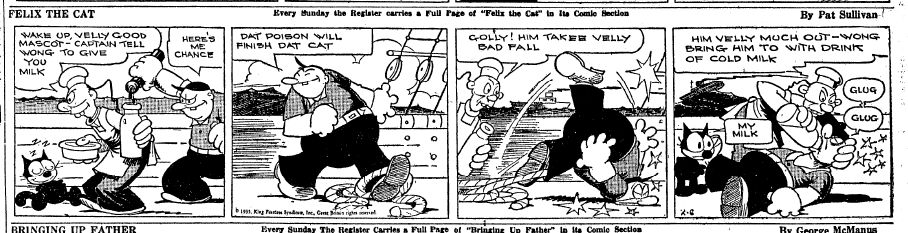
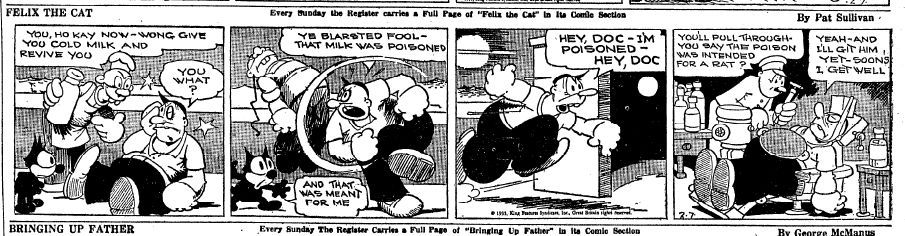


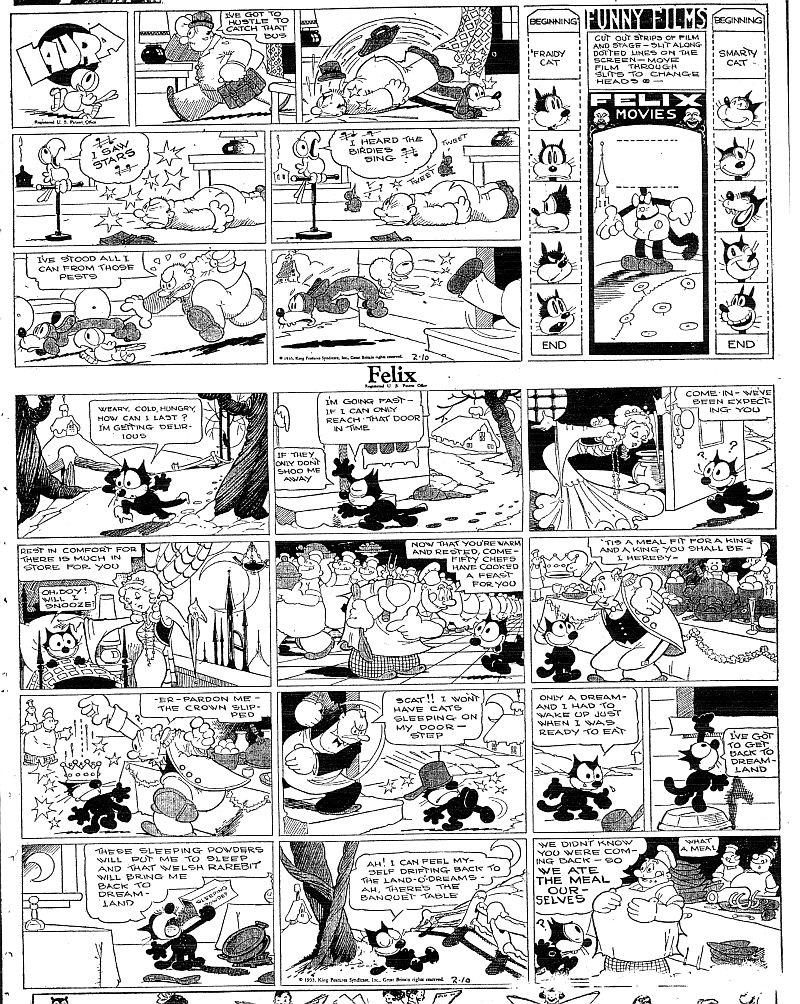
Felix this time is from 2-4 to 2-10-1935. In the dailies, Felix is continually under attack from the “Bully Sailor”. It’s lucky for Felix that the sailor is so backward in his reasoning powers. In the 2-8, he mistakes an octopus tentacle for Felix’s tail, and in the 2-10, Danny dives to the rescue and ties knots in the octopus’s “feelers”. In the Sunday, Felix pulls a “Little Nemo” and winds up in “Dreamland”. The banquet Felix was going to be served winds up being consumed by the cooks after Felix vanishes from his dream, a McCay story twist if I’ve ever seen one. I love the “Fraidy Cat” and “Smarty Cat” characters in the “Felix Movies” feature at the top of the page. Otto had a real gift for designing cartoon cats. Please remember to click on the thumbnails to see the strips at readable size.
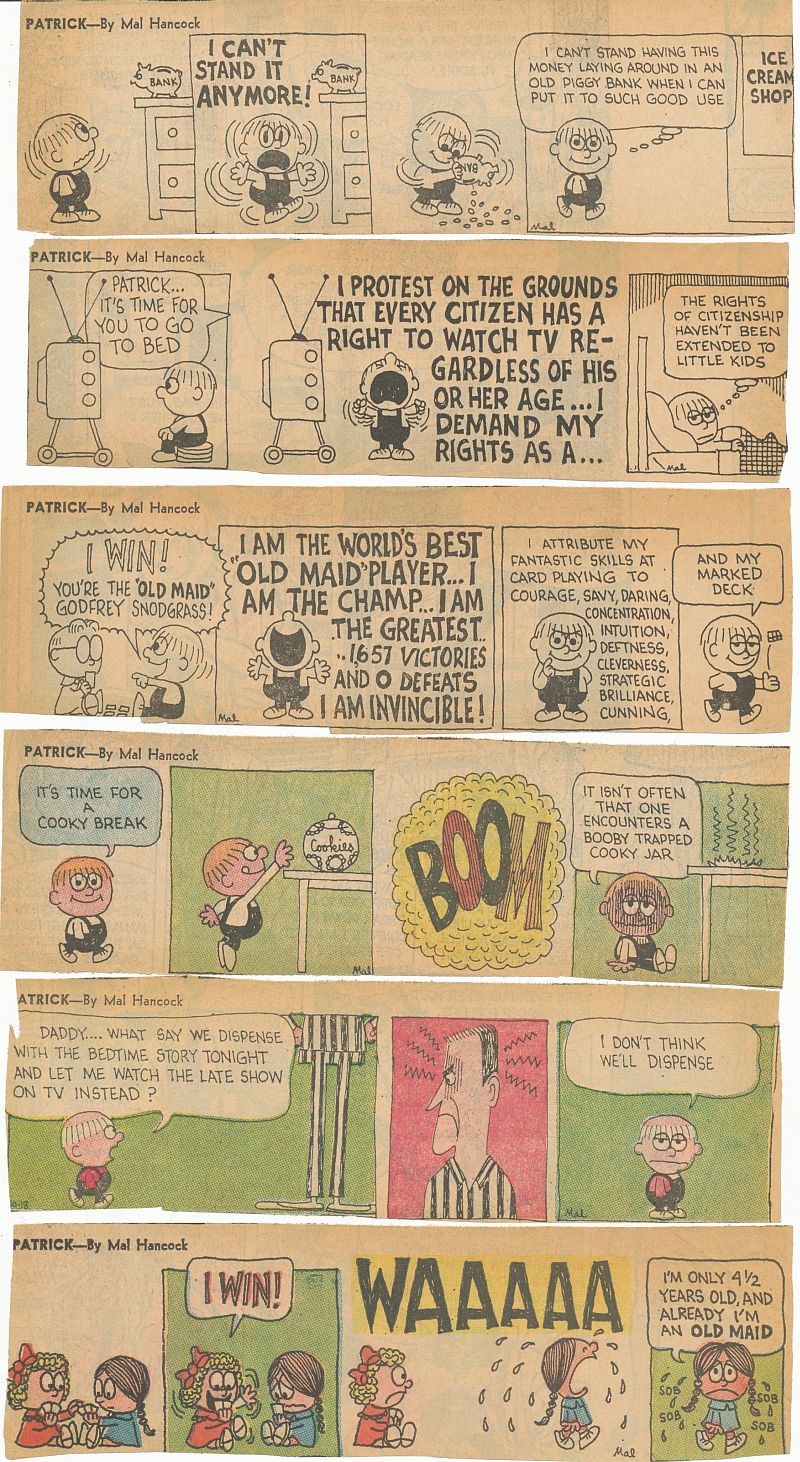
Patrick is from 10-12 to about 10-19-1966 this time. Patrick’s Dad appears in the 10-18, still mad at his son, over TV shows. Patrick’s “right” to watch TV is debated in the 10-13, with the kid finding out he has no rights. You will note that the first three strips in the Patrick section of the post are in black and white. This was the result of a press room strike at the St. Louis Post-Dispatch, resulting in a totally black and white newspaper for at least a week. I don’t recall if it affected the Sunday edition, but the daily lost it’s “unique” color comics for awhile. Does anybody reading this blog know of any other daily newspapers that ran their weekday comics in color? They look pretty if they are scanned from original clippings, but the color tends to mess up the microfilm. See you next time, I hope it won’t be too long.
Well, ..uh..I’ve been Sick!
Sorry for the long absence from the old blog. I caught pneumonia in San Clemente, perhaps from a bad vegi-burger. After I ate it, my stomach was very upset and a day or so later I started feeling sick, really violent chills just from air conditioning. I thought I had stomach flu, but all that really developed was a cough, and a fever that jumped from 99 to 103 degrees back and forth. I also have great shortness of breath, I can hardly walk two blocks without breathing really hard. I miss my two mile walks very much. I am now on antibiotics, which has tamed the fever, but my lungs are pretty full. The worst is when I get into a coughing jag, is I start choking because I can’t get a breath! It can be pretty scary! So please, all my readers, don’t eat any bad vegi-burgers!
    Have you visited my friend Pat Ventura’s new blog? It’s at www.patcartoons.blogspot.com. Kind of an odd address, no “@” sign! You will see many of Pat’s drawings of characters we worked on for the “What A Cartoon!” series of shorts produced by Fred Seibert at the old Hanna-Barbera studio. We, meaning myself, Julian Chaney, Robert Ramirez and many more, really loved making layouts for Pat’s cartoons. Sledgehammer O’Possum, Yucky Duck, his version of George and Junior, what happy memories! I remember I was continually ill from the air-conditioning system in the old plant. My supervisor, Larry Huber, was not happy that I made so many layouts for some of the scenes. I just couldn’t help it, Pat’s designs were so much fun to draw that I wanted to animate ’em! What matters now is, we had fun making them, a few people enjoyed watching them. Now we’re all unemployed and broke. Sometimes you pay for your fun in this business, big studios don’t like independent thinkers. Pat Ventura really thinks for himself, he’s been dreaming up cartoon stories with his own characters since he was a little kid. Go over to his site and maybe drop a comment, he’d love to hear from you.
I’m not too energetic this time, so I will just post my usual strips without much comment.
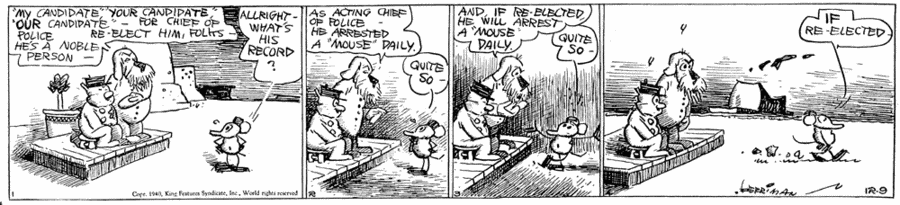
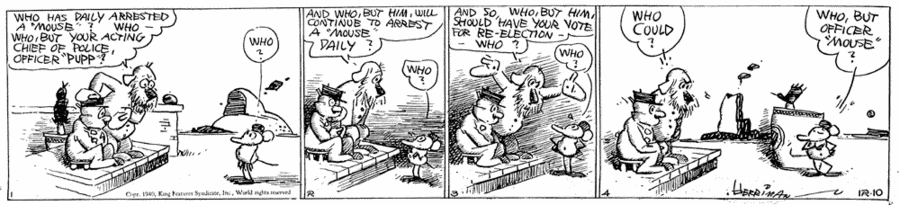

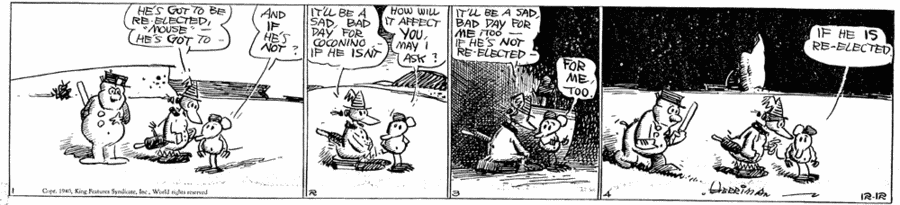

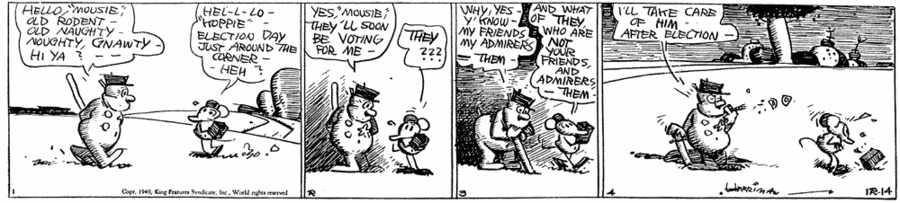
Krazy from 12-9 to 12-14-1940.
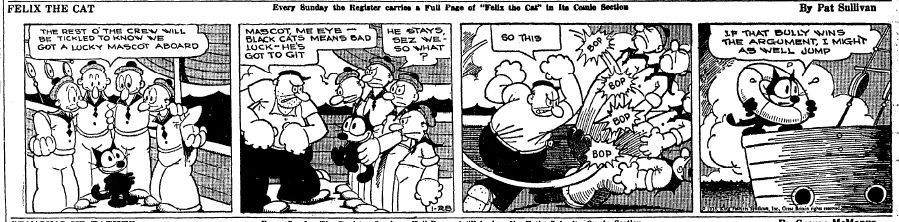

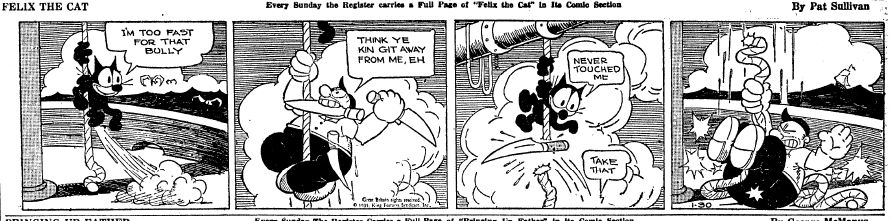
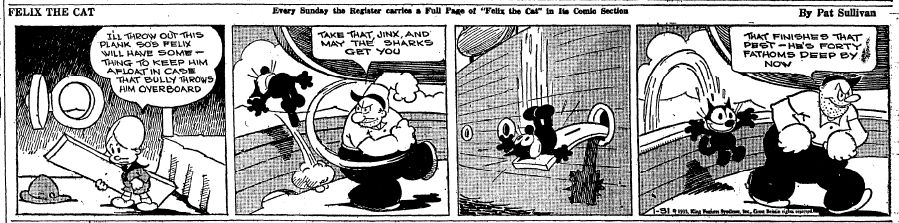
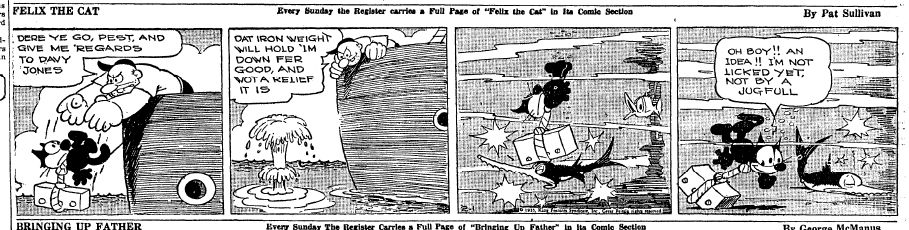
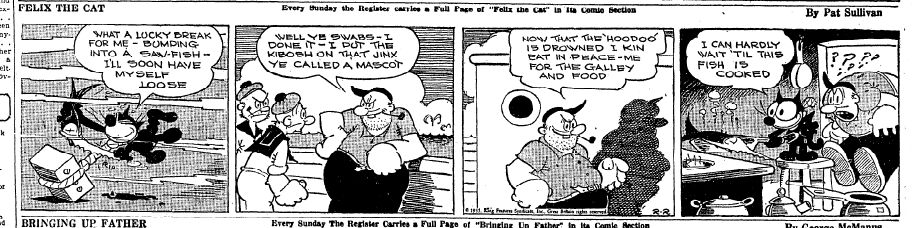
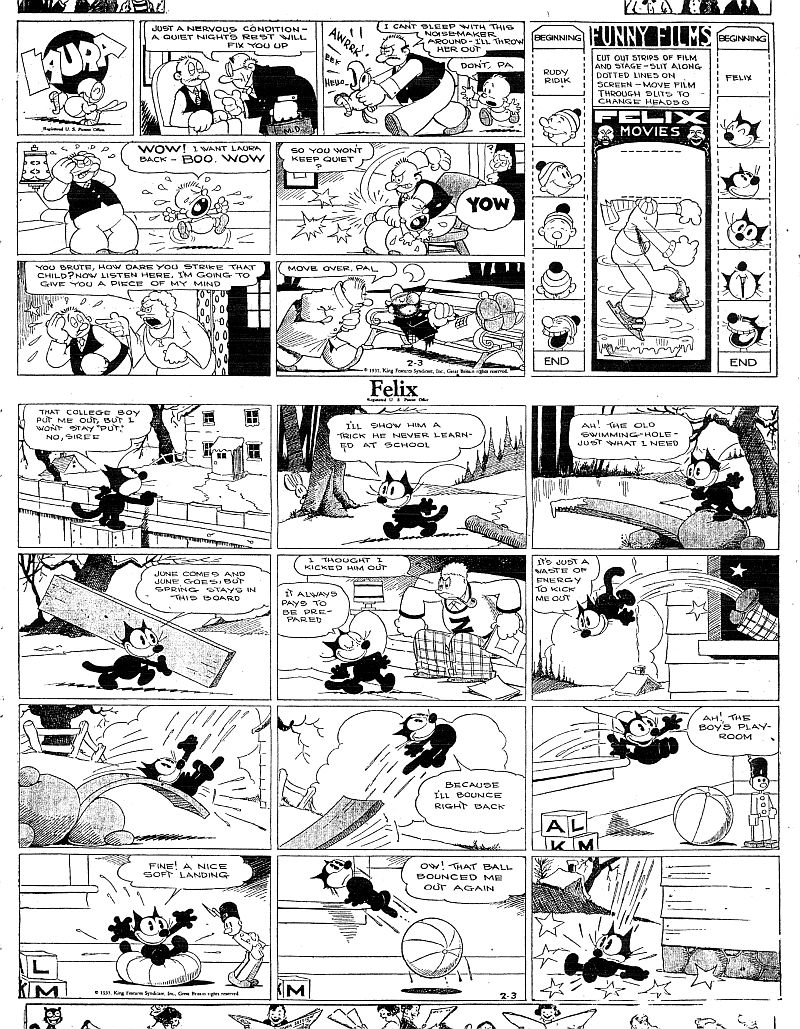
Felix is from 1-28 to 2-3-1935.
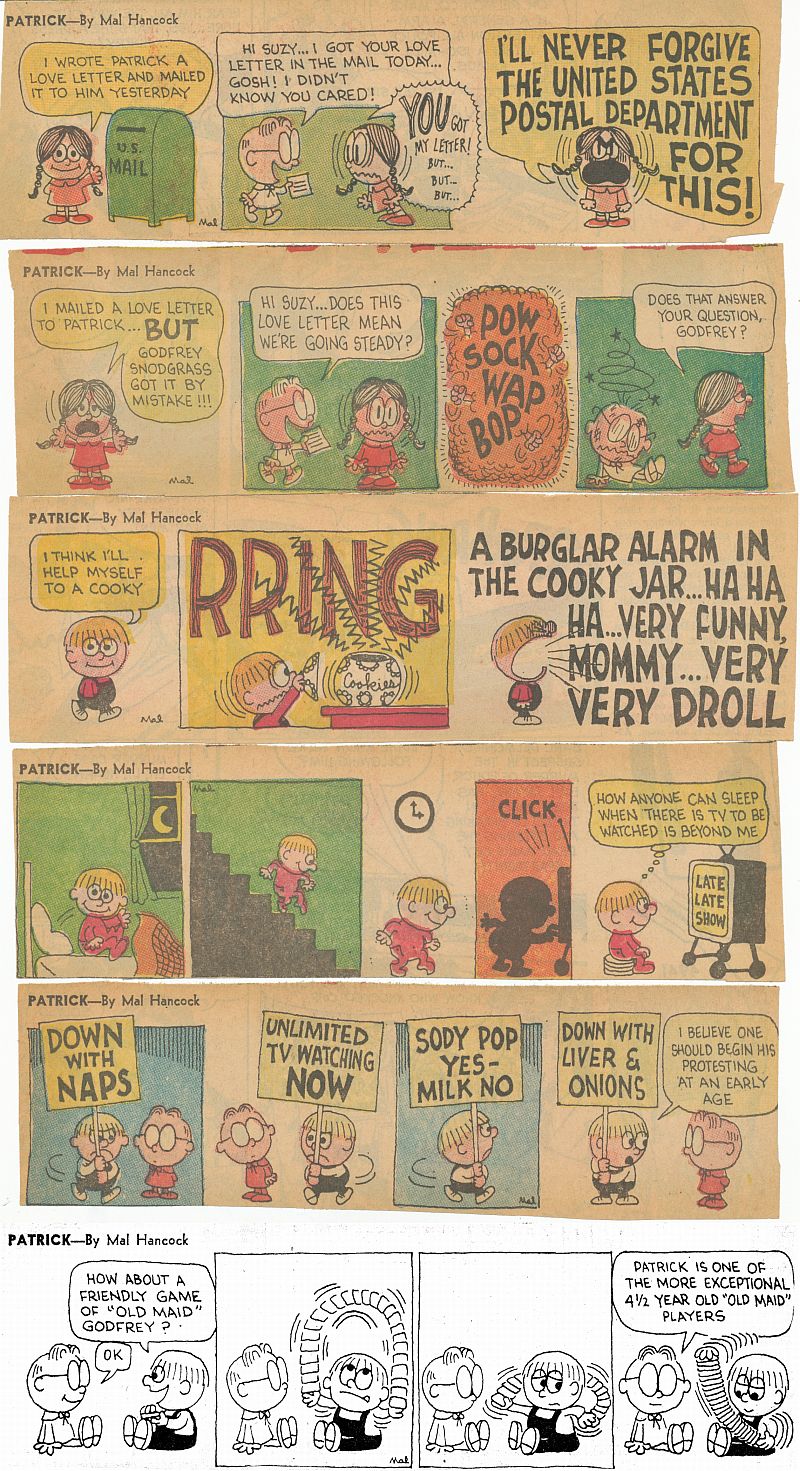
Patrick is from 10-6 to approximately 10-10-1966.  You will note that the 10-10 (?) is in black and white. The St. Louis Post-Dispatch was on strike at that time, and the color engraving department was closed, so all the dailies were printed in black and white for awhile. The Post was always prone to strikes, back when workers had the backbone to demand better wages and conditions. Too weak to write more, see you again soon, I hope.
Garge’s House

I was in the neighborhood, so I thought I’d drop by. The last time I visited 2217 Maravilla St. 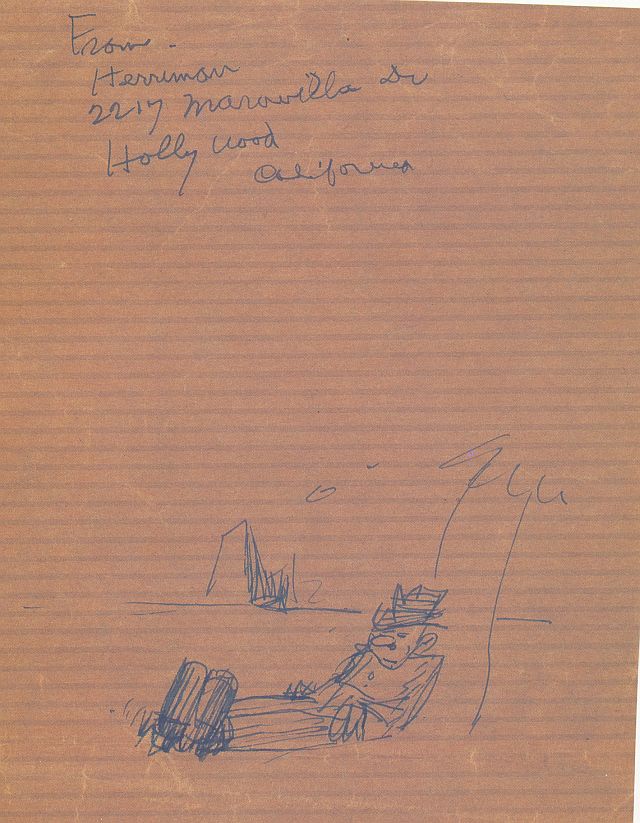 was more than 30 years ago. The little dead-end street has certainly gentrified. There was a time when you could see the Herriman house clearly from the street, complete with the remains of the old weather vane.
 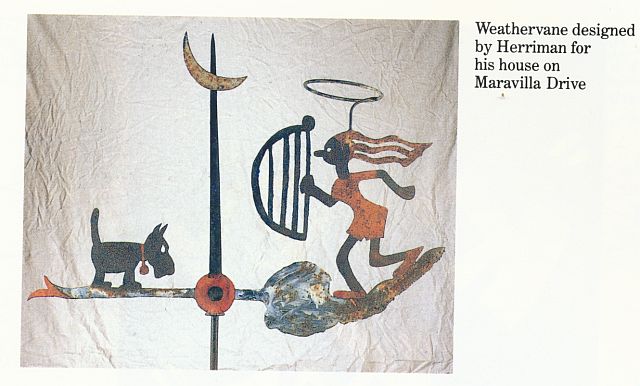 Now there is a big wooden gate and a high hedge blocking the view of the house. It still retains the Spanish design that Garge wanted. He designed the place back in 1931, it once held an art gallery full of Jimmy Swinnerton’s and Maynard Dixon’s paintings of Monument Valley, a lot of Indian baskets and pottery and some Navajo slashes and other designs painted on the outside walls. Herriman’s little studio was in there, too,
 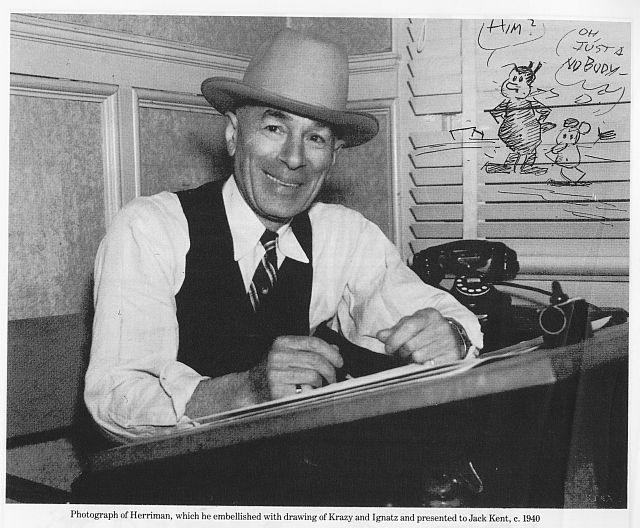 where he drew Krazy Kat strips until he literally died on the job. This house means a lot to me, and should to every lover of the great American cartoonists and their creations. For this house to continue as a private residence, is a crime! It should be set aside and restored to what it looked like when Garge lived and worked there. He even bought the lot across the street and made it into a little park with benches for all who stopped by. Here’s what that park looks like now:
 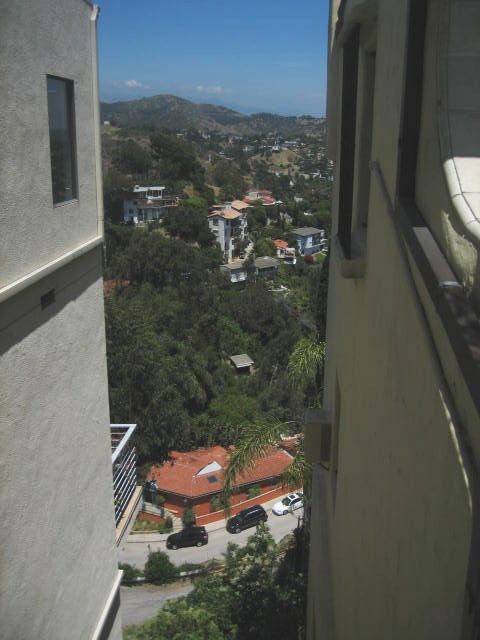 Â Squeezed out by mansions. If you try hard, you can catch little views of the upper story of the house:
 Squeezed out by mansions. If you try hard, you can catch little views of the upper story of the house: 

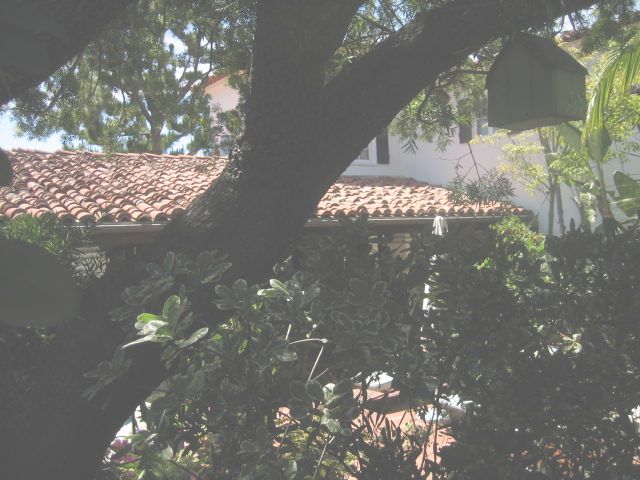


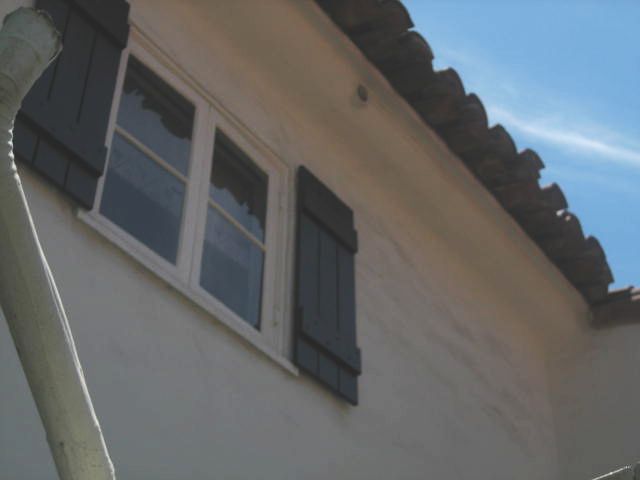 Â This one might have been the windows of the studio. I’m really glad I made the pilgrimage to see this wonderful house again, a house that George Herriman personally designed, and that in a city with so few shrines to it’s great cartooning past, should be treasured and set aside for everyone to visit. Here’s what the current owners did to the garage:
 This one might have been the windows of the studio. I’m really glad I made the pilgrimage to see this wonderful house again, a house that George Herriman personally designed, and that in a city with so few shrines to it’s great cartooning past, should be treasured and set aside for everyone to visit. Here’s what the current owners did to the garage:  It just makes me sick to think of this art treasure being turned into just another suburban dump by a family that probably knows nothing and cares little about the artist who created their house. This post is turning into a tribute to George Herriman’s memory. We will now dive into two more weeks of Krazy Kat from 1940:
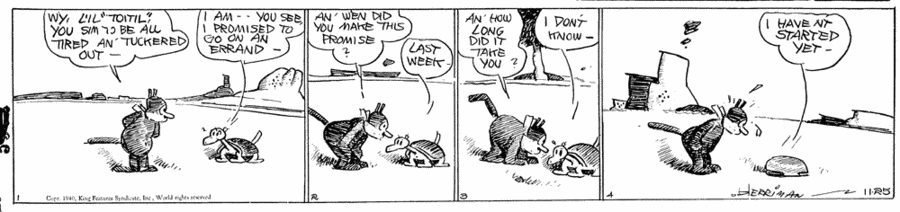
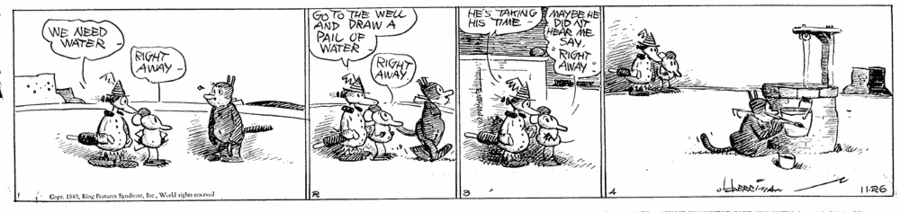

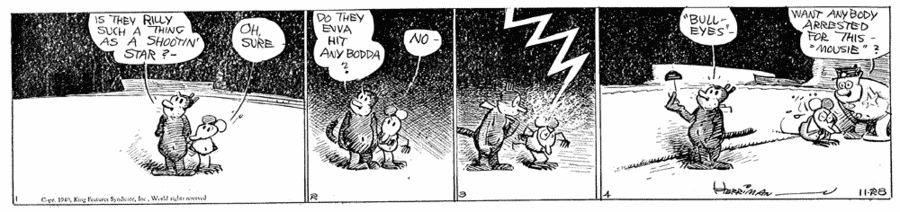
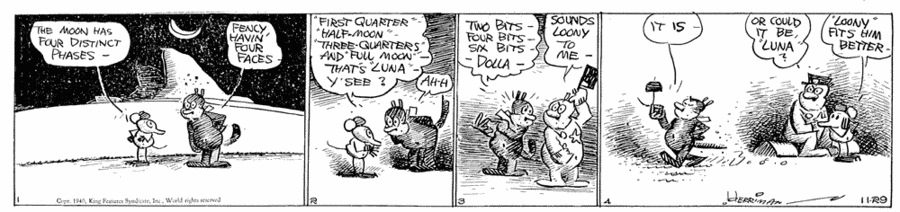

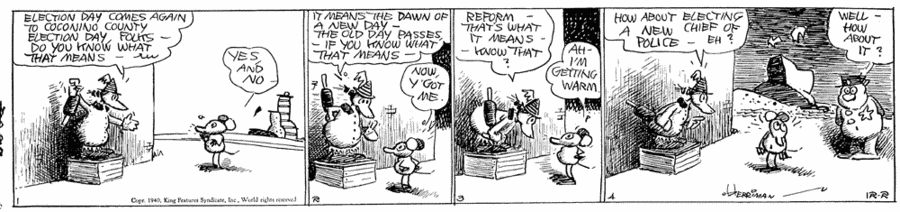
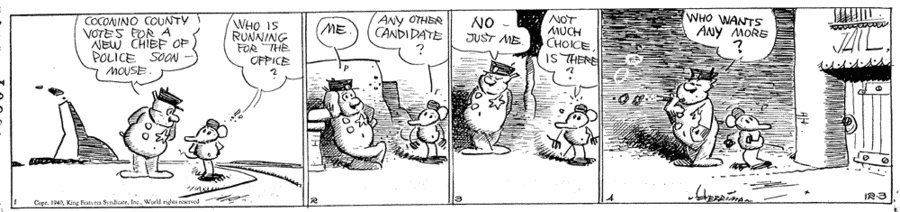
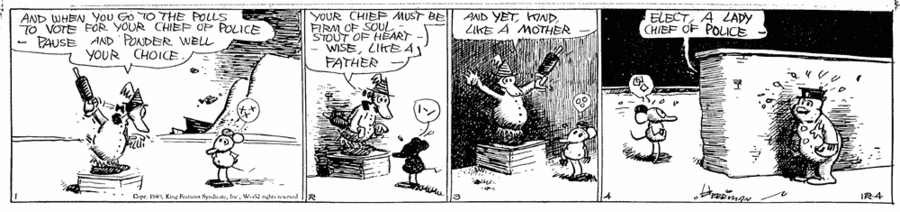
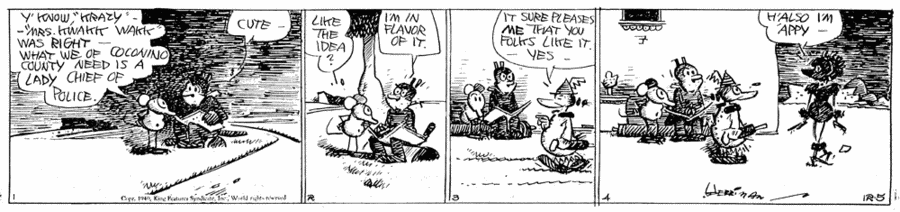
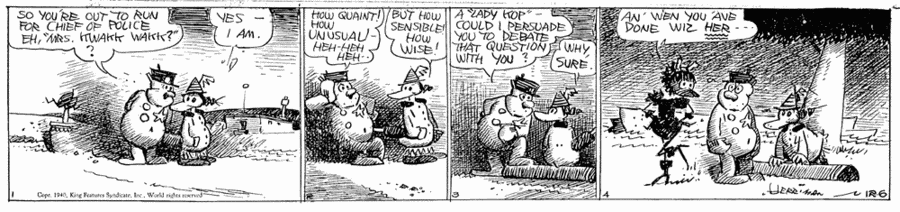
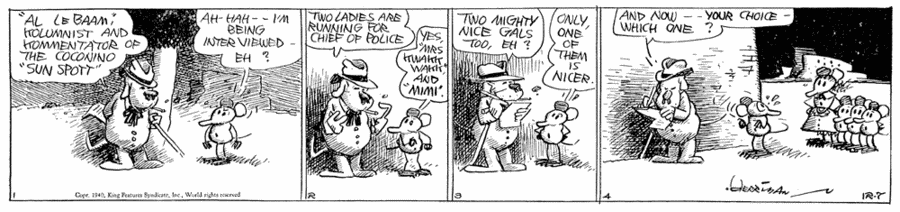
The KKs are from 11-25 to 12-7-1940 this time. In the first group, Krazy literally “draws” a pail of water from the well in the 11-26, is called “loony” in the 11-29 and in the 11-30 lives in a nicely drawn cave with Ignatz, right under the Pupp’s nose. In the 12-2 through 12-7 strips, a political intrigue is developing as Mrs. Kwakk Wakk and Mimi the humanesque French poodle are running for police chief against Offissa Pupp. I wonder who Al LeBamm in the 12-7 represents? Perhaps he was a reporter who knew Garge, or whom Garge is ridiculing. Matilda Mouse shows up in the last panel with the infants.
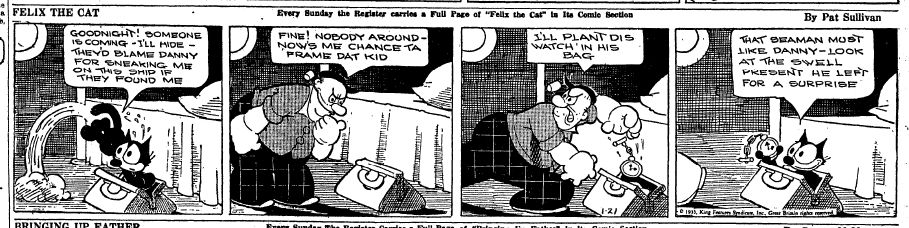


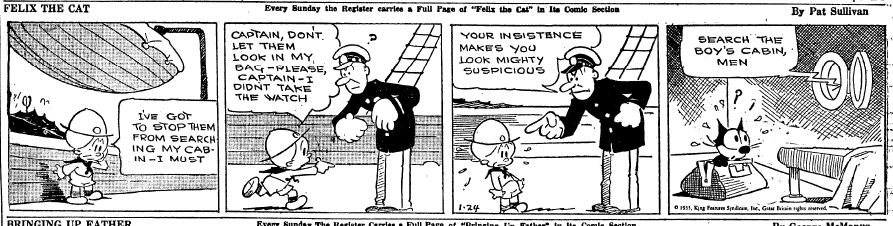
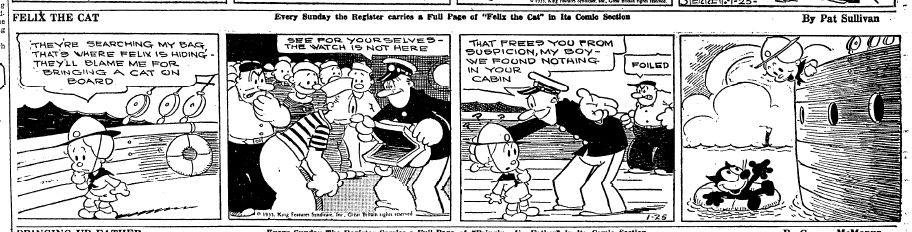

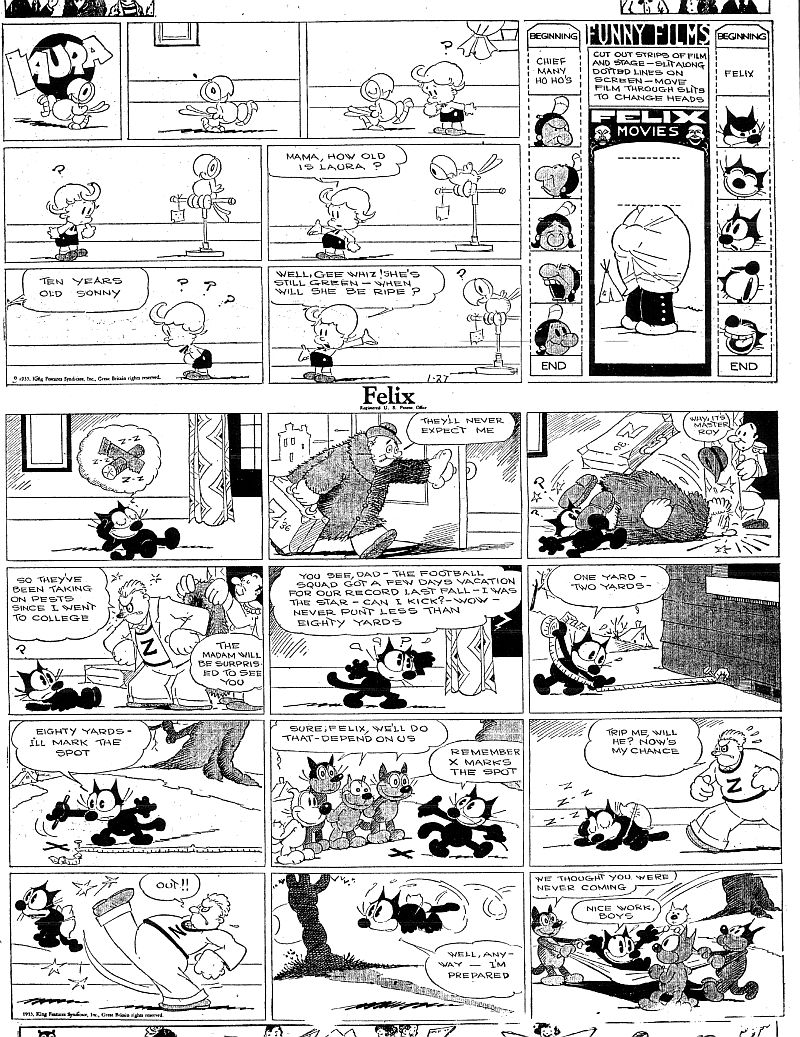
In Felix from 1-21 to 1-27-1935, Felix tries to foil the evil sailor’s plot to discredit Danny by planting a stolen watch in his duffel bag. Danny is afraid that Felix will be detected, but Felix escapes over the side in an inner tube. In the 1-27, Danny introduces Felix to the crew as a “good luck” mascot, and all they can say is “Fine”, in a Messmer understatement. I love the way Otto draws and groups figures, as in the 1-27 with the sailors linked together, and in the 1-23 with the evil sailor leaning against the rail. I love those hands, big circles with tiny stubs for fingers.
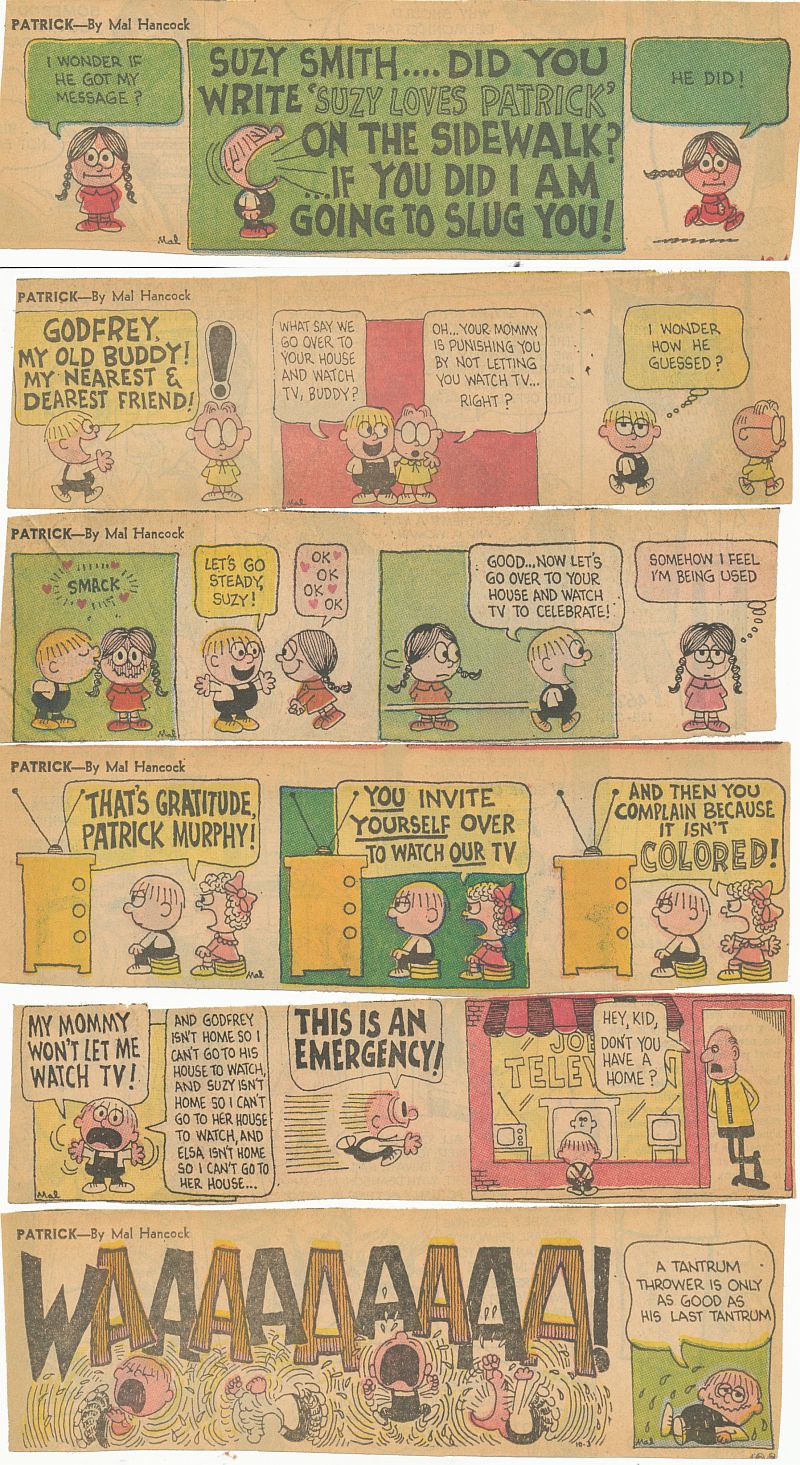
The dates on Patrick this week are really uncertain, but there is a definite continuity here so they are probably the last week in September, 1966. Patrick can’t watch TV because Mommy is punishing him, so he buddies up to Godfrey, Suzy and Elsa to watch theirs. Patrick’s tantrum in the bottom strip this time is real over-the-top. Hancock liked to really push the emotions in his drawings.
No John Sparey letters this time. I couldn’t wait to share my trip to the Herriman house with y’all. See you next time, and thanks for all the comments!
Happy (Sparey) Memorial Day!
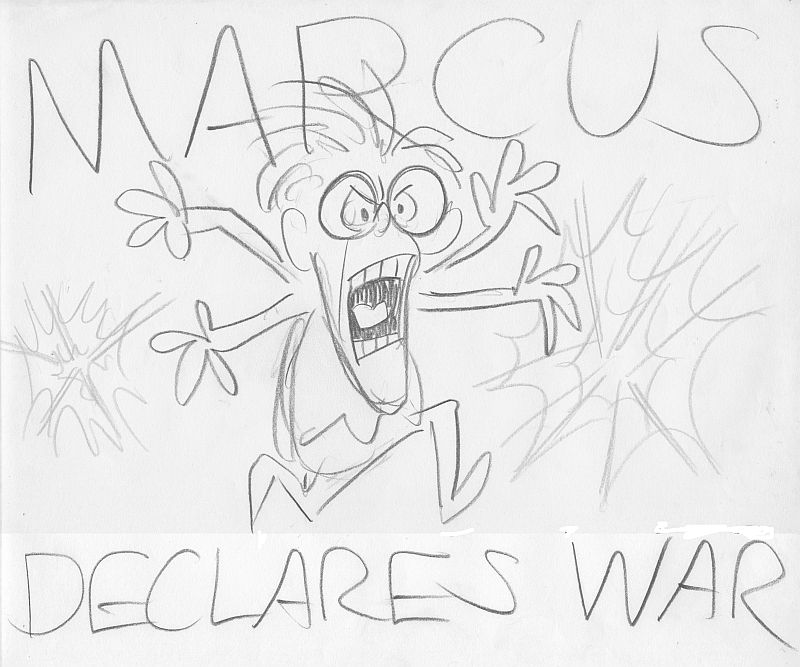
I hope all my readers are having a happy holiday as we remember our soldiers and what they put up with for all of us. The drawing above by John Sparey was inspired by the “Archy Declares War” sequence in “Shinbone Alley”(1969). It turned out to be the only part of the movie that looked anything like George Herriman’s drawings for the “Archy” books. Sam Cornell did the layouts for the sequence. Frank Andrina, the key animator, tossed me a couple of scenes to do in that section, and I was thrilled to be breaking into the ranks of professional animators for the first time! I must have gotten extremely angry one day over some development or other, so John Sparey thought he would comment about it, turning me into an aggressive cockroach.
Here are two more of John’s letters; in the first one, he is commenting on an exchange we had concerning his 16mm family home movies. I offered to screen them for him, since John had no projector. He used a note in his Christmas Card that year to interest me in the movies, but then decided to let his nephew handle the problem for him. John had no car and didn’t want to drive to Glendale from Hollywood. (I wonder if there was a time when John had a car, it must have been frustrating to always take Public Trans. in L.A. ) It’s also interesting that John worked many years at Disney, but had never seen the Mickey Mouse cartoon; “Through The Mirror” until they ran it on television in 2001. I guess the employee screenings in those days were rare. John was also a fan and a collector, as you can tell from his comments on “Animation Blast” and Floyd Norman’s book, “Son of Faster, Cheaper”.
Dec. 11, 2001
Mark,
I appreciate your offer to provide projection facilities. I cagily sent your card a week ahead of the bulk of them, and you came through handsomely. But having unspooled most of the film by hand and eyeballing it with magnification, I feel no need now to view it in motion. I am compiling program notes for distribution to whoever will be getting copies.
At the Union Christmas party last Friday, Carl Bell told me of a place in Hollywood that could help me get a transfer to video. That seemed more convenient than bussing to Glendale.
Then on Saturday, I got a call from the second-generation nephew who had sent me the films to identify in the first place, saying that he would prefer a CD (DVD). If I send him a CD, he can run off as many copies on his computer as will be needed. He says that there should be no problem finding somebody to make the CD transfer.
We’ll see. If you hear from me again, I need help.
I ordered Animation Blast #7 (with which you are familiar) from Bud Plant for its article on Ray Aragon. It properly played up his efforts for the failed Don Quixote project. I feel that his work on that is worthy of a book of its own.
There was also a collection of Floyd Norman cartoons–one of which I couldn’t figure out. When and why would Walt have wanted to ship Winnie-The-Pooh back to England? 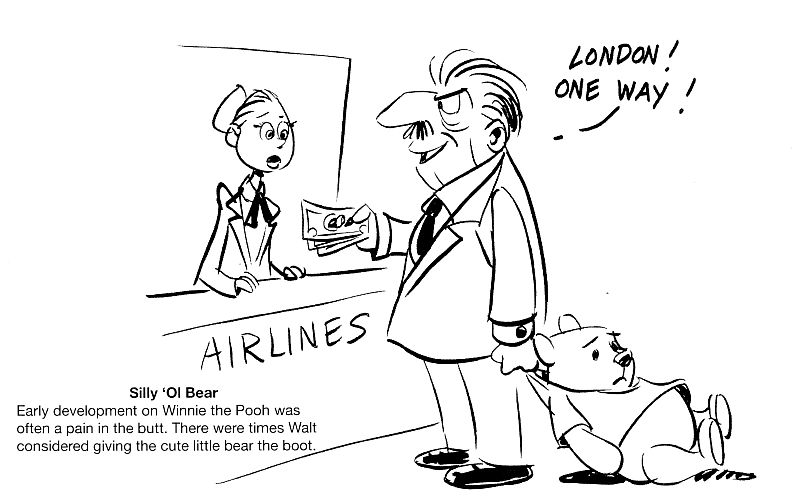  (Mark here, maybe John didn’t read Floyd’s caption, Walt was frustrated at the restrictions of using Milne’s famous character, and almost gave up on Pooh at one point. He probably didn’t “literally” think of shipping the Old Bear back to Great Britain.) Some of Floyd’s jabs at Michael Eisner are sharp enough that he HAS to be good at his job.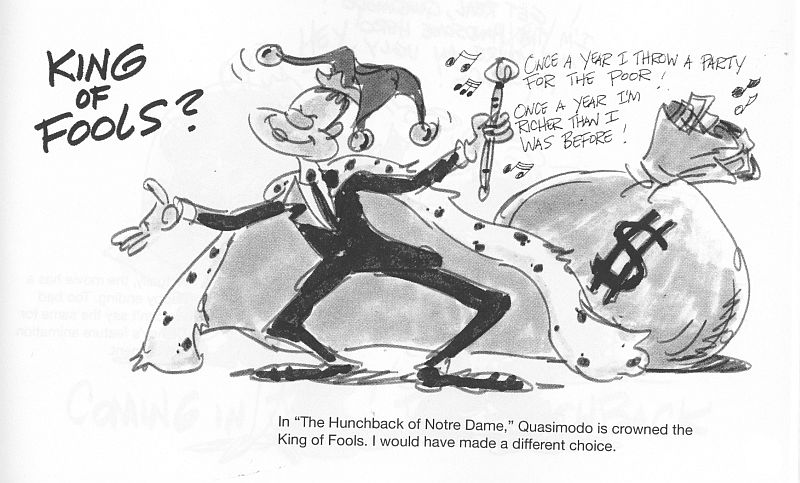
This was pretty much of a Disney weekend for me. Sat. Night A&E had a 2 hour biography of Walt (a rerun, actually). The youngest participants were Floyd and Roland (Rolly) Crump. And Sunday noon, Ch. 13 set aside a 2 hour slot for “Alice In Wonderland”. Too much time for just the feature. My watching paid off. The program started with “Thru The Mirror” which I had never seen complete before–only snippets.
Enough.
John S.
In our second letter from John, dated May 7, 2006, John comments on his experiences with “Access Services” from the Woodland Hills Motion Picture Country House, where he lived after his collapse. He wanted to get his collections and personal things from his Hollywood apartment, but the obstacles to a handicapped older person with no transportation to getting anywhere near the apartment were daunting. It’s interesting to read the long paragraph (4th one) and get an insight into John’s extremely sharp memory for details, and how he could turn his frustrations into humor. Access Services were really obsessed with John’s blood pressure! This letter is really addressed more to John’s family, not me:
May 7, 2006
For the last couple of weeks, an appointment was being set up for me with access services. It was determined about a week ago that my appointment would be on Friday, May 5th. But it wasn’t until 5:55 Thursday evening that I got a phone call telling me transportation would pick me up at 12:30 on Friday. Also, the “home” had hired a “caregiver” to make the trip with me. She arrived at 4:30 and saw to it that I had a dry diaper before I was served an early lunch. I can get on intimate terms with women very quickly these days. You’d never guess from her name, Gemma Cohen, that she’s from the Phillippines.
!!!CINCO de MAYO!!! It was the most satisfying meal-on-a-tray I have had here yet: ground beef taco salad with sour cream and salsa, a Mexican style soup, and a diet custard rather like flan.
Our wheelchair van was the best I’ve seen yet, with a chair space right next to the driver and a clear view all around. We had a one hour trip from Woodland Hills to East L.A., mostly on U.S. 101. You may ask, “What is Access Services?” A good question.
It looked to me like an overblown bureaucratic boondoggle. Inside of a several story-high warehouse space was a rambling sprawl of waiting areas, cubicles, and a testing area of curbs, ramps, and such. First, my California I.D. was copied and I signed away any rights to damages in case of injuries in the testing area. Then my blood pressure was checked with a finger clamp, and I rode onto a scale to show the total weight of me and the chair. Then I rode into a space with Lucite moveable walls that could measure the length and width of the chair. Then my picture was taken with a Fiber Optics camera, and my blood pressure was checked with a finger clamp. Then we were directed to join a group sitting in front of a video screen watching a public service film on the benefits of aids for the handicapped provided by the L.A. Transit System—alternately in Spanish and English–with lengthy screen saver footage separating the shows. That lasted an hour. We were then sent to Room 111. I didn’t see half a dozen cubicles in the area, but one had a cardboard sign 111. In there, I was shown a succession of photos, stopping them whenever I spotted a bus with a specific number or a Jack In The Box or a MacDonald’s location. I was asked to separate 53 cents from a collection of 1 Quarter, 2 Dimes, 1 Nickel, and a number of pennies spread across a table. I was asked about my medications, and I presented them with my list as updated to last November, which I carry around for such occasions as this. It is very much the same as my current dosages. I was asked how I had got along using our transit systems and what problems I had had. So I told them. Then my blood pressure was checked with a finger clamp. I was told I’d learn in a week or so if I qualify for their service. Another 40 minutes in another waiting area, and we were told our van was waiting for us. Another hour trip to Woodland Hills. We were told to expect a 4 hour outing. It took 4 hours, 10 minutes.
What is Access Services? It’s a supplement to Public Transit for the severely handicapped, equivalent to buses, not taxis. Price? $1.80 for less than 20 miles. $2.70 for 20 miles or more.
It’s the first step toward access to my apartment.
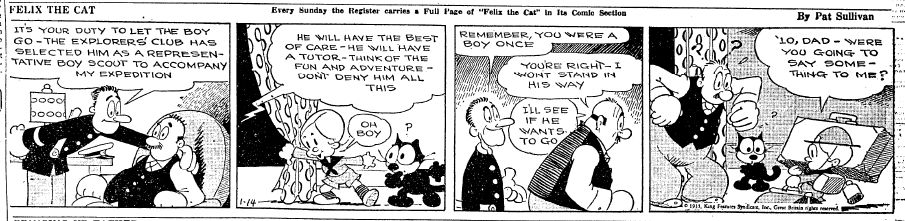


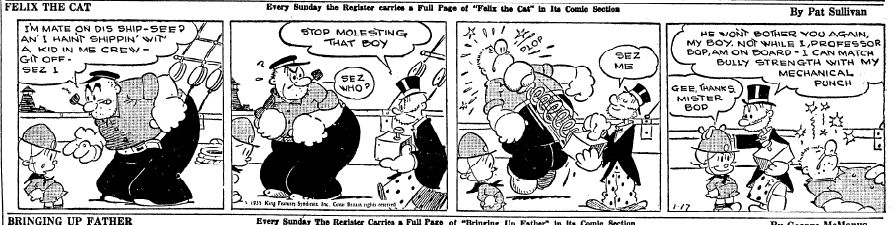
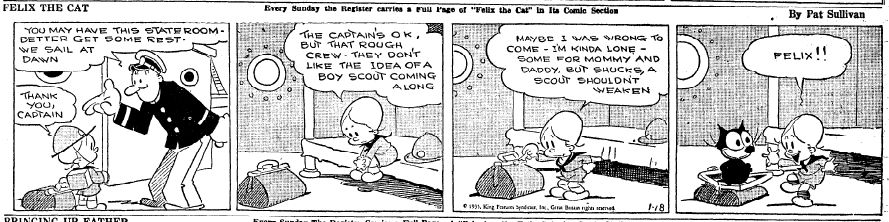
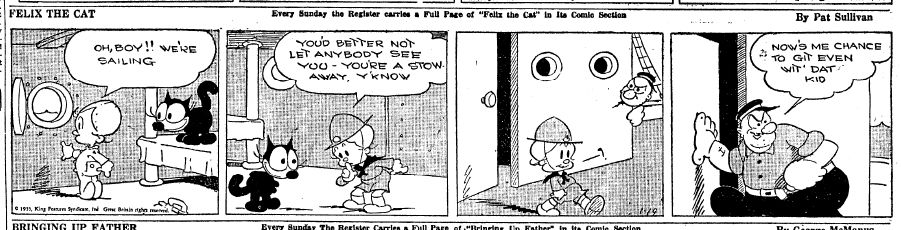
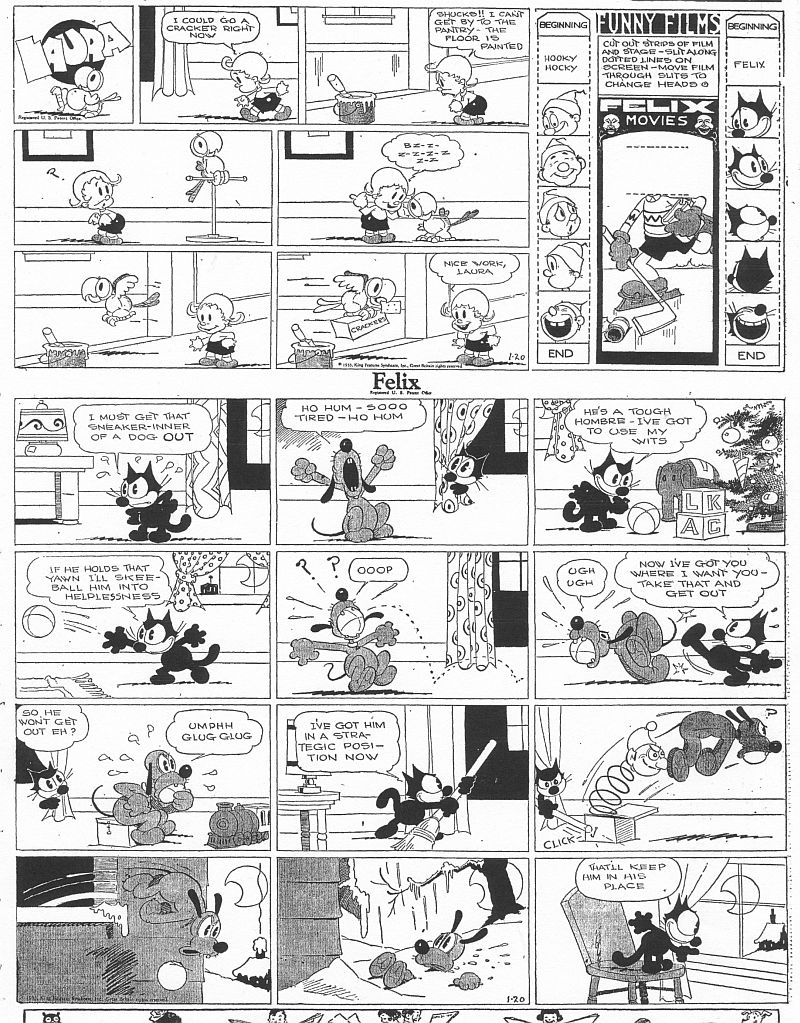
Felix (1-14 to 1-20-1935) continues Danny Dooit’s adventures. At the behest of the Explorer’s Club, Danny is invited to go on an ocean voyage as a representative boy scout with the Club’s expedition. Danny doesn’t even know what the trip is all about, but his parents agree to let him go anyway. The boy could be going into involuntary servitude for all they care! Felix disappears from his strip for two days, and doesn’t re-enter it until he magically pops up in Danny’s bag in the 1-18. In the Sunday, Felix continues to fight Flub the Pup, and ejects him from the house with a Jack-In-The-Box. It’s nice to know that folks were relaxed about taking the Christmas tree down in 1935.
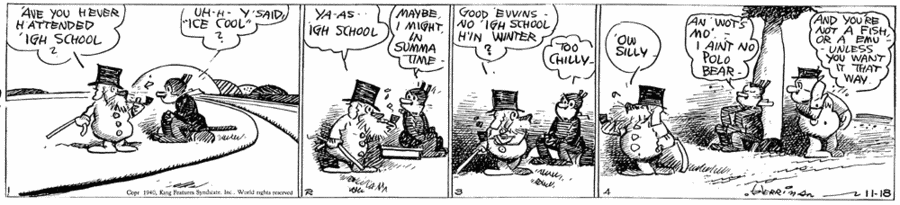

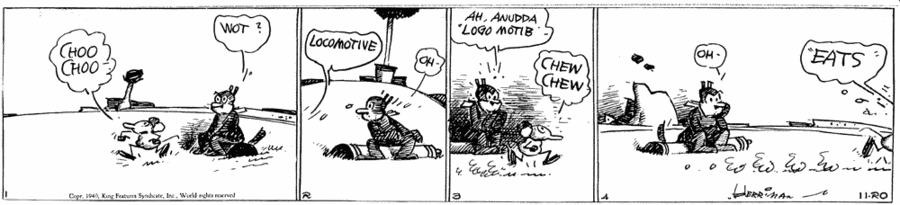
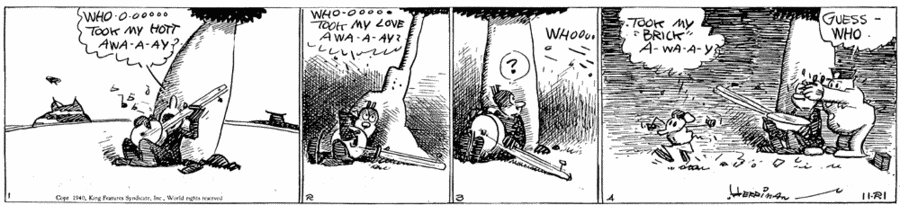
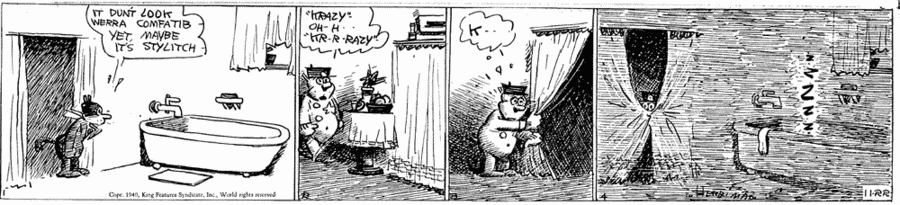
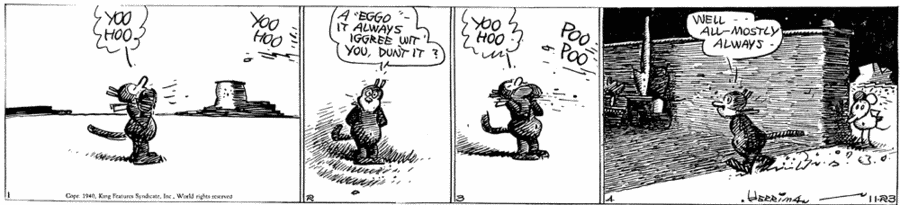
Krazy (11-18 to 11-23-1940) is almost all word play this time. The English Dog in the 11-18 has such a thick accent that Krazy (who has quite a thick accent himself) can’t understand what “Ice Cool” is. In the 11-22, Krazy is naked in the bathtub, Offissa Pupp can’t look at her without her ribbon, which is carefully draped over the edge of the tub. In the 11-21, Garge is quoting from a hit tune of the 1920s, “Who?”, a smash for George Olsen’s band. The original lyrics were, “Whoooo stole my heart away? Whooooo makes me dream all day? Dreams I know can never come truuuue, Seems as though I’ll ever be bluuuue….”
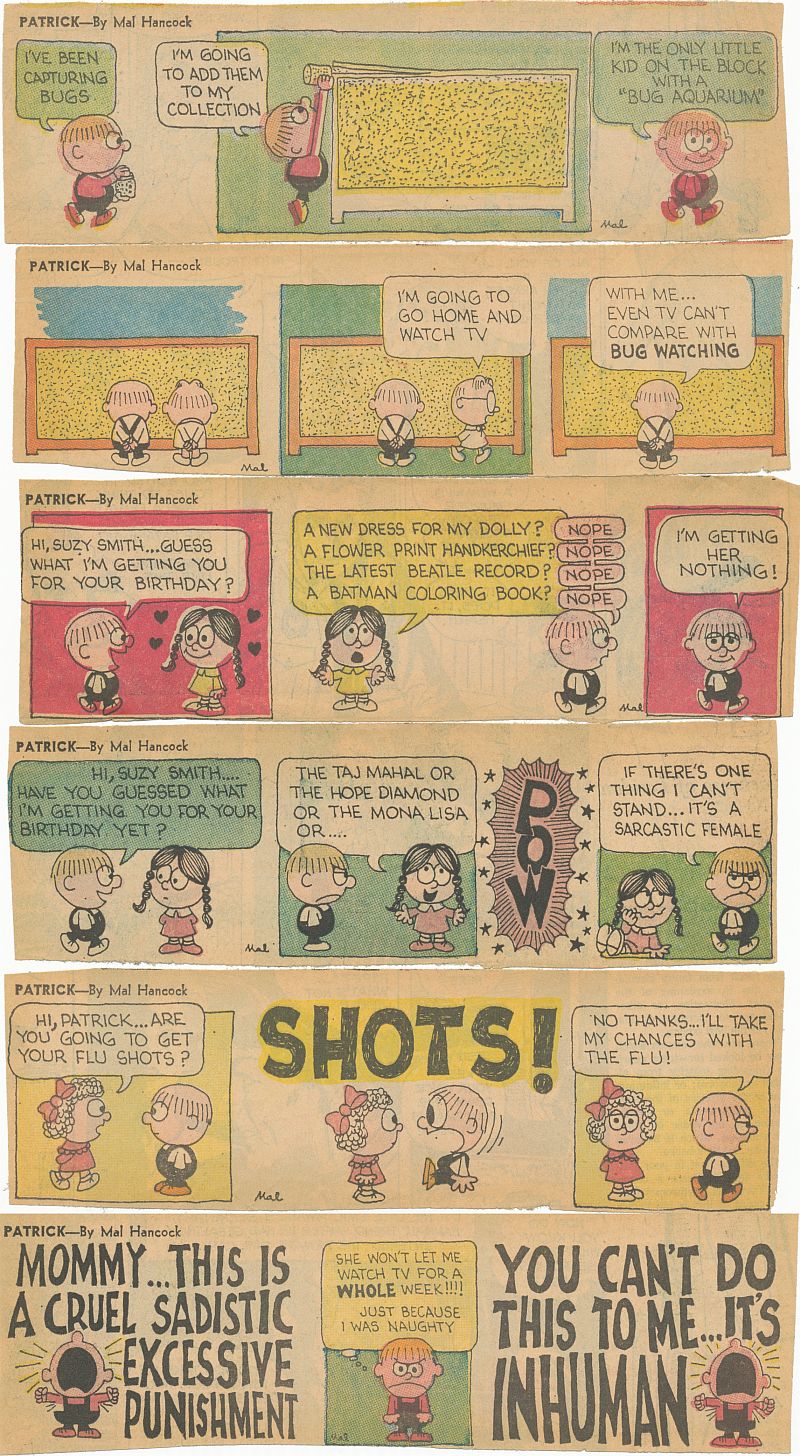
Patrick (approx. 9-20 to 9-25-1966) loves being mean to Suzy Smith. He won’t give her anything for her birthday, then punches her out when she gets a little sarcastic with him. I like Patrick’s extreme reactions to “Shots!” and the “Cruel, Sadistic, Excessive Punishment” of having his TV privileges suspended for a week. There was no cable TV in those days, but still a lot of afternoon and morning kids’ programming, before the era of Oprah took most of it away. See you soon, you wonderful readers!
John Sparey on Allen Wade, Dick Hoffman and Money!
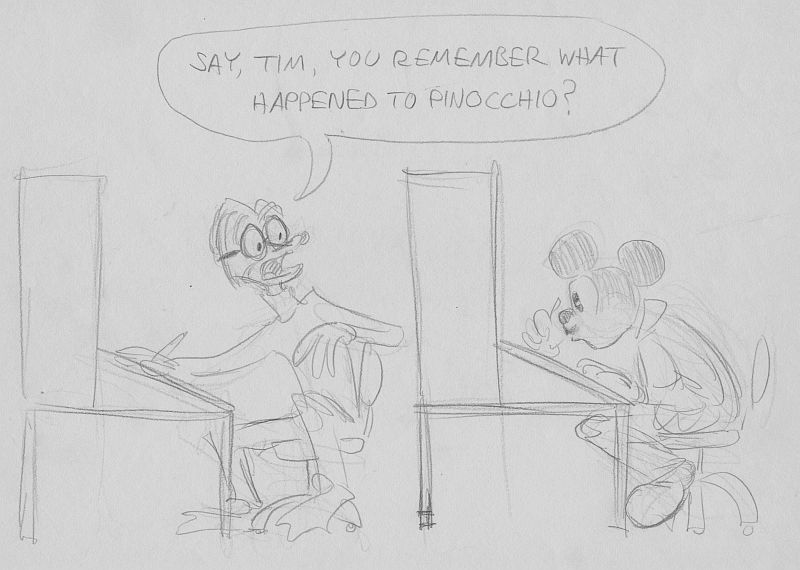
Hi Folks, the John Sparey letters continue! But first, there’s news of “It’s ‘The Cat'”! The Annecy Animated Film Festival in France has requested a print of “It’s ‘The Cat'” for a survey of American Independent Animation which will be screened three times during the Festival! We made the cut! I have no idea how many animated films the Festival considered for this program, but I’m surprised and happy that our cartoon will be included. Greg Ford, my Producer, is quite enthused as well. It will be screened during the Annecy Festival June 6th to 11th, if any of my readers can attend.
   That’s a John Sparey drawing at the masthead of the post this time. For some reason, John caricatured me as a duck and Tim as a mouse, John took great amusement at Disney fans, since he had worked for the Mouse and “graduated” (as he put it). I’ve forgotten exactly what prompted this drawing, it was a long time ago (1969). Here is a letter that John wrote from the Motion Picture Country House and Hospital in 2006, where he was living after his collapse. He writes this time about a mistake I made in identifying a caricature he made during his time at Disney. I thought a drawing he made of Gary Mooney looked like Allen Wade. By the number of times John mentions Allen Wade, and keeps underlining his name, I think it’s obvious there was some kind of ill-will there. Allen Wade was quite a character, Tim Walker and I both knew him and visited his place a few times. Allen was a key assistant animator at Disney, probably in the early 1950s, the same time John was there. I think he worked on Sleeping Beauty. By the time I met him, Allen was pretty dominated by intoxicants, but he was a funny guy, and fun to be around. He loved movie history, Errol Flynn, Basil Rathbone, W.C. Fields (Allen could do a funny impression of Fields). Most of all, Allen was a fan of Bing Crosby, the early, pre-singer’s nodes Bing. I can see how a nervous type, which John tended to be, would be irritated by Allen, but to Tim and me, he was a friend and loved to share his collections and Bing Crosby records with us. Gary Mooney was an assistant at Disney, he worked on Lady and the Tramp, and a very good free-lance animator on commercials. I met him when he worked at Quartet Films, and he broke me in on some inbetweens on a Green Giant commercial. Gary worked for Bob Kurtz in later years. John Sparey writes about Dick Hoffman, who was another Disney assistant who came up the ranks with John.  Later, Dick became an animator at Filmation and stayed with them until the studio closed. It’s kind of sad to read about how Dick Hoffman wound up at the Motion Picture Country House and John’s attempts to remind Dick of the old days at Disney. John also reveals the various weekly wages he was paid over the years. $31.92 at Disney in 1953! I wonder how John managed on that. Leaving Disney was a pretty smart move on his part financially. (John spells Allen Wade’s first name as “Alan” in his letter, I’ve left it as he wrote it.)
Mark,
You may wonder why you are receiving all of this unsolicited material. Just lucky, I guess. You were the first person to advise me that the Anim. Guild was posting my Disney gallery of art on its website. That was on your Christmas card. And you mentioned my caricature of Alan Wade…alan wade??!! I had drawn Alan Wade? I had no recollection of it whatsoever. This prompted my deeper involvement in the computer lab here. The “Alan Wade” portrait was about the last of my drawings posted by the Guild. That was not Alan Wade! That was NOT Alan Wade!! That was NOT ALAN WADE!!! It was Gary Mooney. 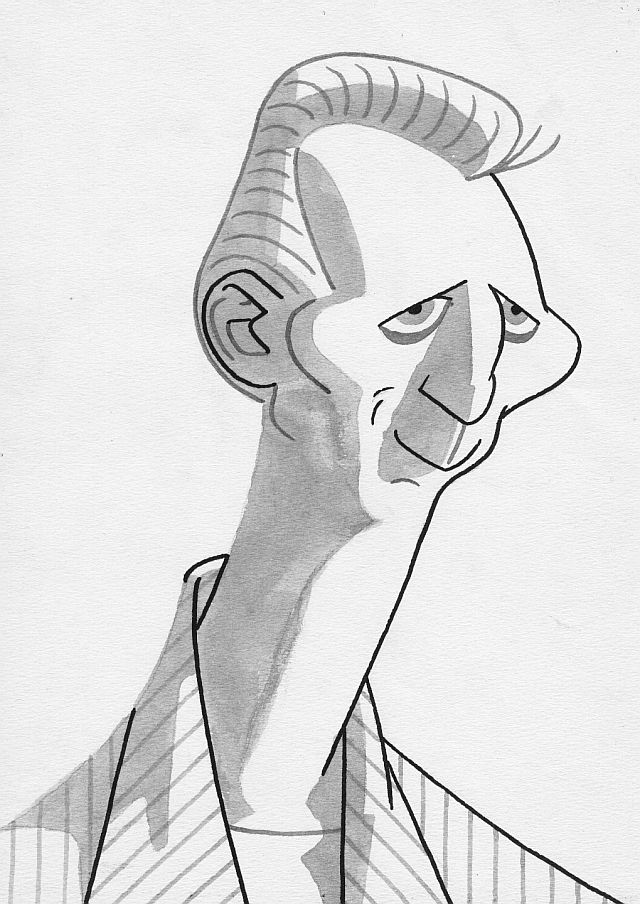 Gary is also in my mini-mural, “Disney Bull Pen, 1954”, seated at the desk. And Dick Hoffman was also in the group.
 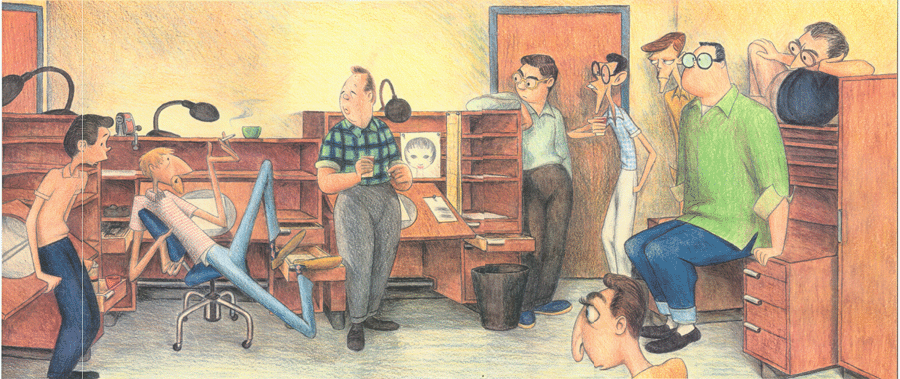 And both Dick and Gary were in my seven dwarf line-up.
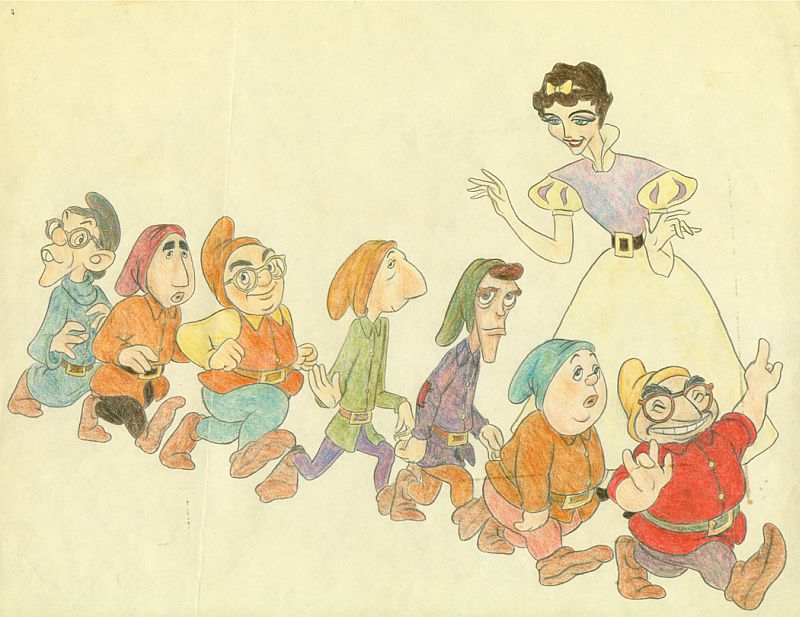 I never worked with either of them after we “graduated” from Disney, but I kept some awareness of Gary’s moves in the business. However, I heard very little about Dick. At one point, I learned that he had been in a bad car accident. Some years later, I spotted him at a large Union meeting where Ed Asner delivered a prepared speech encouraging us to go on strike. His speech completed, he (Dick) pivoted quickly toward the Exit and was gone. Then he turned up at an art exhibit organized by Phyllis Craig at Film Roman. I hadn’t identified him; he seemed so shrunken, and he needed a voice box so that I didn’t even have his normal voice to identify. Having done my mental double-take on hearing his name, we tried some trivial chit-chat. We had never been “pals”. But he had managed to stay out of the hospital habitats all this time until now. So when I was told a few months ago that a “Richard Hoffman” I might have know from animation had recently joined us, I knew it couldn’t be good news. Following a physical collapse somewhat similar to mine, he has been spending most–if not all—of his time in bed. After going to ask about chances of planning a visit with him (in a different wing), I was led directly to his room. I was not prepared for a monologue conversation. His battery operated voice box was not working. The visit was not a success. I slunk away. Realizing that I had materials to use as an excuse for a second visit, I downloaded prints of my two pictures that include him. It went well. He’s alert and clear-minded. He knows that visitors can sometimes have trouble understanding him and is prepared to write notes. He recalls various events we shared, so I came up with a group of studio gags as an excuse for a third visit. But I still need props.
One of the records that I have kept from the time I started at Disney is a list of my weekly salaries. So I can accurately report that for my first week at Disney in April of 1953, I earned $37.84 as a beginning apprentice inbetweener, with a take-home pay of $31.92. By April of 1954, I had moved up to temporary breakdown and a salary of $69.94. That was almost exactly what I was getting on Crusader Rabbit in Hollywood in 1951, once you translate my $300.00 monthly pay into weekly terms. I neglected to keep payroll records for my 6 weeks with Jay Ward on C.R. in Berkeley in 1950. I spent 1952 in the Navy as my reward for staying in the inactive reserve. By the time I “graduated” from Disney in March, 1958 I was an Asst. Animator earning $104.08 plus “Sleeping Beauty” overtime. Moving over to TV Spots as a beginning animator on the new C.R. in color automatically bumped me up to $145.00 a week. Two years of automatic raises had lifted me to $200.00 a week. I was ROLLING in dough!
But Enough of That.
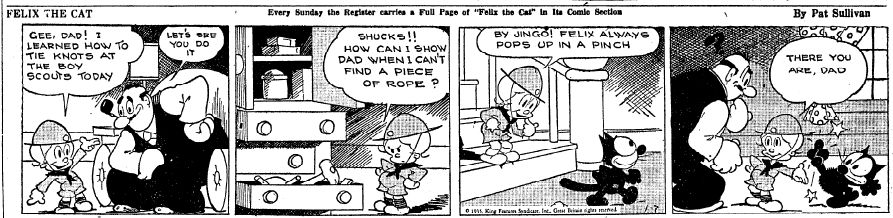

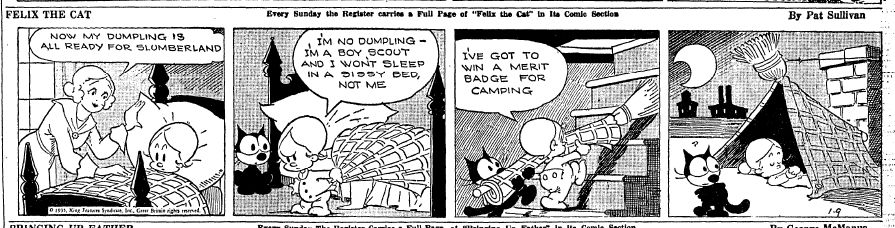
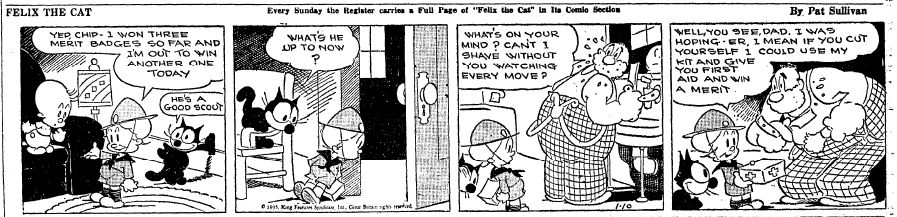
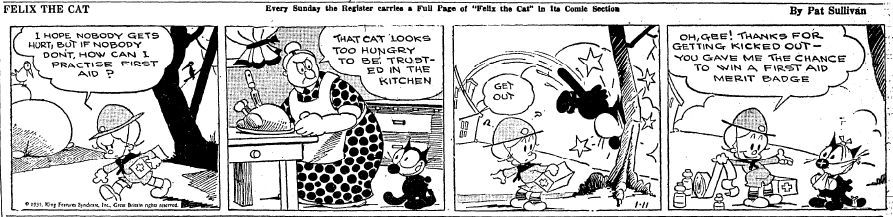

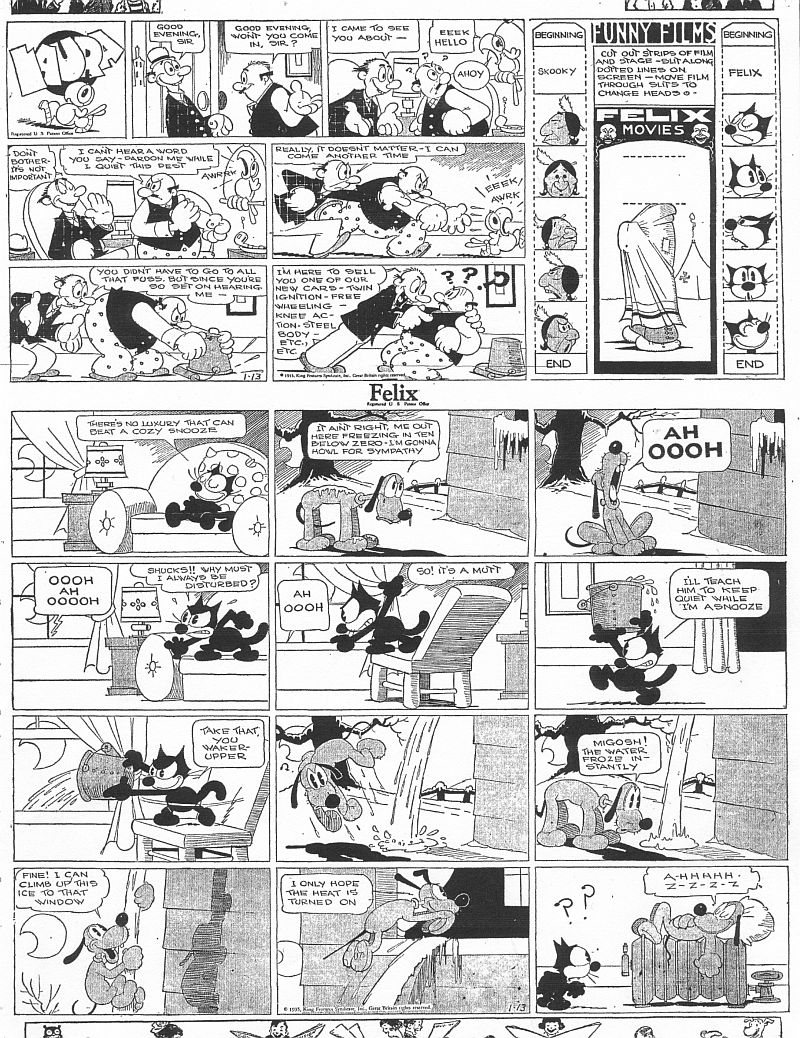
Felix is from 1-7 to 1-13-1935 this time. Danny Dooit enters the action in the 1-7, this time as a Boy Scout. Felix gets knots tied in his tail, so Danny can practice his Scout knots, and in the 1-11, Felix once again is pitched head long out of the house. Danny uses the opportunity to dress the Cat’s wounds. I love the drawing of Felix hitting the tree, beautiful cartooning. On the twelfth, Messmer builds suspense by a knock on the Dooit’s front door. I love the howling dog in the Sunday page, he reminds me a lot of the early Pluto. He might be an early version of Flub, the pup, which Otto used in the Felix comics of the 1950s and 60s.
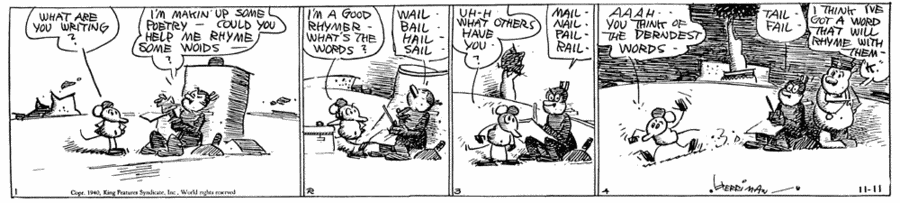
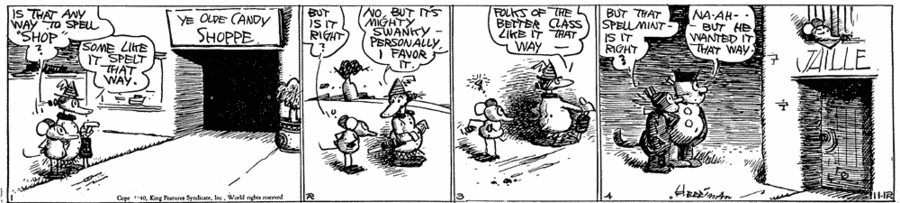
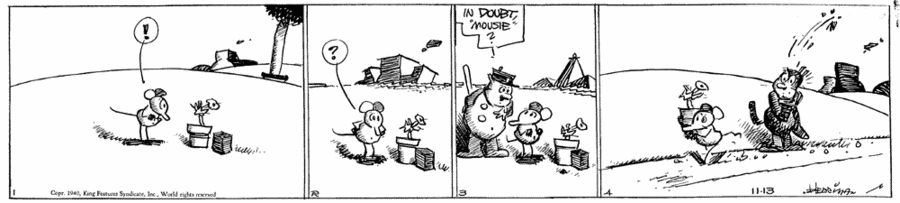
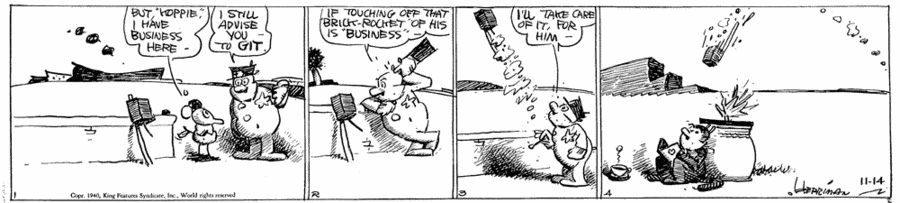
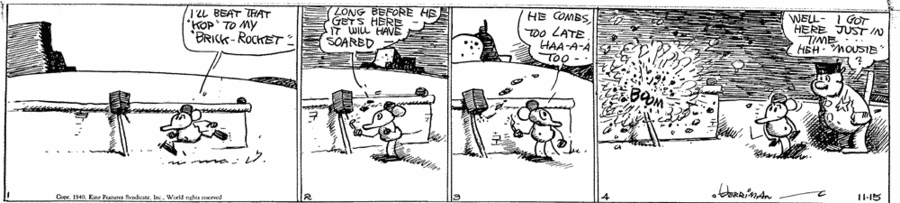
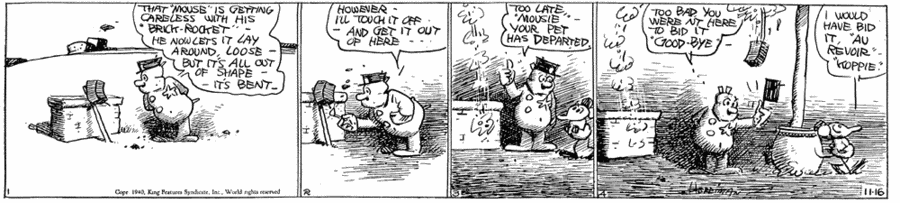
Krazy this time is from 11-11 to 11-16-1940. The action centers mostly on Ignatz’s ‘Brick-Rocket’. Ig ties a brick onto a sky rocket and aims it at Krazy, Offissa Pupp unwittingly completes the firing in the 11-14. The ‘Brick-Rocket’ becomes a boomerang in the 11-16. I like the subtle rhyming gag in the 1-11 as well. By this time, we are so familiar with the “Ignatz+Brick=Jail” equation that we can complete it for ourselves.
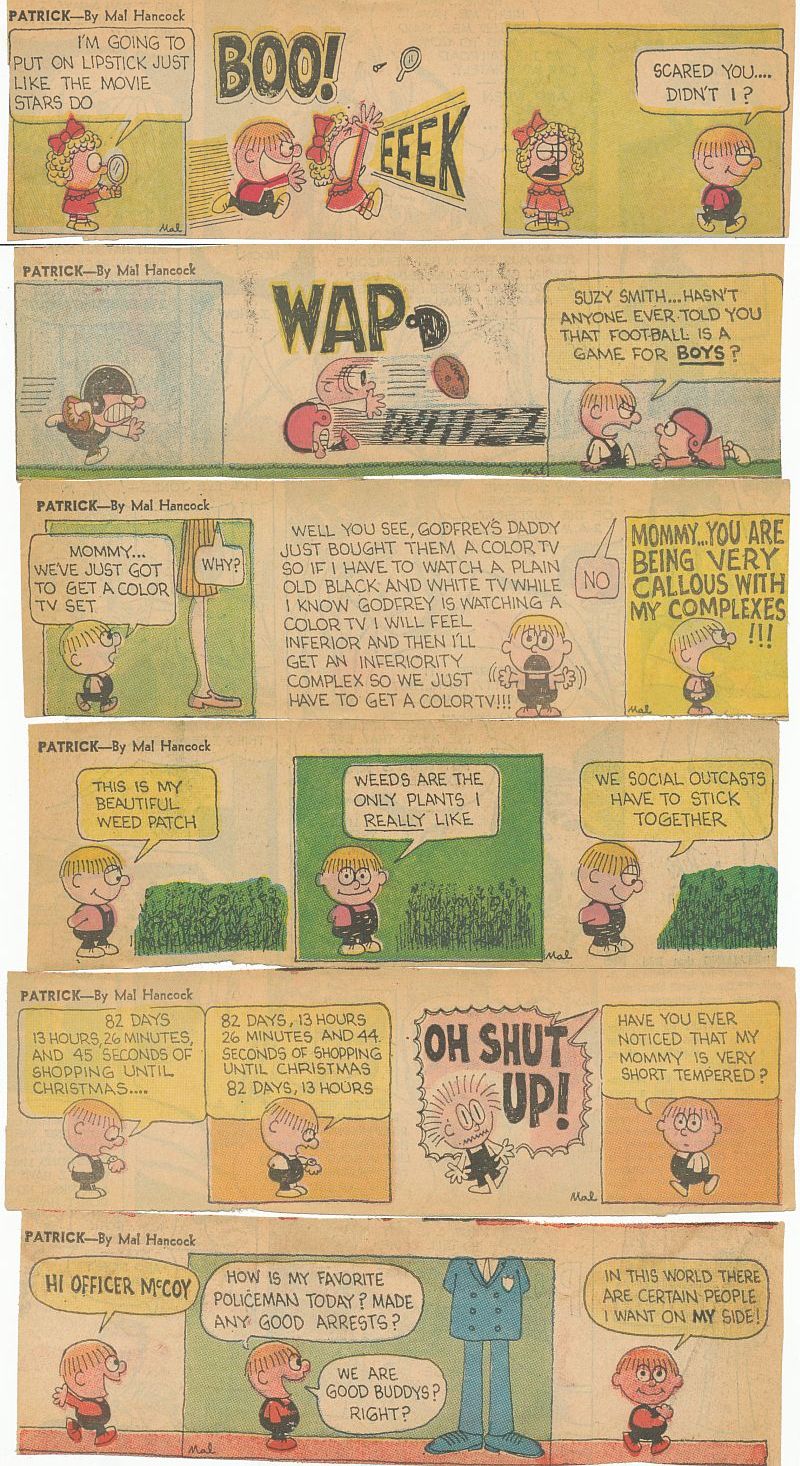
Patrick is from approximately 9-9 to 9-15 this time, with “9-15” on top. There is almost a month’s gap between the strips from the last post to this one. Probably summer vacation took place and nobody was around to save the papers. I love Patrick’s “complex” about Godfrey’s color TV, pretty new technology in 1966, and his relentless count-down to Christmas shopping which pushes his “Mommy” over the edge. Sorry that I can’t date these more accurately. Back in my strip-clippin’ days I was lucky to have time to clip them, let alone date them and put them in the correct order. I’m much more meticulous about my newspaper clippings now, but I do a whole lot less of them. I love newspapers, but don’t even subscribe to one, I just accept my neighbor’s copy when she’s through with it.
John Sparey’s “Family Letter” and Felix 1935!
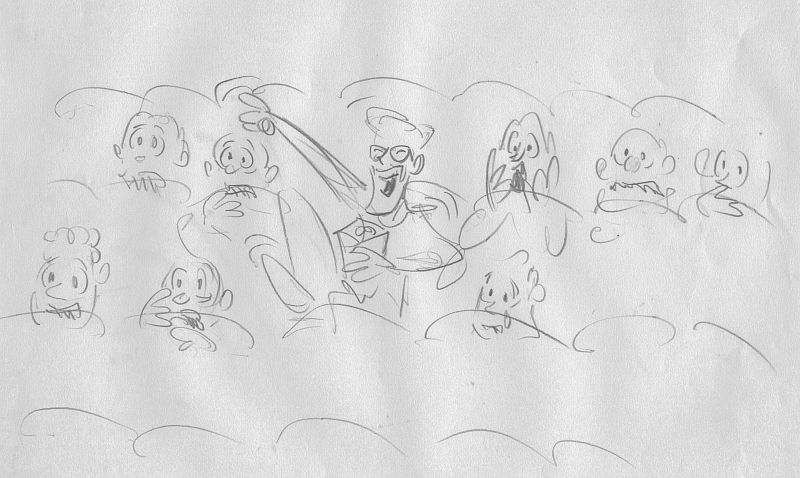
This is a drawing by John Sparey from 1969 when we worked together on “Shinbone Alley”. He thought I had a rather gruesome sense of humor in those days, and he depicts me laughing at a moment of tragedy/suspense in a movie theater audience. What a monster I must have been! I probably had some half-baked theories about “black humor” that struck John as peculiar and worthy of commentary. Here is a letter that he wrote to his family in 2006, after John had his stroke in his Hollywood apartment and wound up in the Motion Picture Country House and Hospital for long-term care. His apartment remained full of his things and unoccupied for a long stretch while John was adjusting to his new life at the Country House. He talks a bit about a visit from Iraj Paran, former art director at Hanna-Barbera, and Liz and Mark Bakshi, members of Ralph Bakshi’s family:
May 4, 2006
Dear Family and Mark,
Let’s see. When did I write my last family letter? Was it before I composed my first computerized message to all on my Christmas Card list? Was it before I quit having meals with my own little “snake pit” group to enjoy meals in the hospital’s dining room with the hospital’s more functional patients? White table cloths, menus with choices between two entrees and a choice of side dishes. Food more thoughtfully prepared. This week’s return to meals on trays in our own quarters is a temporary setback caused by a flu quarantine.
Last week, I was moved from a double room on the first floor to a single on the second. My clock radio could now provide real music rather than just deliver white noise. I can play the TV with no concern for a blind roommate. I began to feel I was putting out roots.
This Monday, I went on an off-campus shopping spree. Best Buy and Target’s. Bought a larger TV with DVD and VCR to replace the set provided. I have a perfectly good early 90’s floor model RCA plus a DVD/VCR unit in my apartment. But they would be space hogs here. I was provided transport plus a volunteer shopper. I also got a new Timex. I got tired of people looking at the white spot on my wrist-bare since last December-and asking “where’s my watch?” Plus such odd items as a drawer lock and a new address book.
We have an attractive dark haired nursing supervisor here named Hiva Paran. (Hee Va Pa Ran) in conversation last week, she mentioned her husband Iraj. IRAJ PARAN?!! I had known and admired his work at Hanna-Barbera 35 years ago. He had a personal painting style exactly like ancient Persian miniatures. Both are from Iran/Persia. Iraj was new to the country and was hired for the background department by Bill Hanna within ten minutes of showing his portfolio. He stretched that into a career of over 20 years at the studio, becoming their art director. So yesterday, Iraj came to our facility for some X-rays, and stopped by for a visit. We had a cheerful chat and reminiscence about the “good old” days. He looks about the same now as he did then.
Today? Nothing much. Just had a visit from Liz Bakshi, Ralph’s wife. They live in Silver City, N.M. these days. Liz is out here visiting some of her kids. The oldest, Mark, lives just next door in Calabasas. I first met Mark when he was visiting his father during the making of “Fritz the Cat”. As they were entering one room, Ralph covered his eyes and said, “not until you’re eighteen”. When Mark completed his education, he got some executive position at Disney, but after several years he shifted to Paramount, where he has remained. Yesterday, Liz said that Mark has just been made President of Paramount [!] Liz is just as bright and cheerful as Ralph is loud and angry. We had a good visit.
(This is basically a letter for family distribution, but I just wanted to share some of the fun I’ve been having.)
John S.
I will be posting a few more letters from John soon, telling his further adventures at the Motion Picture Country House.
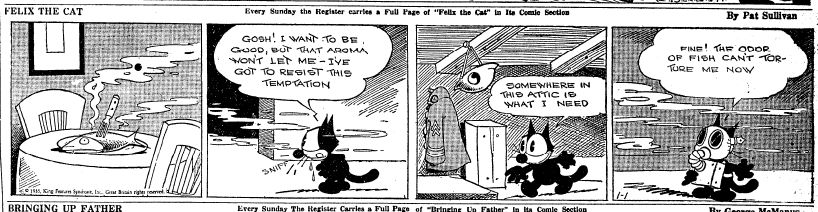

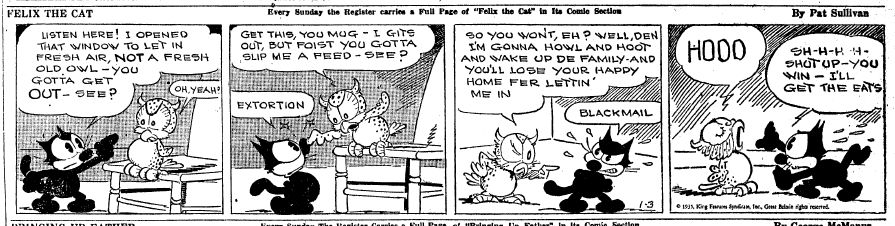
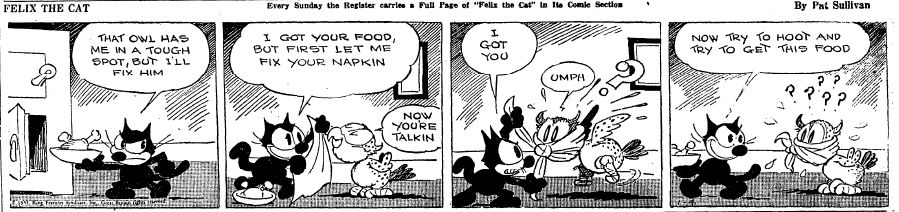
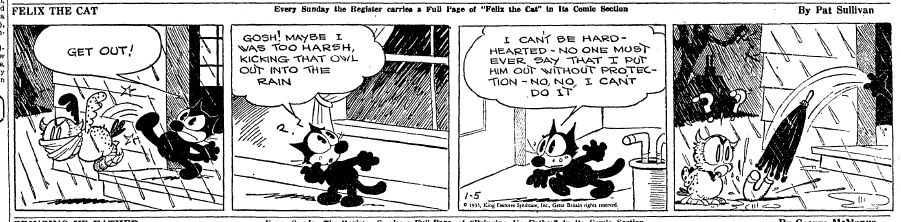
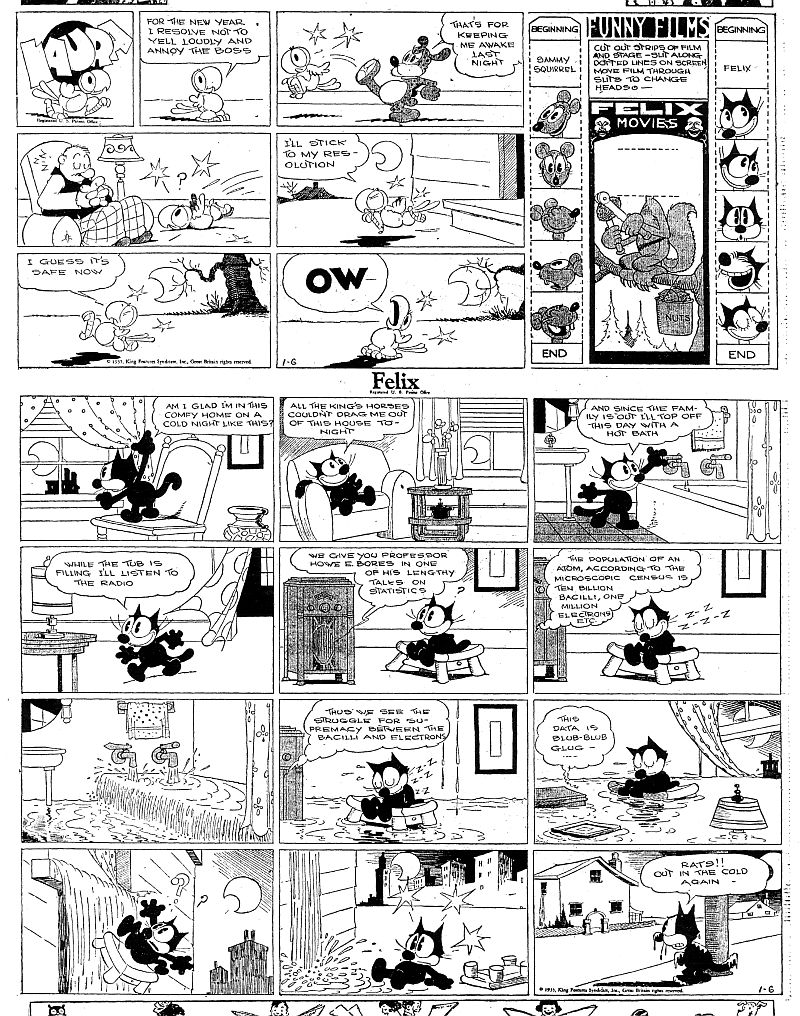
I’ve decided to take Felix back in time to the year 1935! I love the artwork and design of Felix in these early-30s strips. In 1937 there was an unattractive design change. So why not show Felix at his most appealing? In the dailies from 1-1 to 1-5, Felix opens a window in the Dooit house and a rather demanding owl flies in. He tries to blackmail Felix for food, but Felix ties his mouth shut with a napkin in the 1-4, (note the funny drawing in the last panel with the owl with the napkin tied around his head) and then tosses him out in the 1-5. In the Sunday, Felix actually WANTS to take a bath (not a favorite of cats), but then goes to sleep and floods the Dooit domicile. He winds up freezing and friendless outside.
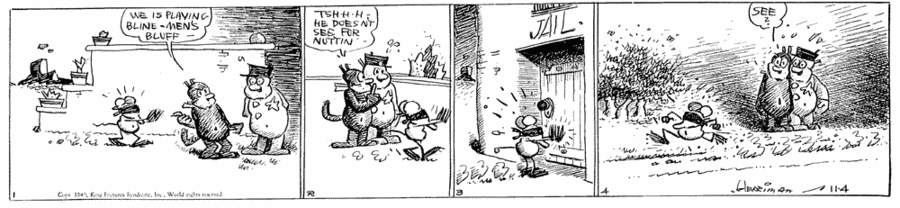
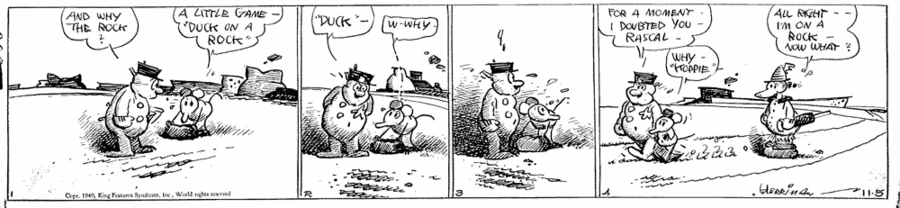
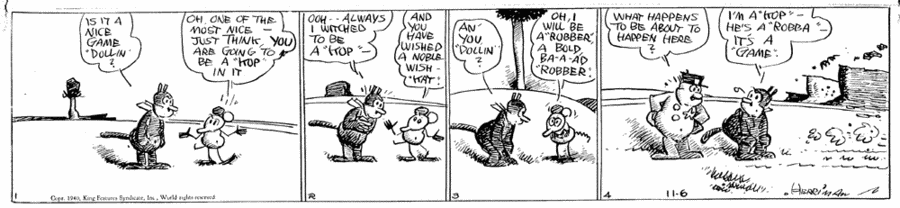
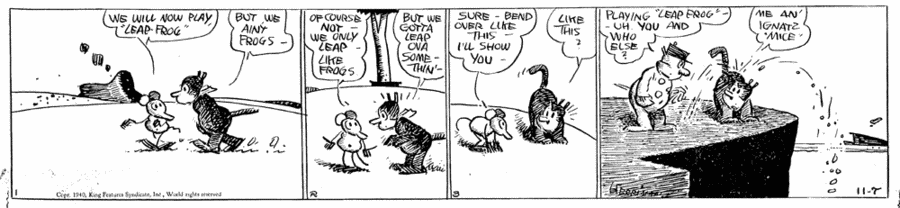
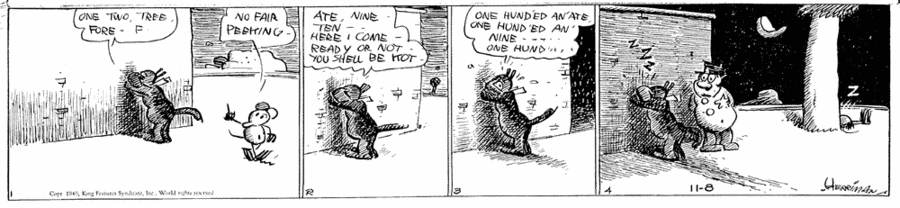
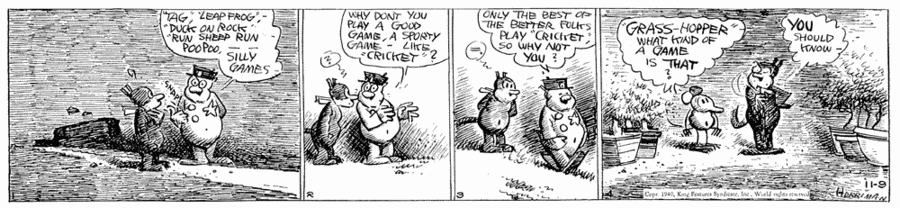
In Krazy this week, 11-4 to 11-9-1940, the Coconino cast play games, including such obscure ones as a medieval child’s game called “Duck On A Rock”, see the 11-5. Mrs. Kwak-Wakk takes the “Drake” position on top of the “Duck” rock. They play “blind-man’s bluff” and Krazy cheats a bit at “Hide and Go Seek”. Offissa Pupp may have a bit of English Bulldog in him as he suggests they play “Cricket” in the 11-9, which Krazy konfuses with “Grasshopper”.
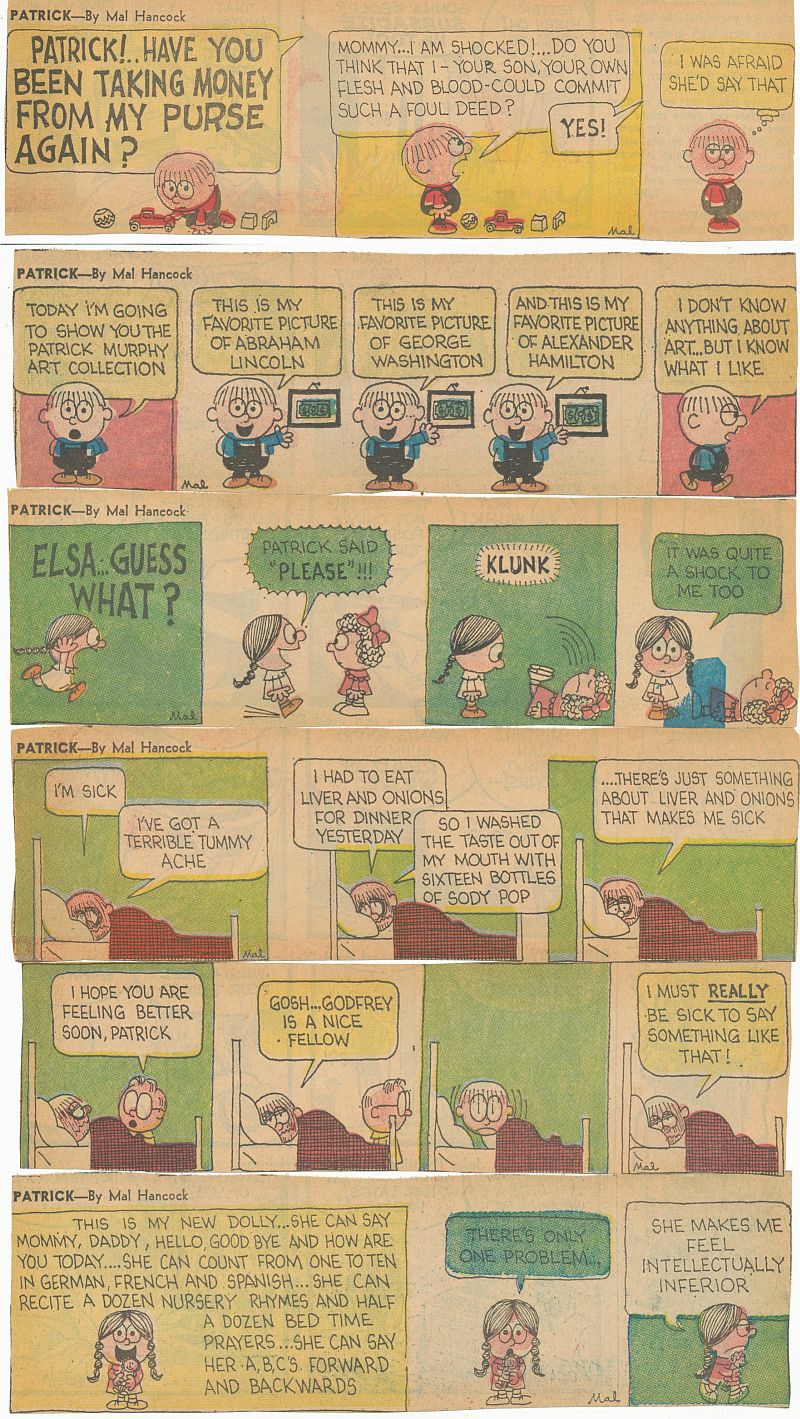
Patrick is from 8-8 to 8-13-1966 this time. My fool computer wouldn’t let me put the 8-13 strip at the bottom, so it’s running at the top! Actually the sequence works well, as Patrick steals money from Mommy’s purse, then has a framed exhibition of his “Portraits of Presidents” in the 8-8. I like the 8-10 and 8-11 as Partick tries to kill the taste of liver and onions with 16 bottles of “sody pop”, then blames his stomach ache on the liver! He’s so sick in the 8-11, he calls Godfrey a “nice fellow”. More from the Post-Dispatch on our next visit. Thanks for the great feed-back I’ve been getting lately. I even have a fan from Germany! Hi Klaus, glad you like Felix. Maybe someday David Gerstein will do a second Felix volume, he’s the King O’ De Cats!
John Sparey on “The Funny Company”, and the end of 1936 Felix
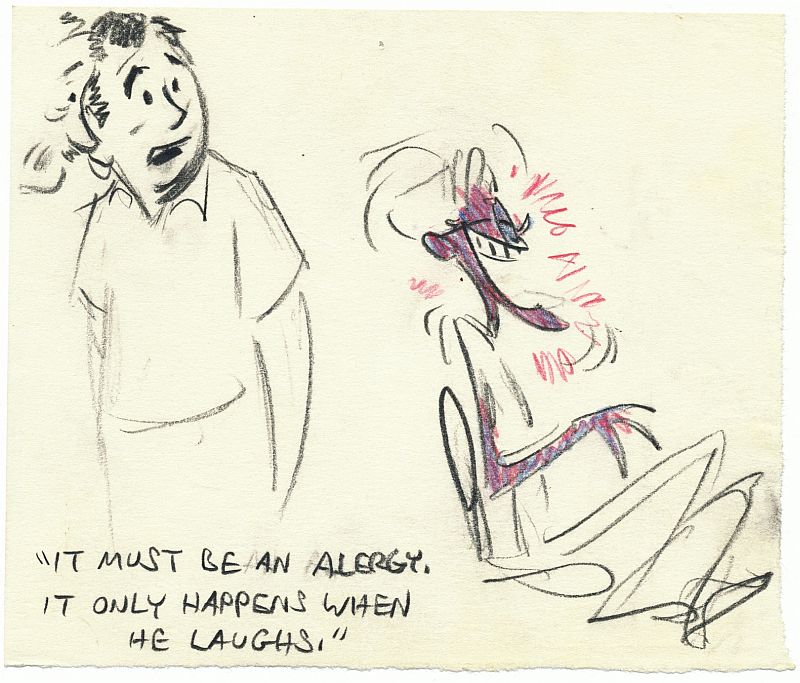
Hi Readers, here is another 1969 John Sparey gag cartoon about my crazy laughter. That’s John and Mike Sanger to the left of the panel. Sometimes I’d get to laughing so hard that I would literally turn purple, and that’s what John is commenting on here. Actually, in laughing that hard, I would feel so embarrassed that I would blush at the same time I laughed. I still have a complex about blushing today, it’s just not “macho”, muchachos! Here is the text of a letter that John wrote to me in 2001. He remembers the heady freelance days of the 1960s when he worked for TV Spots and Sam Nicholson. He gets into some pretty technical talk about camera mechanics, but I feel that those “in the know” will be amused by it, and everybody else skip to the comics! Here it is:
July 9, 2001
Mark,
I generally hole up in my apartment on Sundays to take care of accumulated bills and correspondence (dated for the outgoing mail on Monday). (Mark here: I think that John lived either with his mother or by himself most of his life.) Although Lee Mishkin joined TV Spots (later Creston) during my time there, I cannot recall actually working on any of the same pictures with him. I tend to associate him with the “Fractured Fairy Tales” there, and chances are that he was on “Calvin and the Colonel”. He seemed pleasant enough and I liked his personal cartoon style of the time, but layout and animation tended to maintain separate cliques. As head of layout, Norm Gottfredson seemed to look down on animation as a necessary evil. (Mark here: I think that Norm felt about the same way when I met him at Fred Calvert’s studio in 1968.) But to me, he couldn’t draw a character the same way in two consecutive layouts. I felt that his heritage from his father consisted primarily of his strikingly similar build and the family name. His childish drawing style seemed a precursor to the prevalent styles today. I had little contact with Lee, and since that time have only seen him on rare social occasions.
As for “Linus the Lionhearted”, I don’t know where to start digging to find my TV cartoon references to see where that was animated. At TV Spots, we had the first season of “The King and Odie” (AKA “King Leonardo and His Short Subjects”). Shull Bonsall must have underbid the Mexicans for that one.
After Creston closed, and a year on “The Man From Button Willow”, came a year with Sam Nicholson on “The Funny Company”. He was then located at the animation center on Homewood, south of the Cinerama Dome. Libby Simon’s mother was a partner in a cel service in the same building. They worked on “T.F.C.”. Jerry Nevius rented a studio there, and while we were there, he hired Bill Littlejohn to work with him on the first Tiger Paws commercial. But then Bill got all the following Tiger Paws spots. And Chuck Jones set up there before moving to Tower 12. (But that must have been a later time.) Bob Bemiller and I rented space there to work on “Funny Co.”. He provided the desks. That was my only job on which I could deduct business expenses. We were the entire animation staff, working on separate episodes. I never saw who did storyboards or layouts. (I’m not sure we had layouts.) Dave Hoffman worked in Sam’s office doing animation checking. I don’t recall who did backgrounds.
The show had less than a shoestring budget. In one shot, I had Belli Lagoona (Mark here: Belli Lagoona was the Bela Lugosi type villain of the series.) peering out from behind a pier piling. I gave him two dialogue positions with one inbetween. When we saw it on screen, Belli did an odd hop between lines. The man from Mattel (which bartered the show) turned quizzically and almost asked something. But he held his tongue. The scene aired that way. I tracked down the cels and drawings and found that it (the inbetween) was inked with the drawing resting against the pegs and then was registered to the B.G. (Mark here: In other words, the drawing was not on the pegs when it was inked.)
In another episode, a British chap had a held body and separate head positions. To avoid bad registrations, the head was exposed on a level below the body, with the neck painted generously below the collar line. So it was shot with the head on top of the body and the flesh color slopping down over the shirt. I was glad it wasn’t one of my shows. It aired that way.
I had another shot of Belli screaming as the plane he was flying headed right at camera. Limited to a 12F setup, and with no copier or enlargement facilities, I used a center to center truck from a 12F to a 4F, one field at a time. Then enlarging what would have been a 3F–using the squares method of enlargement—and trucking from 12F to 4F in half as many frames as before, then enlarging the 2F and trucking in about 2 frames. Then I had to go onto ones until the screen was the black of Belli’s mouth interior. It was hardly the world’s smoothest continuing truck, but it matched the product.
I don’t see myself enjoying the Smokehouse packed mostly with strangers, but thanks for asking. (I think I tried to invite John to lunch at The Smoke House, a North Hollywood eatery on Caheunga Blvd., but can’t remember why.)
Turning out a 3 minute animated film in this day and age seems a rather masochistic project. Who gets to see it? But if “It’s ‘The Cat’” is ever released for the public, please let me know. I can’t see it on the Internet, I don’t have room for a computer.
John S.
I think it’s rather funny that John thought I was a masochist for making “It’s ‘The Cat'”, maybe he was right! The second short still has not gone before the cameras as yet, but ol’ masochistic me still lives in hope that it will happen soon!

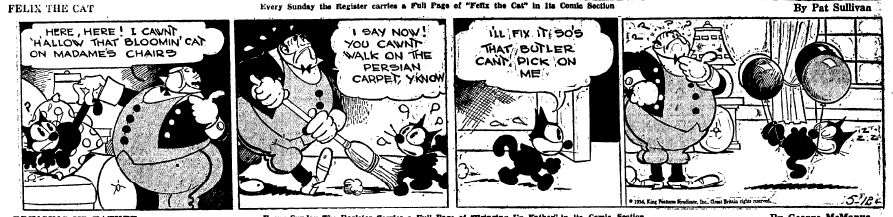
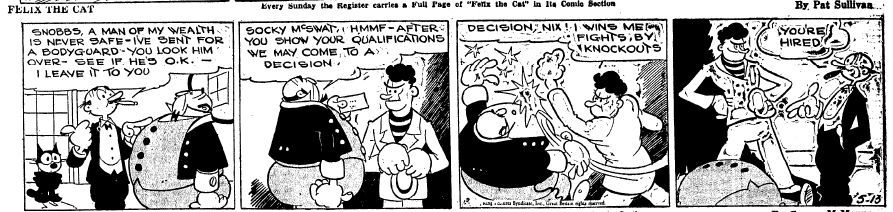
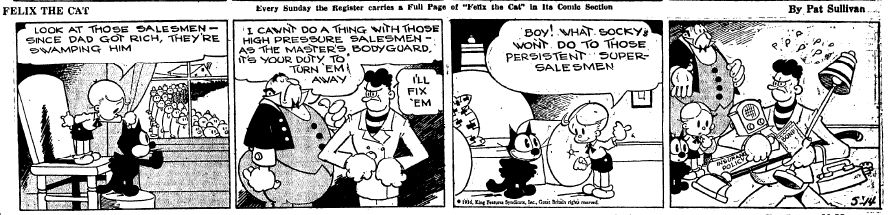
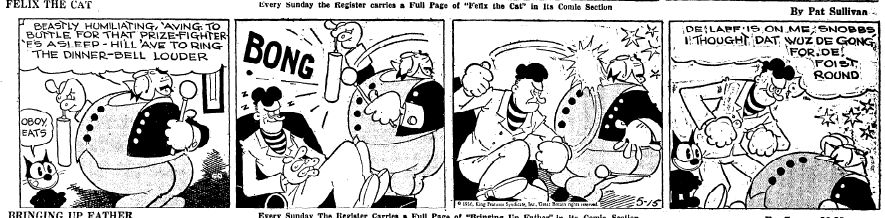
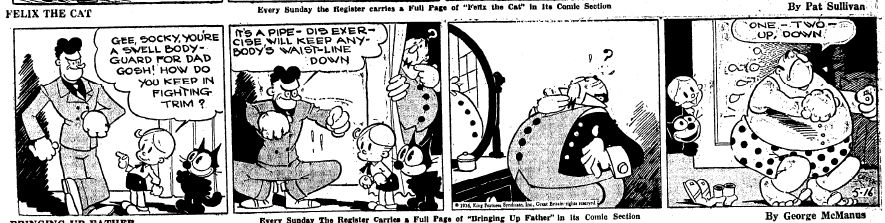


Felix is from 5-11 to 5-17-1936 this time with a copy of the daily for 5-20 thrown in. Snobbs the butler comes to the fore as Felix’s menace this week. Socky McSwat, the bodyguard appears for the first time in the 5-13, and keeps beating up Snobbs. The Sunday, has Snobbs believing that Felix is a jinx, then loving him after Felix causes Snobbs to lose ten pounds. Unfortunately, I still haven’t found the Felix dailies for 5-18 and 5-19-1936. If I find them, or one of my readers could send them to me, I would be very grateful. If you now go to the post for August 15th, 2009, you may read the entire Felix year of 1936 minus the two dailies. Next time, we will still have Felix with us, but from a different year.
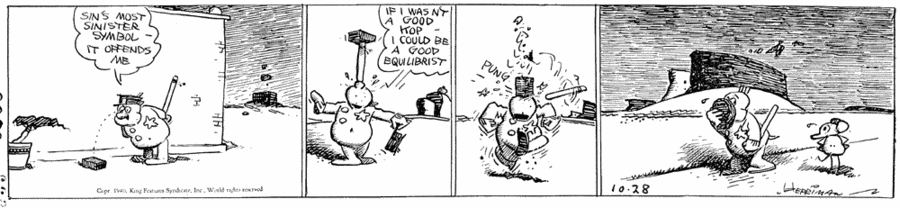
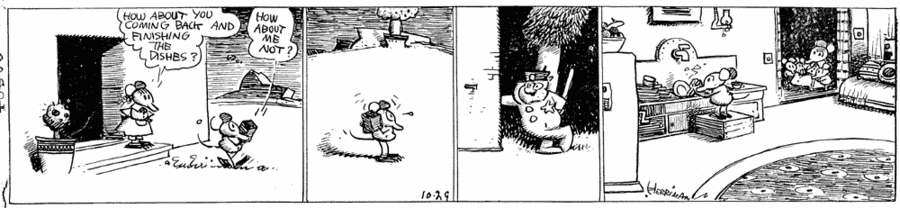
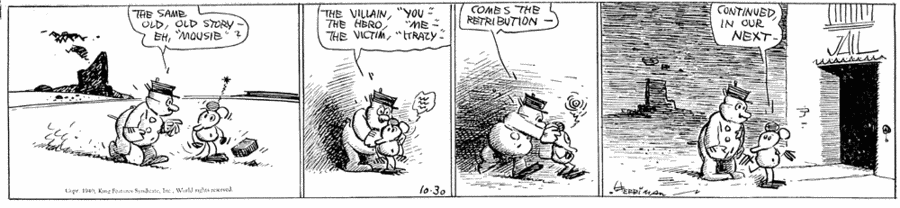
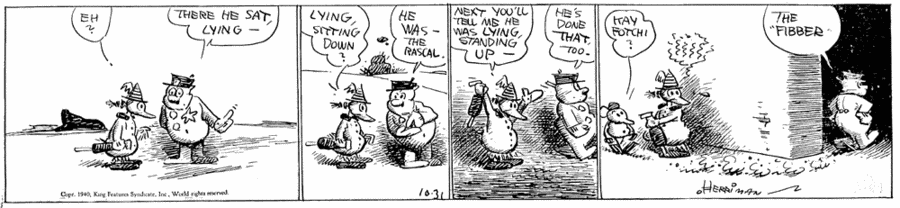
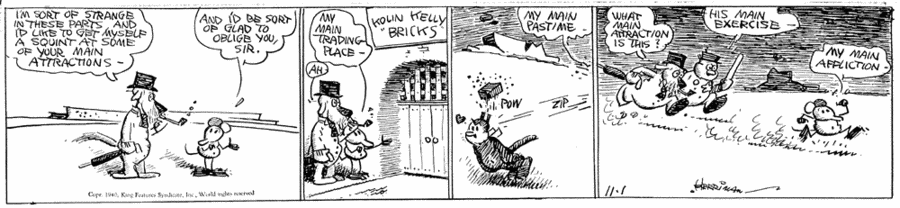
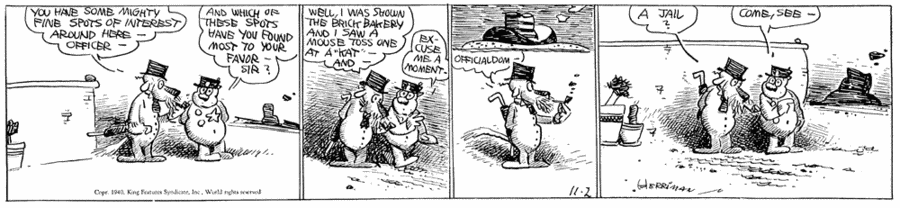
Krazy is from 10-28 to 11-2-1940 this time. Bricks and Jails take a big part of the gags, and a tourist drops in on 11-1 and gets the grand Coconino tour from Ignatz and Offissa Pupp. I wonder if any enterprising souls ever considered building a real adobe “Jail” near the Navajo Tribal Park in Monument Valley, with Herriman artifacts inside? Garge fans from all over the world would come there, I betcha. By the way, what does Ignatz mean by “Kay Fotchi” in the 10-31?

Patrick is from 8-1 to 8-6-1966 this time. My favorite gag is the 8-3, as Godfrey explains to Elsa why he remains Patrick’s friend, even though Patrick is abusive. This kind of gag shows that Patrick’s mystique is growing, he is a potent character even when offstage. The last strip remember is from August 6th, exposing the depth of Patrick’s greed. More of Patrick from the St. Louis Post-Dispatch next time.
Sparey on Iwerks, John’s Letters Continue
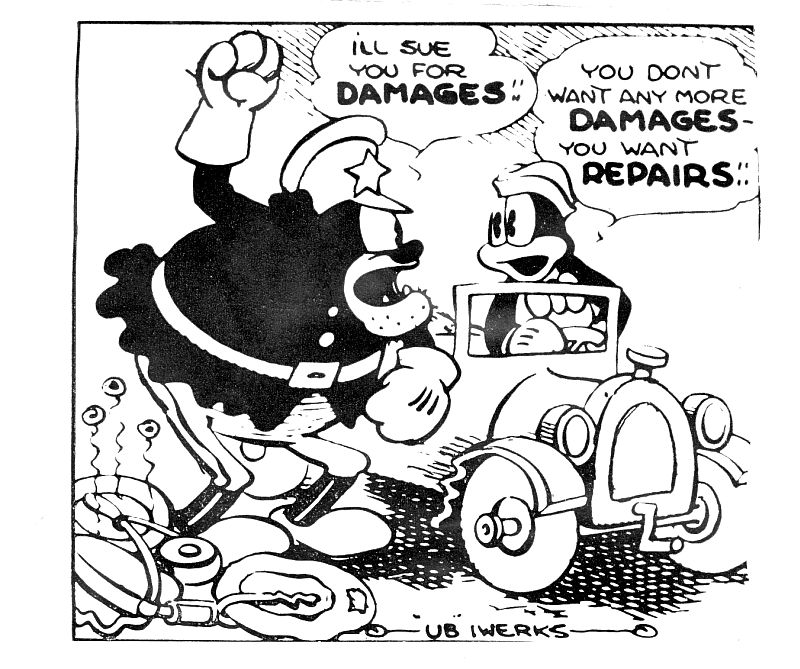
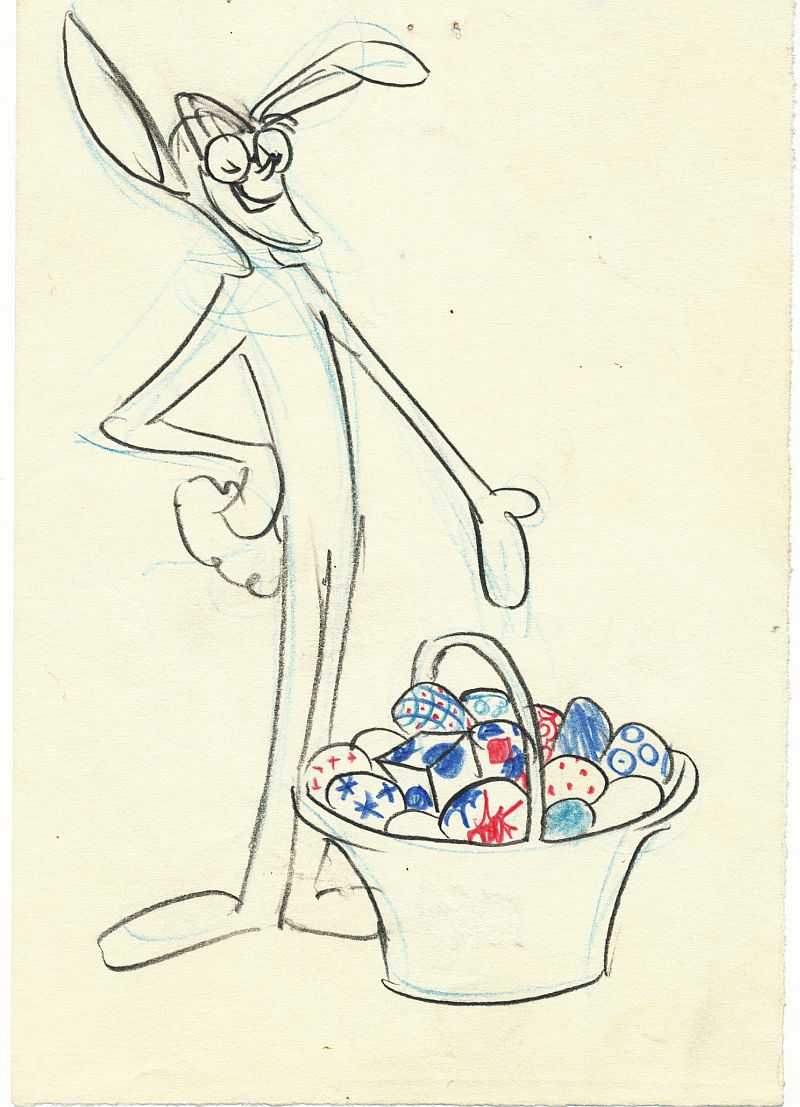
Hi Readers! I’m printing John Sparey’s letter from 1999 reacting to Leslie Iwerk’s documentary, “The Hand Behind the Mouse”. I was a part of the film, Leslie interviewed me at my desk at home, answering questions about Ub. I was known as a big fan of Ub’s animation and his cartoons, such as Flip the Frog and Willie Whopper. I got to meet Ub at the Burbank studio in 1962. I found myself riding in an elevator with him at the Animation Building. I told him I really admired his work and enjoyed Flip and Willie. His reply: “We don’t talk about that stuff here.” That closed the conversation. Above, you will see the only panel I’ve ever found from a Flip the Frog comic strip or comic panel. It came from an old photography magazine. Ub definitely drew it, that’s also his lettering, compare it with the early Mickey Mouse strips he did. Does anyone have any further information on the Flip strip? David? Cole? The little drawing near the Iwerks is a caricature that John Sparey drew of me, once again sending up my cackling laughter. I thought this one would be appropriate for Easter, it shows me as a bunny with a bunch of colored eggs that I “laid”, see the post from last month for more info. Here’s John’s letter:
Oct. 11, 1999
Mark,
I was one of five people at the first Friday showing of “The Hand Behind The Mouse”. I realize that you were not involved in the making of the film, but I wish to comment on some aspects of it, and I don’t know those other people.
I was a bit bemused by the direct link between the scandals of Fatty Arbuckle (1921) and Wallace Reid (1923) and the frocking of cow udders (1933).
I had known that Ub’s first name had been Ubbe, but I was interested to note that although his screen name on those first mouse cartoons was Ub, in Roy’s 1930 letter to Walt advising him of Ub’s departure, he still used the name Ubbe. But an early cartoon from Kansas City had the combined name “IwwerksDisney”, with a double W. That shot was reprised later in the film. But I had not recorded the name on his Father’s patent papers, shown earlier, for comparison of the family name.
Certain time lines were unraveled and regrouped for what would seem like clearer continuity. Mickey’s career was followed well into the thirties before leaping back to Ub’s leaving. And his return to the studio in 1940 would have been before Walt’s involvement in the war effort. His development of traveling mattes was followed through to the end before backtracking to his Xerox work, which was presented as if in full bloom with 101 Dalmatians.
I apologize for repeating any of the following info that you may already know. The first use of Xerox in animation that I was aware of was on animation of Maleficent, for which roughs no more than 11/2″ tall were blown up for cleanup and then reduced to the original size for inking onto cels. Your were probably glued to the TV set when “The Art of Animation” was presented on Disneyland. For one segment, a garbage can quartet was Xeroxed on cels to simulate a pencil test. (Mark here: John is referring to the Disneyland show “Adventures in Fantasy” #5708, 1957). According to Ed Solomon,the animation had to be reworked about three times before Walt was satisfied that it looked rough enough for a pencil test. (As opposed to an earlier segment for which the Soup Eating sequence from Snow White was cleaned up to be shot as an actual pencil test. Yes!! I did cleanup on the seven dwarfs!) (Mark: This show was “The Plausible Impossible” #5644, 1956.) I left the studio in 1958 after completing my dragon chores. The first Xeroxed animation to reach the big screen was in “Goliath II”, in which some construction lines were left in the finished product. Then came 101, etc. I must admit that I have not seen the bulk of Ub’s work. I had never seen such a lengthy segment of “The Skeleton Dance”. And I was surprised to note that the music I had always assumed was in “Skeleton Dance” was actually in “Hell’s Bells”. (Note: Grieg’s “March of the Dwarfs”.) I can’t figure out exactly where the cow dragging its udder behind a screen and coming out wearing a skirt fits into the scheme of thing. (Note: This scene was in “The Shindig” 1930, before the Hays code was enforced rigidly.) While the Hays office was planning to lower the boom? Surely not after.And was God actually lifting his middle finger to the top of the screen? Or was I reading more into the shot than was actually there? (Note: This scene was used in the Willie Whopper cartoons “The Air Race” and “Spite Flight”, 1933. It was actually supposed to be St. Peter, a diabolical pun, when you realize St. Pete was flipping off the aviators because they wouldn’t offer him a ride.)Eric Cleworth told an anecdote of watching Flip the Frog on early TV with his daughter. Flip was skipping from stall to stall of a barn with a couple of milk pails. Each time he disappeared, there was the sound of squirting milk. When he went into the last stall, there was a loud bellow, Flip came flying out, and a bull stuck his head out, saying “That Hurt!” Eric’s daughter had to ask him what he was laughing at. (Note: This scene is from “The Milkman”, a Flip cartoon, 1932.)It was 1963 before Robert Mitchum tried milking a bull in “What a Way to Go!”Should Ub Iwerks be considered the Kricfalusi of his day?John S.And what is that animation desk you are sitting at? It seems like one I saw in a museum once. (Note: Leslie Iwerks shot the interview with me sitting at my old Disney Inbetweeners desk. I’m surprised John didn’t recognize it, as they were in use when he worked at the Burbank lot.)
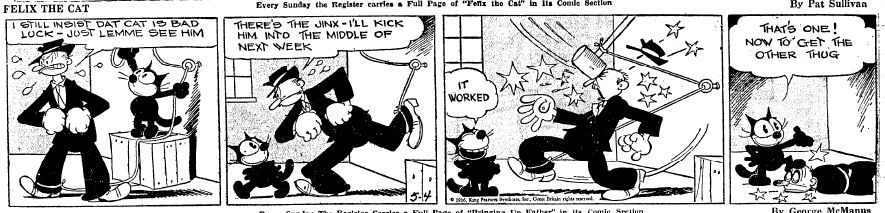

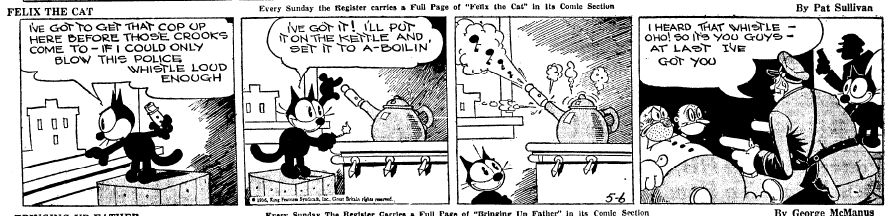
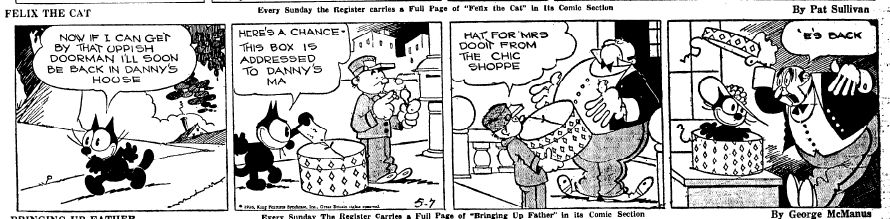


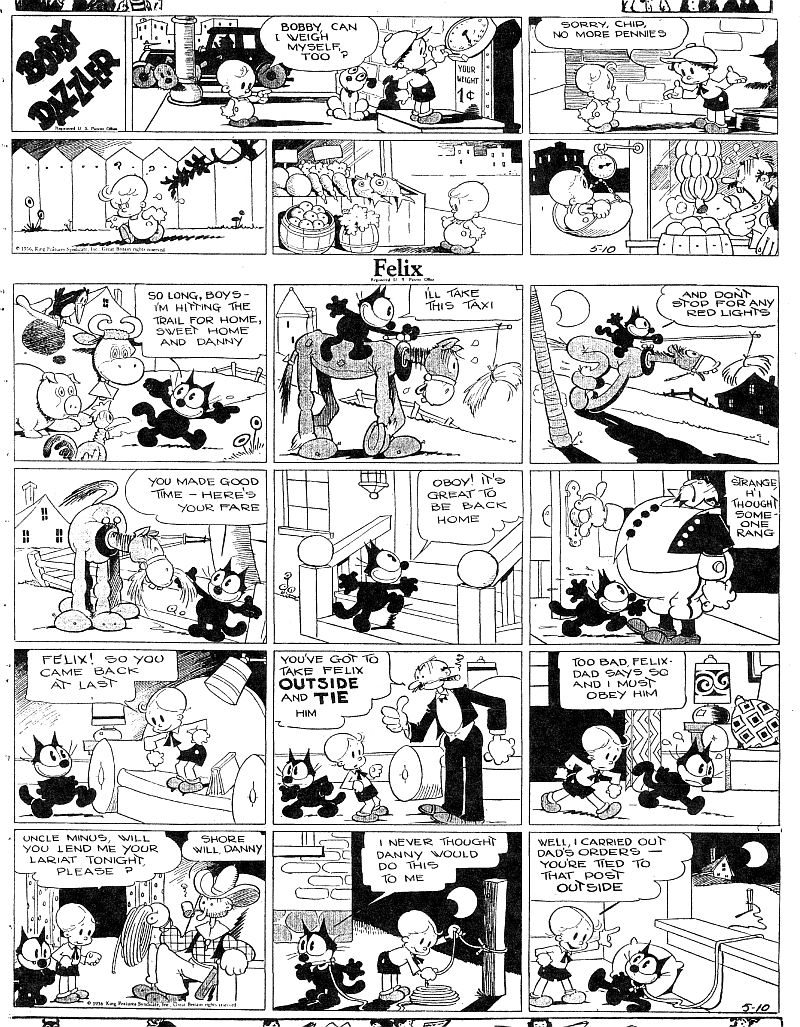
Felix is from 5/4 to 5/10/1936. Felix literally “blows the whistle” on the kidnappers and returns home to Danny. He gets by Snobbs the butler in a hat box and soon encounters the new family pet, a bulldog! Danny points out in the 5/8, that Felix “brought Dad his millions..” How nice that Danny remembered that! In the Sunday, the storylines more or less tie together, as Felix returns to the Dooit household by way of the Professor’s farm. The poor little cat is immediately tied up in the backyard as a welcome home present!
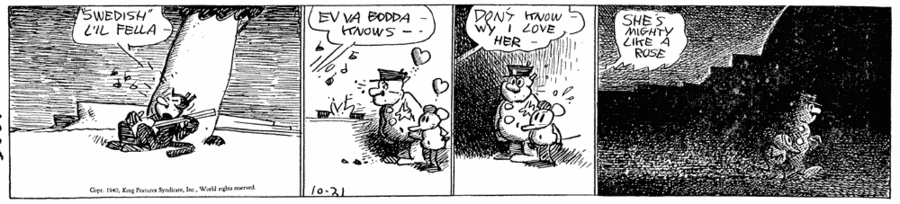
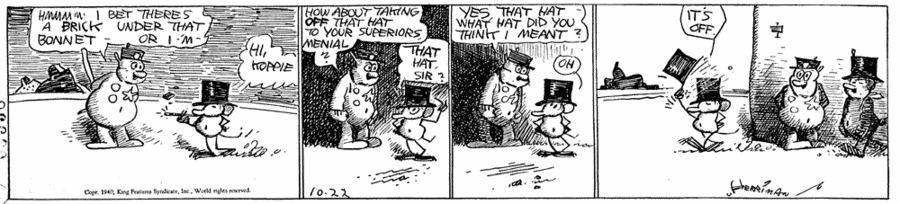
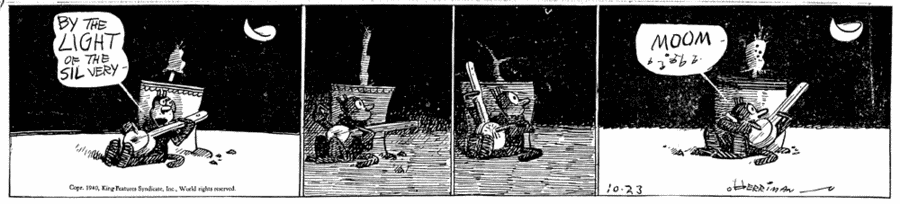

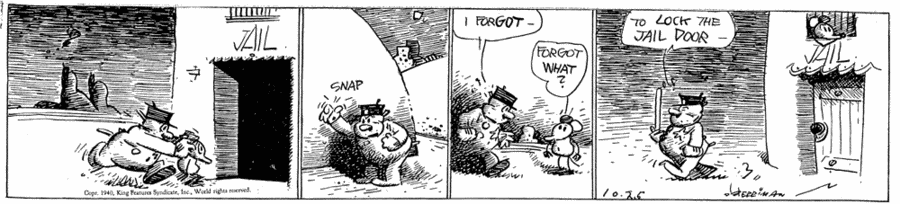

Krazy is from 10/21 to 10/26/1940. The peculiar humor continues as in the 10/21, where Krazy switches the gender of the love interest in “Mighty Like A Rose” midstream, disappointing BOTH Offissa Pupp and Ignatz. I didn’t know Ignatz felt that way about Krazy. The 10/23 has Krazy waiting for the moon to turn on again as he sings “By the Light of the Silvery Moom”. In the 10/24, Krazy has a “hife” full of “B’s”, and they are “rilly” the letter “B”s.
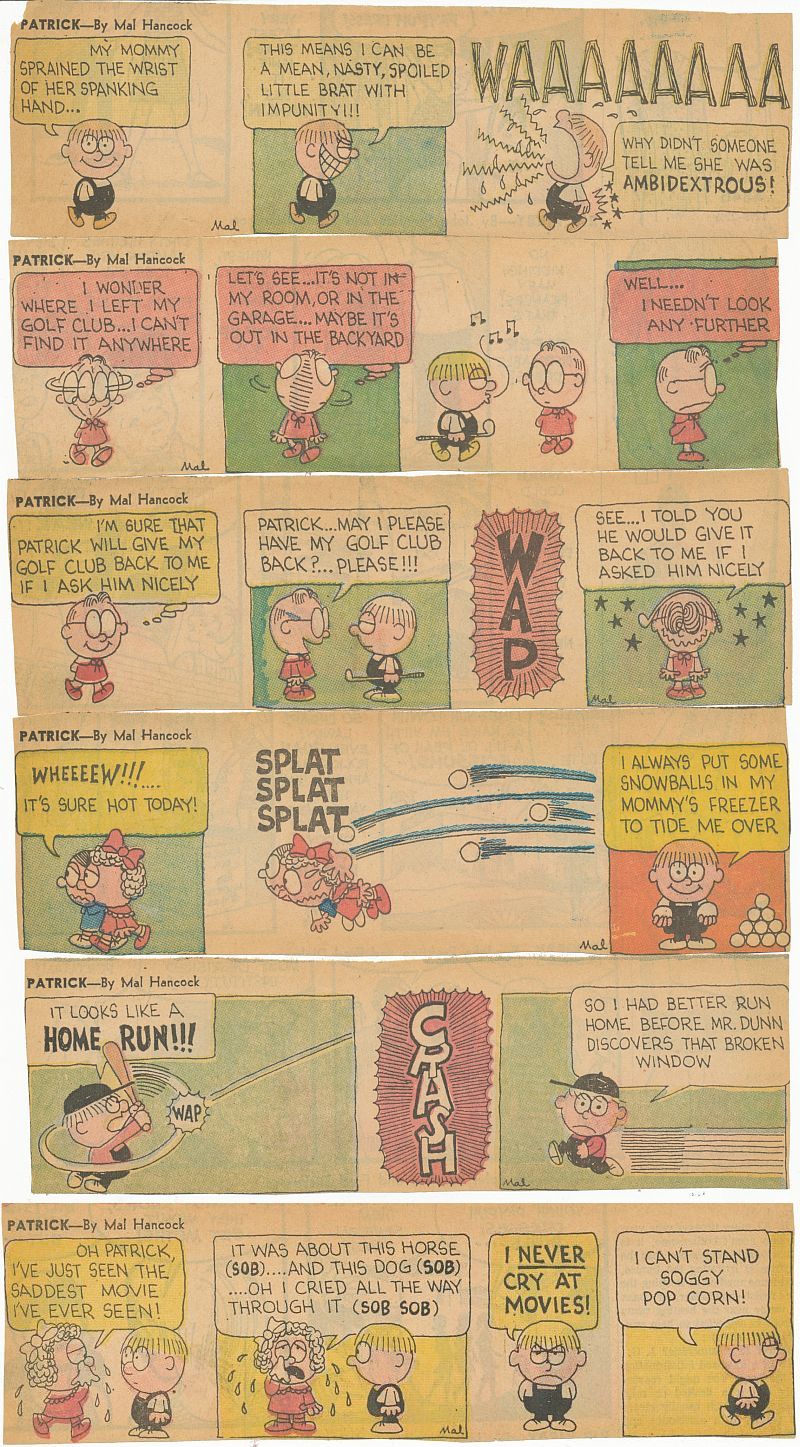
Patrick is from 7/25 to 7/30/1966. He waps Godfrey over the head with Godfrey’s golf club, smashes Mr. Dunn’s window with a baseball, and never cries at movies. Patrick is the central focus of the gags this week. In the next post or two, Felix will have come full circle to 5/20/1936 and will complete our reprint of the year 1936. I am short just two dailies, 5/18 and 5/19/1936. Can anyone help me find them? Cole? David? Any other Felix strip collectors out there? See you next time!
John Sparey’s Letters Part Two
Hi Everyone! I’m very pleased with the high quality of response I got to my last post on John Sparey. Thanks to Charles Brubaker, Daryl Boman, Bob Jaques, James Tim Walker, Bruce Woodside, Scott O., Keith Scott, Bronnie Barry and David Nethery, the comments were really good! Bruce Woodside had the most meaty essay, refer back to the comments on the last post to read it.
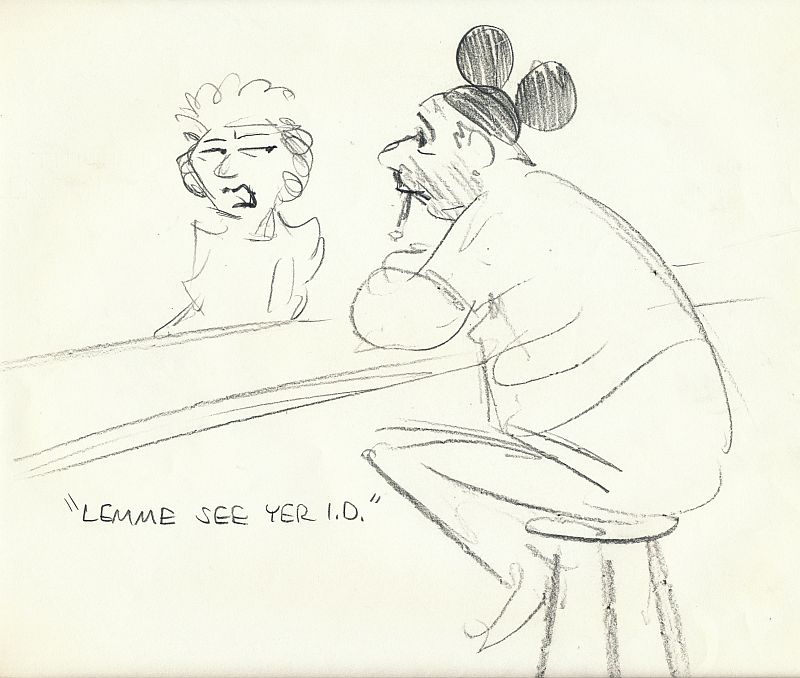
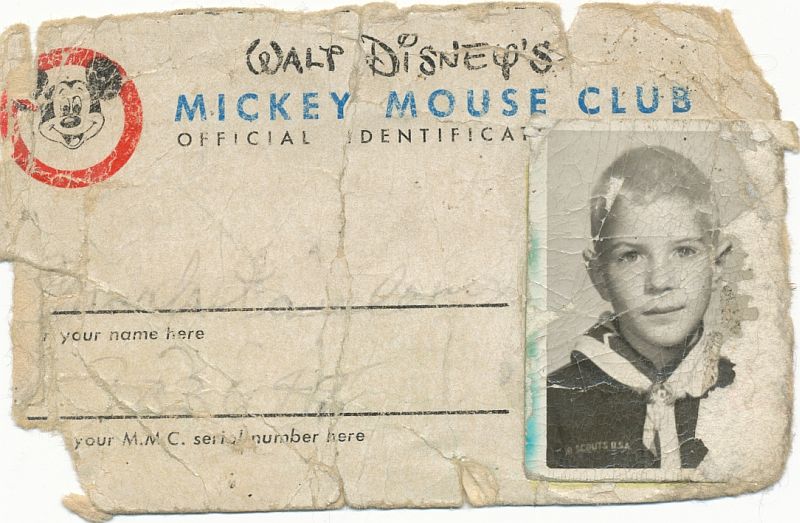
The cartoon above was drawn by John Sparey in response to an embarrassing incident that happened to me on my 21st birthday, that summer of 1969. Mike Sanger and I went to a local bar at lunch to get my first legal drink to celebrate. I didn’t have a driver’s license yet, since I didn’t know how to drive and didn’t learn until 1970. When the barkeep asked to see some photo ID, the only card I had to show was my Mickey Mouse Club card which I got in 1955 (picture above). I flashed the card, and the next thing I knew, I was out on the pavement. Of course, Sanger got a tremendous laugh out of it, and when we got back to the studio, made sure everybody knew what an ass I’d made out of myself. As I recall, John didn’t react at all, but an hour or so later, presented me with the cartoon above. I wonder if John ever tried to crack the humor magazine market, he really had a talent for the one-liner gag cartoon.
In this letter he wrote in 2004, John talks about his final job in animation, his retirement, and then proceeds to critique the last 6 or 7 Disney “flat”, as he called them, animated features. John could be quite an acid critic, and I can still hear his tone of voice as I re-read his letters. He always sounded almost unemotional, yet sophisticated, as if wearing an invisible lorgnette on his nose, with his head held high, looking down at you. Remember, none of the opinions expressed are mine, nor necessarily of this blog, but Mr. Sparey’s alone: (By the way, Bruce, John mentions you in this letter.)
April 7, 2004
Mark,
I saw the L.A. Times article in which they firmly planted their tombstone on the history of flat animation, but I waited to see “Home On The Range” before making any kind of response. When Bill Schultz, at Film Roman, put me on a “call when needed” status, (like never) I mentally summed up my M.P. retirement benefits, social security, IRA and 401K savings (yes, Film Roman had a 401K plan) and began retirement wheels rolling. However, the Union put me on their “available” list. I got one phone call from a company I had never heard of. And they had never heard of me. They asked me to bring in my portfolio. Portfolio?!! My last portfolio when I started at Disney was a scrapbook of my college cartoons. The rubber cement holding them in place had dried up decades ago. Most of my jobs since then linked from one to another. Our conversation was brief.
I got another call from Richard Rich (Nest Anim.). On the recommendation of Bakshi alumni such as Steve Gordon and Bruce Woodside, I was asked to help finish “The Swan Princess”. So my last three months of work were on the board, rather than telling others how to do it. June 30 will be the tenth anniversary of my final work day. “Swan Princess” had seemed like a worthy contender, but Disney took care of that by reissuing “The Lion King” on its opening day. Sadly, although the first two sequels escaped briefly into a few theaters, neither came up to TV standards. A few years later, Rich came out with another disappointing feature (which I forget) made in partnership with another company (which I forget). This was followed by the preschooler parody of “The King and I”, in partnership with Rankin and Bass.
Incidentally, for all I know, “Swan Princess” may have been the last animated feature to have all of its animation completed in the L.A. area. The crew included people from every decade of my career, dating back to Gordon Bellamy and Sheila Brown from the Disney fifties.
From my Bakshi days, I have though of Rankin and Bass as “Rank and Base”. When “The Hobbit” turned up on TV while “Lord of the Rings” was still in production, Ralph found the precise Arthur Rackham illustration that they had used for their ugly Bilbo model. (Where is Paul Coker when you need him?)
But enough about me.
It was good to learn from the article that some of the “good guys” such as Floyd Norman and Tom Sito, are still in there trying. You probably know the story of how Floyd almost got into the B.G. Dept for “Sleeping Beauty” on the strength of one painting—until somebody got a look at him.
I made a point of seeing “Destino” during its brief December release. If the final rendition was anything like the original concept, I think that Walt made the right decision. I noted that its copyright was 2002. When I spent time in the Art Props Dept. at Disney between features, I came across photostats of Dali storyboards, but all I remember is the image of ants crawling out of a hand. Yes, that was in the short, but without any Dali look. Overall, the picture looked as if it had been done on several different continents, without much coordination. My primary after image is of figures flitting off into the distance. And of course it contained some of Roy’s required computerized BG movement. But I hope that Roy will still win his duel with Michael Eisner.
If “Home On The Range” is truly the end of the line, at least the genre didn’t go out with a whimper. I thought it was far better than much of the recent crop. I only objected to all those sharp points on the cows’ muzzles. In the crowd of names in the credits, I only managed to snag two onetime co-workers: Dale Baer and Renee Holt. If you don’t know (but you probably do) Renee was once one of Rudy Gernrich’s shaved-head Unisex models. I also spotted a couple of names that could be younger generations: Hester and Aardal.
If I ever have a chance to see “It’s The Cat”, I trust that my reaction will not be as negative as it was to “Destino”. But then I only know your personal style from over thirty years ago.
For me, the last truly satisfactory Disney flat was “Tarzan”, even though each of the lead characters appeared to have been designed for a different project.
Hedda Hopper’s newspaper column once made reference to “Monstro, the Singing Whale from ‘Fantasia’”. Of course, “Fantasia” was whale-free until the invasion of the space whales in “Fantasia 2000”. Incidentally, I find the current United Airline commercials more diverting than the Hirschfeld-influenced “Rhapsody In Blue”, which seemed like an effort. Not knowing your contributions to the feature, I shall refrain from further comment.
Other features? “Treasure Planet” was the “Ishtar” of animation. The grotesque animation was overwhelmed by those massive sailing space ships. “Atlantis: The Lost Empire” was for lovers of mechanical contraptions. “Lilo and Stitch”? Sort of mushy. “Brother Bear” seems hardly worth making—in the spirit of “Spirit”. “Ice Age” was nice. If “The Road To El Dorado” was meant to evoke Hope and Crosby, the corporate choice of voices seems to be disastrous.
Judging from the trailers, “Shrek II” looks like the giant gorilla for the year. The computerized “Garfield” moves his lips. That used to be a Jim Davis No-No.
I thought that “The Triplets of Belville” was Oscar-worthy.
I could go on.
John S.
Sadly, I don’t think John ever got to see “It’s ‘The Cat'”, he probably would have been critical of it, but he liked me, so he would have pulled his punches. I have many more letters that John wrote, mostly describing his retirement adjustments and his ordeal when he passed out in his apartment for several days, unable to call anyone on the telephone for help. We’ll post those as we go along. The response to the last post would indicate that you would like to read the letters, and I’m sure John would have appreciated being recognized.

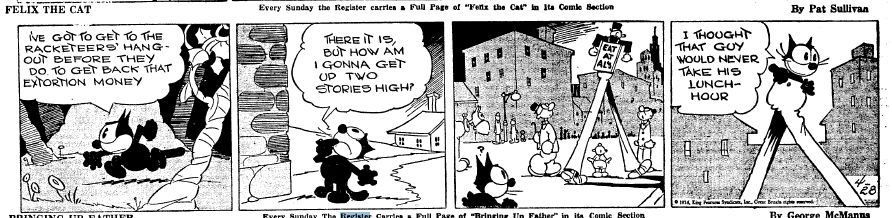
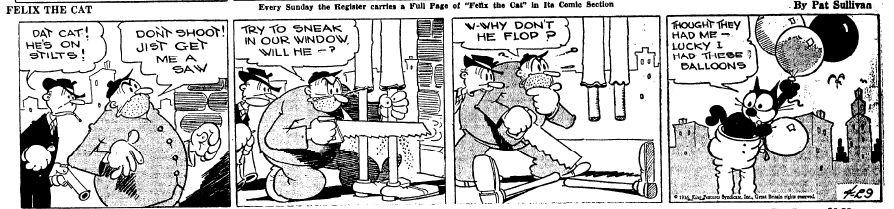
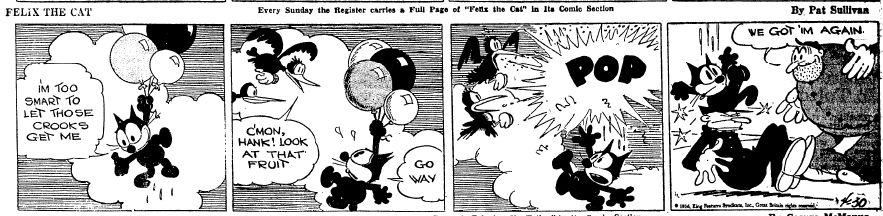
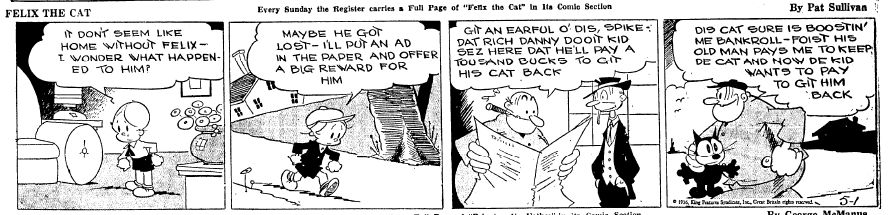
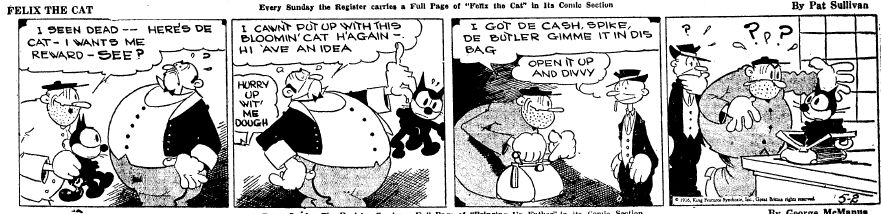
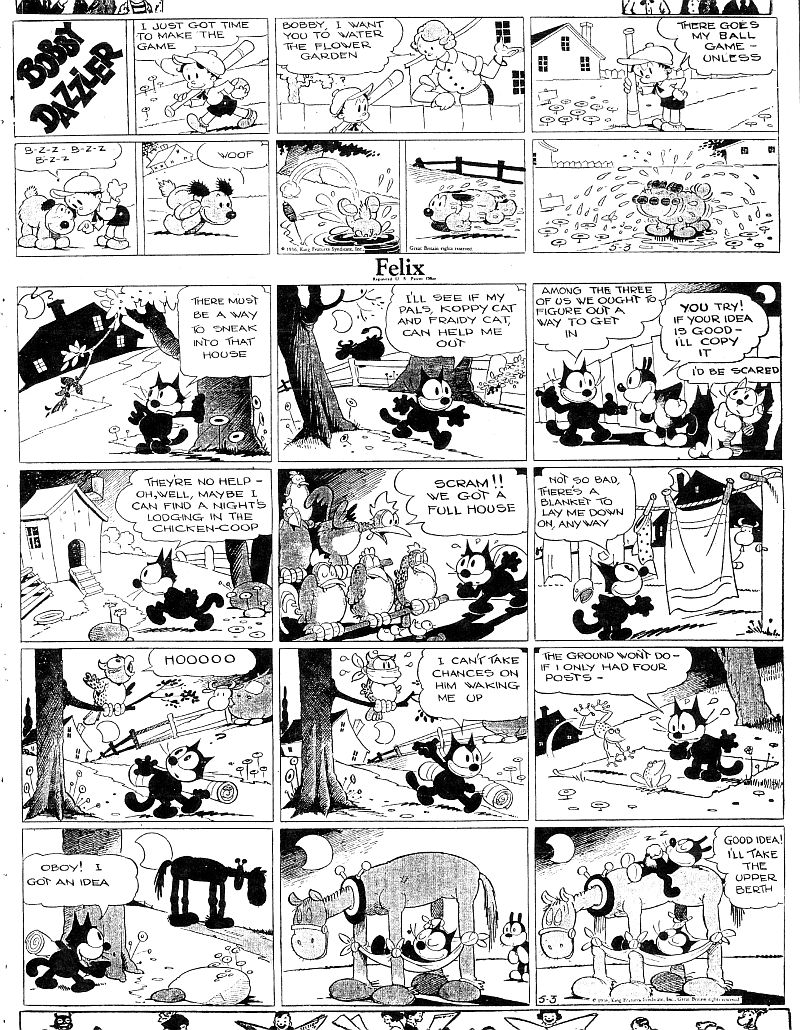
In Felix this time, from 4/27 to 5/3/36, you could call the story line, “the cat came back”. Felix eludes the racketeers several times, with the old reliable tail substitute and balloon escape gags, but winds up back in the racketeers’ clutches, courtesy of Snobbs the butler. Meanwhile, Danny Dooit is frantic, and wants Felix back home. In the Sunday, I love the extra cats that Otto creates here, “Copy Cat”, who is a ringer for Krazy, and “Fraidy Cat”, a cute little white cat. Otto must have liked “Copy Cat”, as he brings him back for an encore in the last panel.
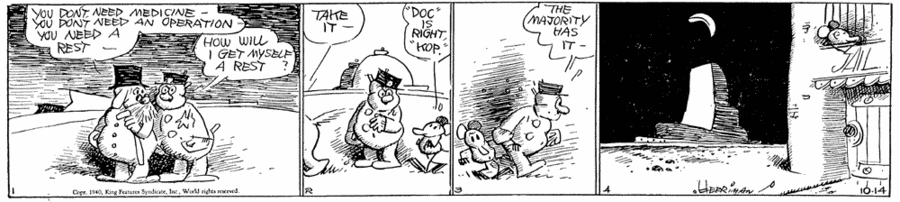
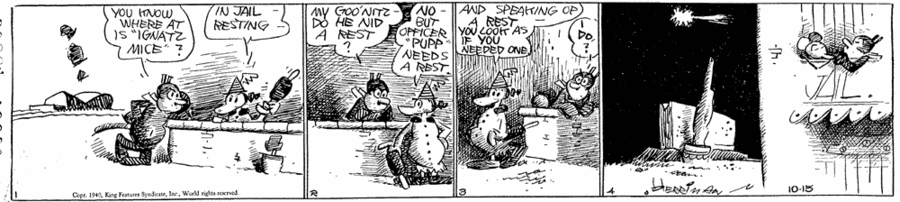
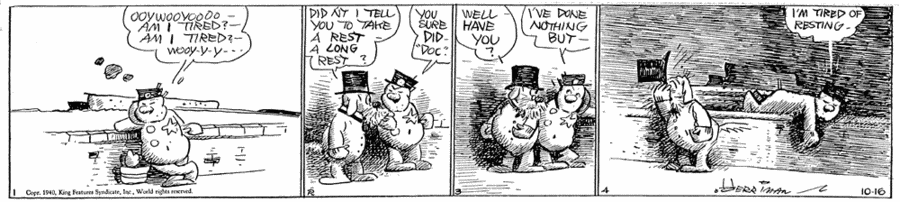
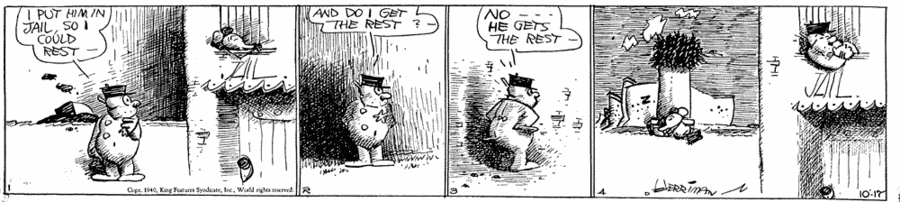
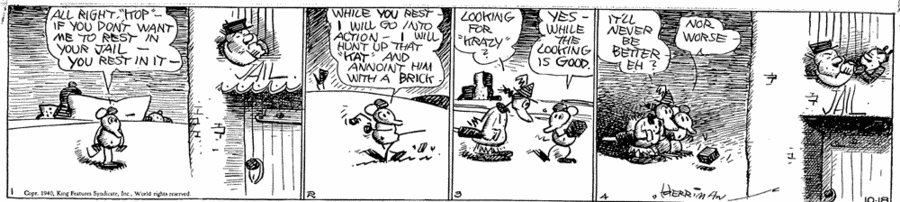
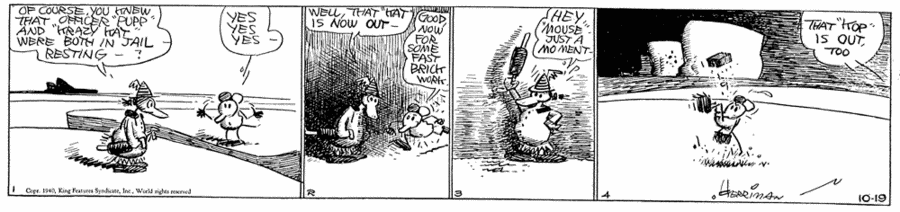
In Krazy, from 10/14 to 10/19/1940, Offissa Pupp is a pooped cop and his doctor prescribes “a rest” for him. Herriman has a field day with the pun, “arrest” and “a rest”, and gets a whole week’s worth of strips out of it. Even Krazy lands in jail.
 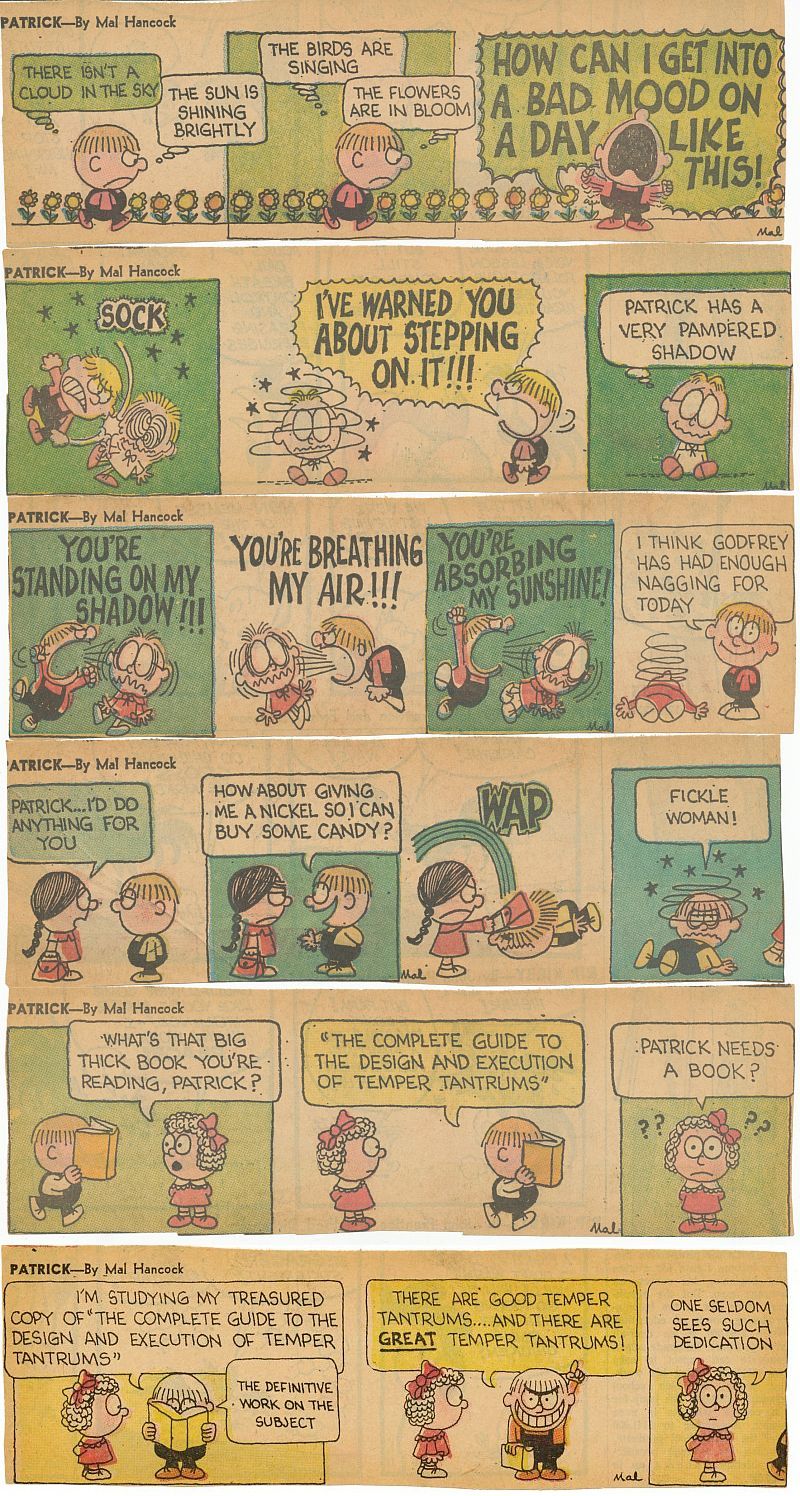
Patrick seems to be channeling his inner Lucy this week, in the strips from 7/18 to 7/23/1966. “You’re Standing on my Shadow!”, etc. seem to be appropriate for Lucy to scream at Charlie Brown, at least the early Lucy. In the 7/23, Elsa’s deadpan remark: “One seldom sees such dedication”, seems to strike a Linus tone. Overall, though, Patrick seems as Mack Sennett to Schulz’s Hal Roach. There is a lot of hitting (WAP), screaming and general mayhem that Schulz used extremely sparingly. More next time, many Patrick strips yet to come. Thanks again, folks, for your great comments, enjoy reading!
A Book Review
September 20, 2011
Uncategorized
1 Comment
Mark
This book is highly recommended for those who don’t have many of the previous Krazy Kat collections. Much of the material in this book is reprinted from Patrick McDonnell’s “Krazy Kat: The Comic Art of George Herriman”, published by Abrams in 1986, and various volumes of “Krazy and Ignatz: The Complete Full Page Comic Strips”, published by Fantagraphics between 2002 and 2010. If you only get one book on Krazy, you could do worse than this one. The only really negative thing I could say about this Craig Yoe/Abrams effort, is that is was printed and bound in CHINA. For a book about an American icon, Krazy Kat, to be printed in China, in these times of few jobs for American citizens, is a crying shame. Surely there are a few companies left in the United States that could do a high quality color printing job on a book like this, much better than Chinese printers can do. With jobs so scarce, the costs should be negotiable. Craig Yoe is a dedicated devotee of old American strip cartoonists, he has also done a fine book on Milt Gross’s comic book work, which was printed in KOREA by IDW publishing in 2009. With a little more digging, I’m sure that Mr. Yoe could have found an American printer for this book as well. I hope he will change his production model in the future, so that I can recommend his books without any reservations.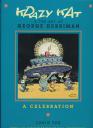
Speaking of KK, let’s look at this week’s batch from 1-13 to 1-18-1941. In the 1/14 strip, you will note a joke similar to the one that Frank Tashlin used in his “Porky’s Spring Planting” animated cartoon in 1938, q.v. “I’m called a watchdog, cause I’m fulla ticks.” In the 1/15, Ignatz is given a very appropriate conveyence to the jailhouse, a hod (for carrying bricks, see “Bringing Up Father” if you don’t know how they are used). There are star gazing gags in the 1/16 and 1/18 strips, and Krazy makes another brick-worthy pun in the 1/17 involving “shell fish”.
Felix is from 3/4 to 3/10/1935 this time. Felix tries to assist the crew in their hunt for the rare Dodo fish, but he is called a jinx by the sailors, then Felix’s catch of a prize Dodo fish is broiled by the Chinese cook. Felix then finds another Dodo fish as he holds his breath for a couple of days undersea! In the Sunday page, Felix continues his adventures in Dreamland, riding on the Nightmare. It turns into a very funny dragon wearing a top hat, and a shark, putting Felix undersea again. Felix is caught by a fisherman who wants to cook the cat for the King. Felix gets out of that situation with two kernels of giant popcorn.
Patrick is from 11-14 to 11-19-1966. Patrick’s crib-bound little brother is named in the 11/14 (“Nathan”, reminds me of Fanny Brice’s hit, “Oy, How I Hate That Fellow, Nathan”) and Patrick and his Mommy are at daggers drawn over his need for a dog. In the 11/19, Partick rips Elsa’s favorite movie magazine to shreds at her birthday party, what a guy! We’ll see y’all next time.