More About John Bohnenberger

Cathy and I are thinking a lot of our late friend, and wonderful artist, John Bohnenberger. Cathy wrote a tribute to him that was in the last post. This time I’m putting up four images of John’s paintings that I found on the Internet that I especially admire. The one upstairs is called “The Fox”, and has to be my favorite Bohnenberger I’ve seen so far. I love the black squiggle he’s used for the little fox at the bottom of the page, and how the small creature seems to be looking out over his purple and yellow pond into the forest beyond. John’s really used complimentary colors well here, and he’s just suggested the forest in the distance by leaving white, pine shaped spaces in the background. Reflections work well in watercolor, and John has used them very appealingly here. I love this painting for it’s color and cartooniness!

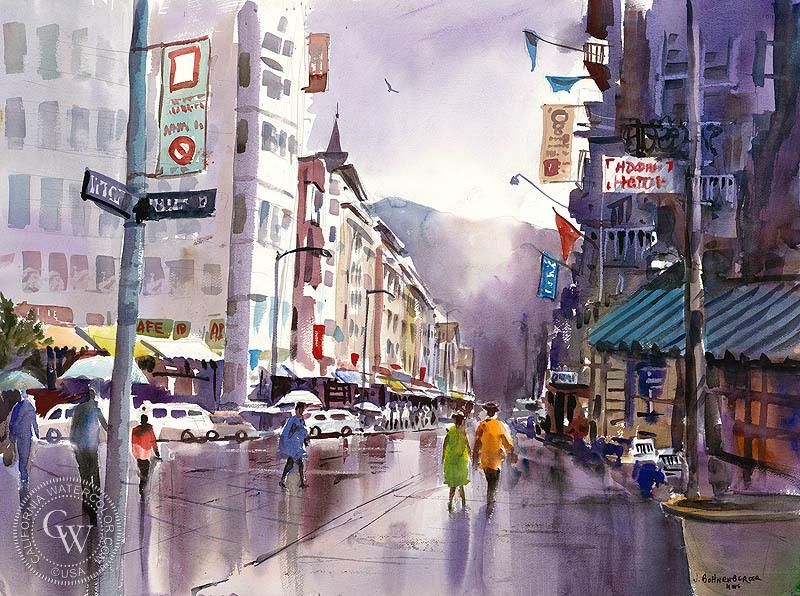  The two paintings here are called “Blue Boy” and “The Intersection”. They show two sides of John’s skill, “Blue Boy” shows his almost photographic style, very realistic handling of the boats with those watercolor reflections dominating the composition. The top half of the picture is loaded with detail, but doesn’t feel heavy. The bottom half is devoted to reflections of the top half, but not a mirror image. John could really do water! “The Intersection” is the more impressionist side of John’s ability. Very loose handling of the people, buildings, umbrellas and sky, coupled with a wet street for those attractive reflections. He’s used little bits of bright color, red accents in the signs and orange in the ponchos, which brighten the whole painting. He’s used violet and subdued colors most everywhere else. This painting suggests a city street without painting every window ledge and headlight.
   Here is another beautiful watercolor that John called, “The Klondike Cafe”. This painting suggests a little harbor in Alaska without an over-excess of mood. The trees in the background are really one big shape with just a few little accent shapes for contrast and the buildings and boats are defined by the shadows and reflections they cast on themselves and on the water. Note how different the reflections are in this painting than in “Blue Boy”. Very simple white shapes with a few white squiggles on the surface of the water. This painting reminds me of watercolors that might have been done by Roger Armstrong (who John knew) and Hardie Gramatky.
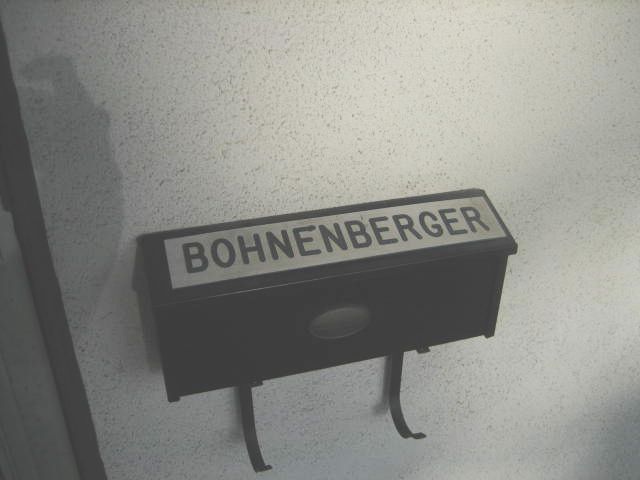
   Here’s a copy of the now “rare” little program printed for John’s eulogy near the retirement community where he lived. John lived to be 86, but always seemed younger than that to us. John, Cathy and I are and were shy people. We don’t like to force ourselves on anybody, and usually keep to ourselves. John didn’t encourage any visitors to his little living space which you can see below from the outside. According to friends, John had no room in his apartment for anyone to sit. It was FILLED floor to ceiling with his paintings. If you visited, you stood until you got tired, then the visit was over. Like visiting Ollie Johnston’s house when he had left it, this same feeling came over me when we saw where John had lived. How I wish we (or I) had just BULLED my way over there and knocked on John’s door. I really wanted to visit his studio. He never invited us (or me) and didn’t encourage visitors, but shucks, this man was very special, and SHOULD have been visited. So, dear, shy and gentle readers, if you admire an artist or want to visit them, just BULL your way in there. Look how short life is, and how little time we have to say “I love your work, how do you do it?” I wish I could have put a little note in John’s mailbox below, saying simply, “John we loved your paintings, and loved you, too.”

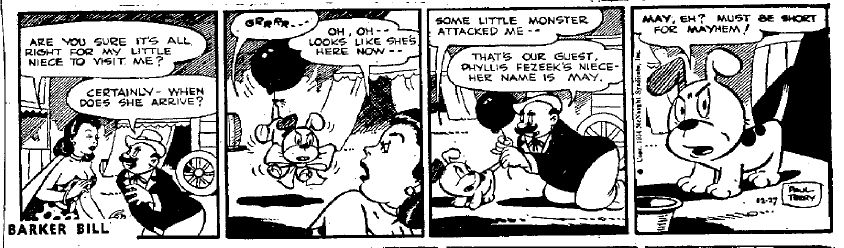
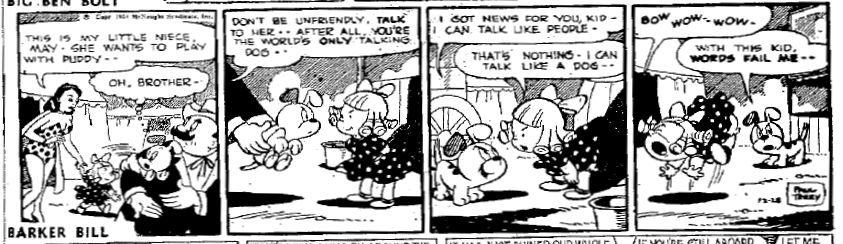
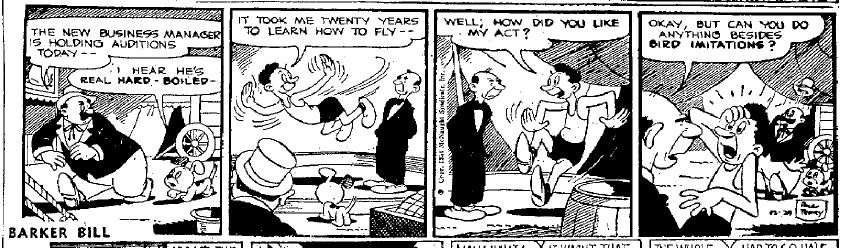


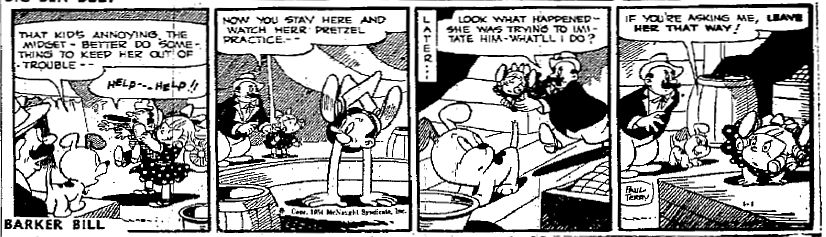
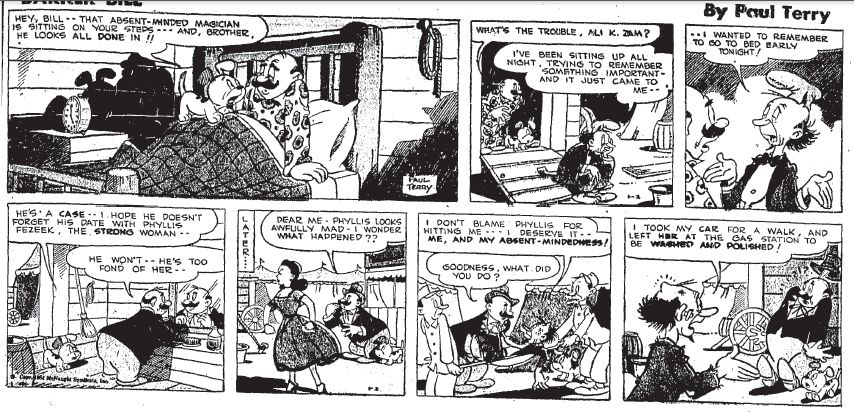
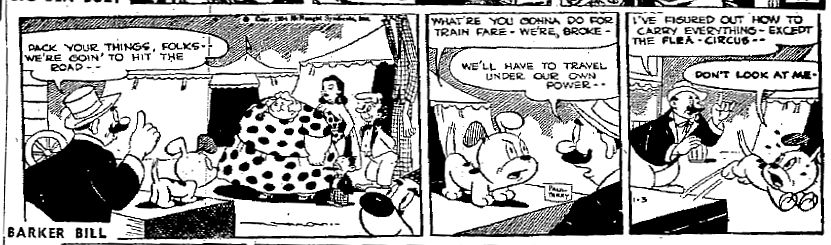
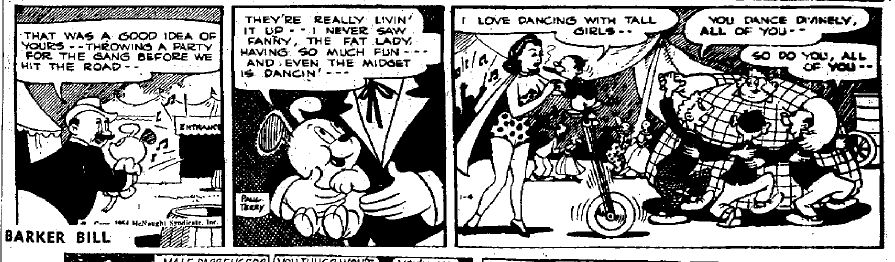

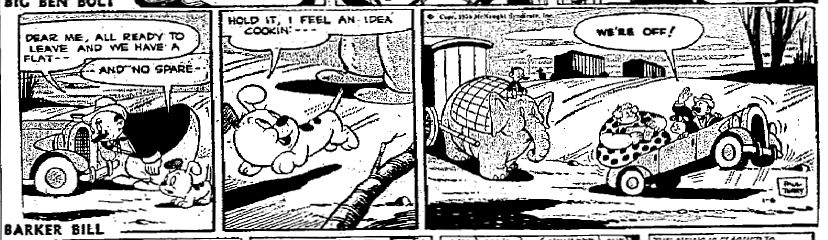
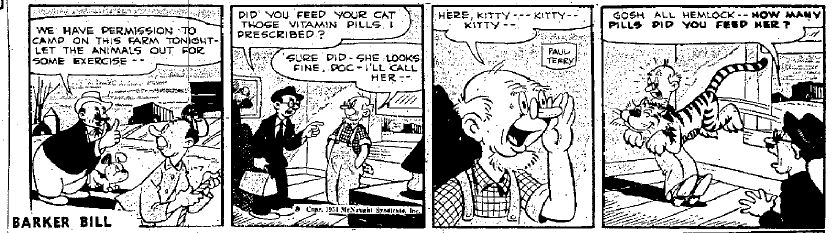
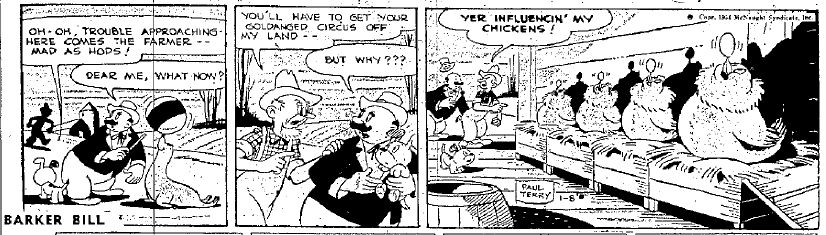
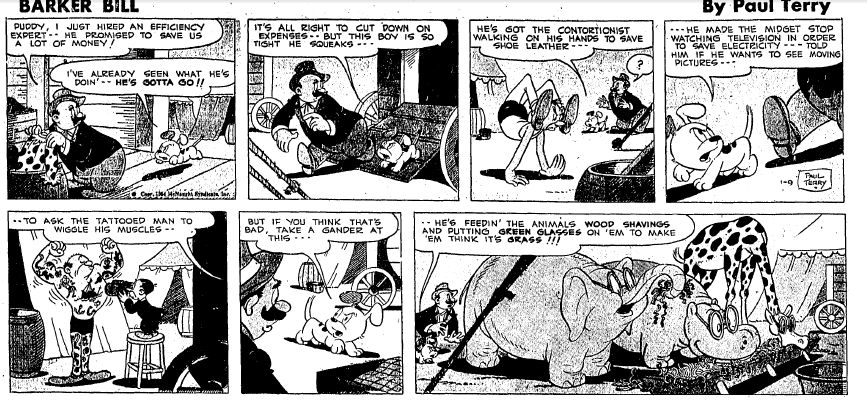 Â In Barker Bill, from 12-27-1954 to 1-9-55, the strong woman, Phyllis Fezeek, invites her niece, May to visit her. May immediately starts playing rough with Puddy, who breaks his rule against speaking to anybody but Bill and talks to May. The circus packs up to go on the road, fat lady, efficiency expert and all. In the Sunday for Jan. 9th, there are a couple of gags that remind me of the song “Lydia the Tattooed Lady” from the Marx Bros. film “At The Circus”, and the final panel reminds me of the RBGH that cows are fed these days. Maybe they give the cows green colored glasses so they can’t see the awful stuff they throw in their troughs.
 In Barker Bill, from 12-27-1954 to 1-9-55, the strong woman, Phyllis Fezeek, invites her niece, May to visit her. May immediately starts playing rough with Puddy, who breaks his rule against speaking to anybody but Bill and talks to May. The circus packs up to go on the road, fat lady, efficiency expert and all. In the Sunday for Jan. 9th, there are a couple of gags that remind me of the song “Lydia the Tattooed Lady” from the Marx Bros. film “At The Circus”, and the final panel reminds me of the RBGH that cows are fed these days. Maybe they give the cows green colored glasses so they can’t see the awful stuff they throw in their troughs.
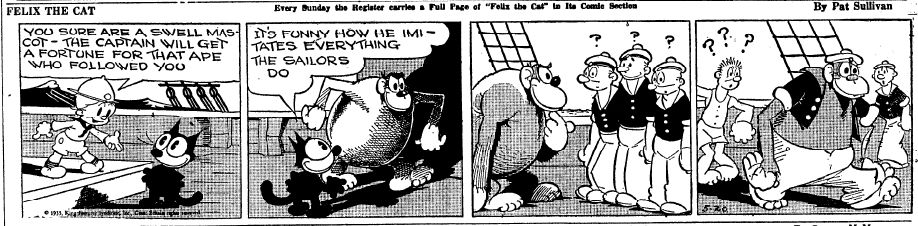
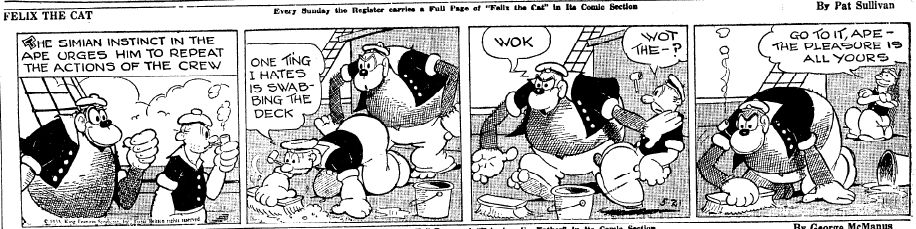
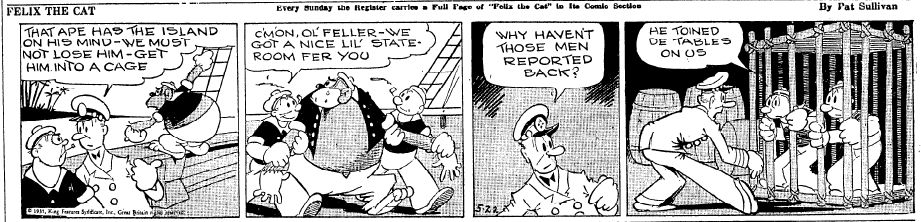
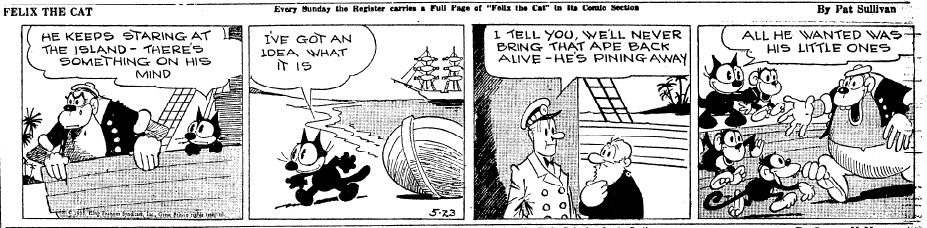
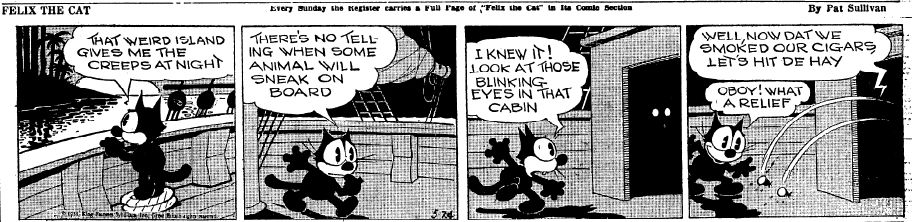
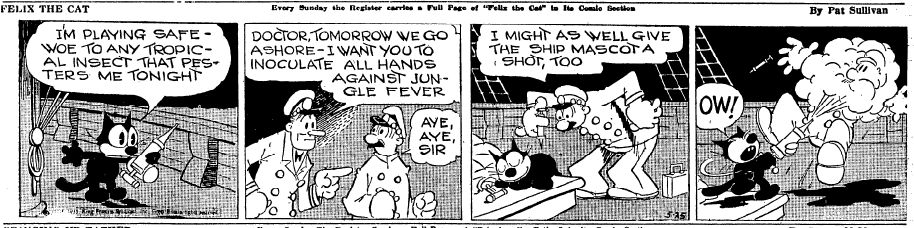
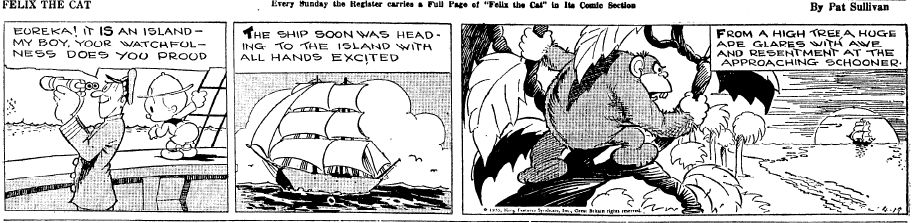
 Â Felix this time, from 5-20 to 5-26-1935, continues the story of the Island Ape held captive on the ship. Felix lures the Ape’s little family on board to keep him company, and ship’s company prepares to explore the island by getting inoculated against jungle fever. In the Sunday, Felix continues to wear white gloves as he uses hollow spaghetti to blow black pepper in the face of the giant.
 Felix this time, from 5-20 to 5-26-1935, continues the story of the Island Ape held captive on the ship. Felix lures the Ape’s little family on board to keep him company, and ship’s company prepares to explore the island by getting inoculated against jungle fever. In the Sunday, Felix continues to wear white gloves as he uses hollow spaghetti to blow black pepper in the face of the giant.
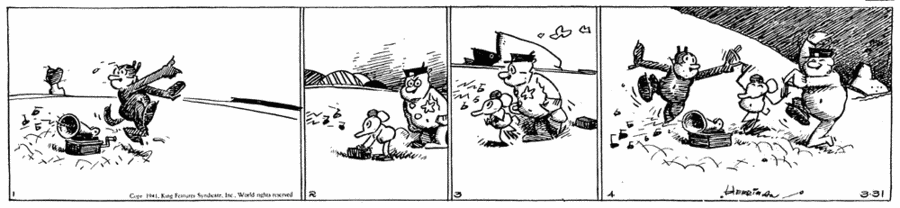

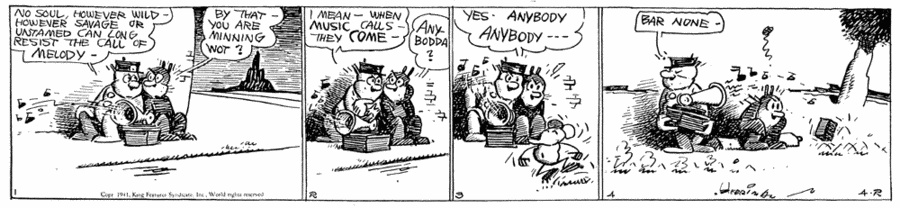
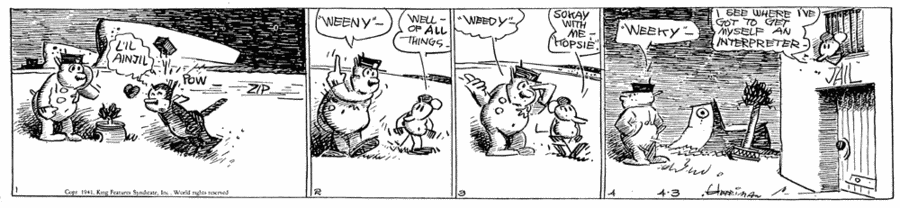
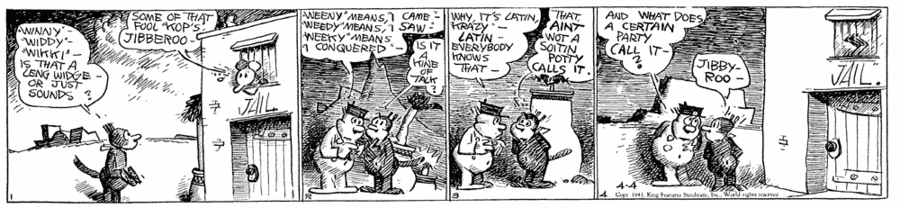
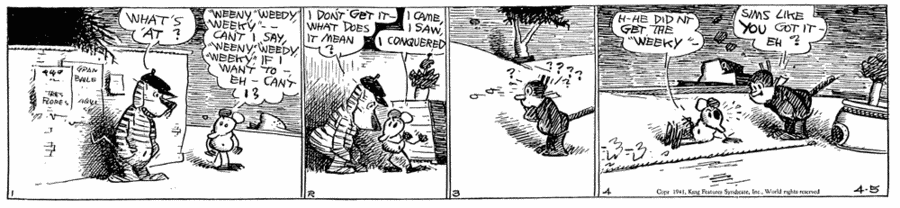 Â In Krazy, 1-31 to 4-5-1941, a gramophone and a famous Latin phrase bookend the gags. Ignatz gets a black eye from a tough dog character other than Offissa Pupp in the 4-5.
 In Krazy, 1-31 to 4-5-1941, a gramophone and a famous Latin phrase bookend the gags. Ignatz gets a black eye from a tough dog character other than Offissa Pupp in the 4-5.
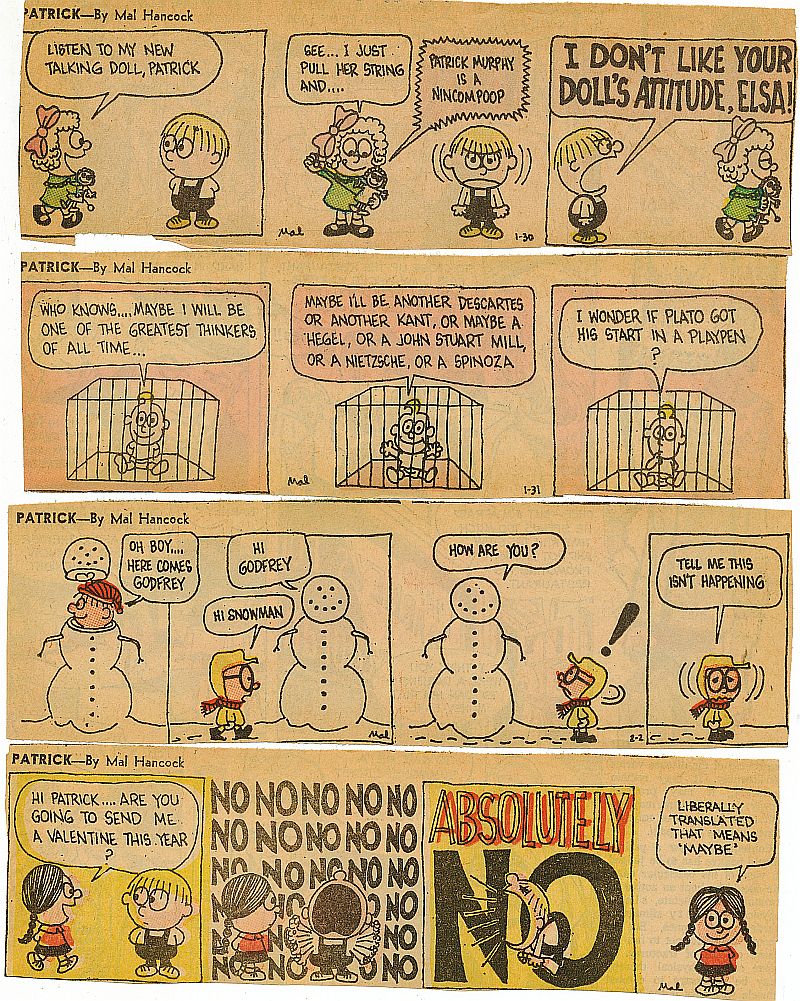 Â Patrick, this time from 1-30 to 2-4-1967, missed two days, 2-1 and 2-3. I guess Dad didn’t bring the paper home those nights. Nathan certainly has command of philosophy in the 1-31. I’m not familiar with John Stuart Mill, guess I’ve got some research to do.
 Patrick, this time from 1-30 to 2-4-1967, missed two days, 2-1 and 2-3. I guess Dad didn’t bring the paper home those nights. Nathan certainly has command of philosophy in the 1-31. I’m not familiar with John Stuart Mill, guess I’ve got some research to do.

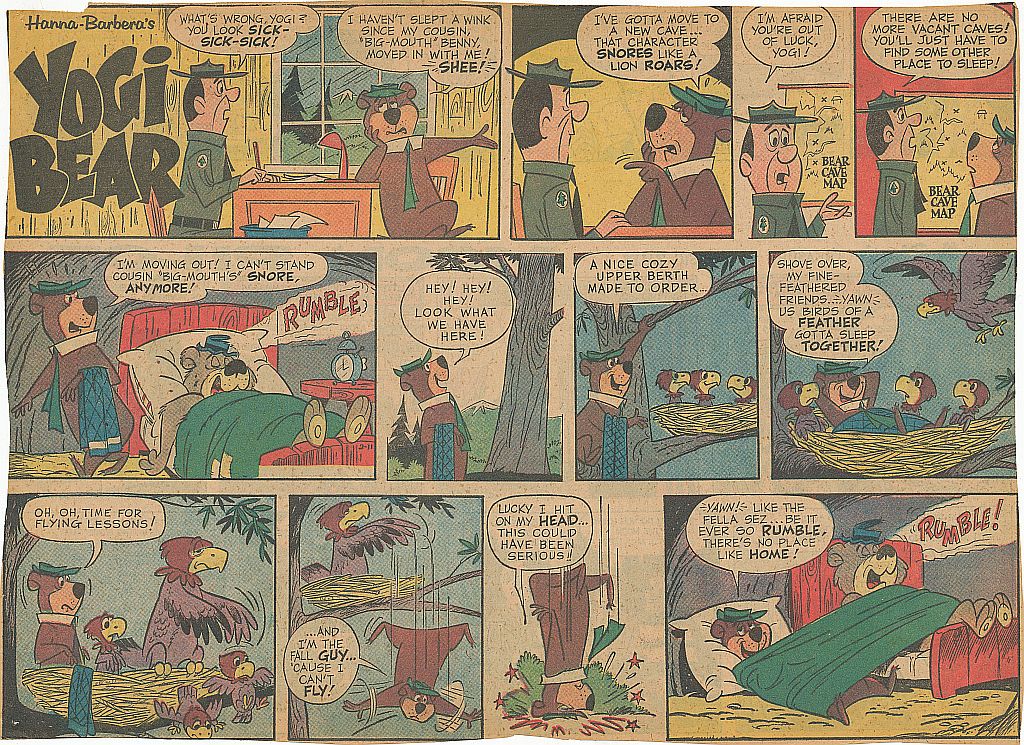
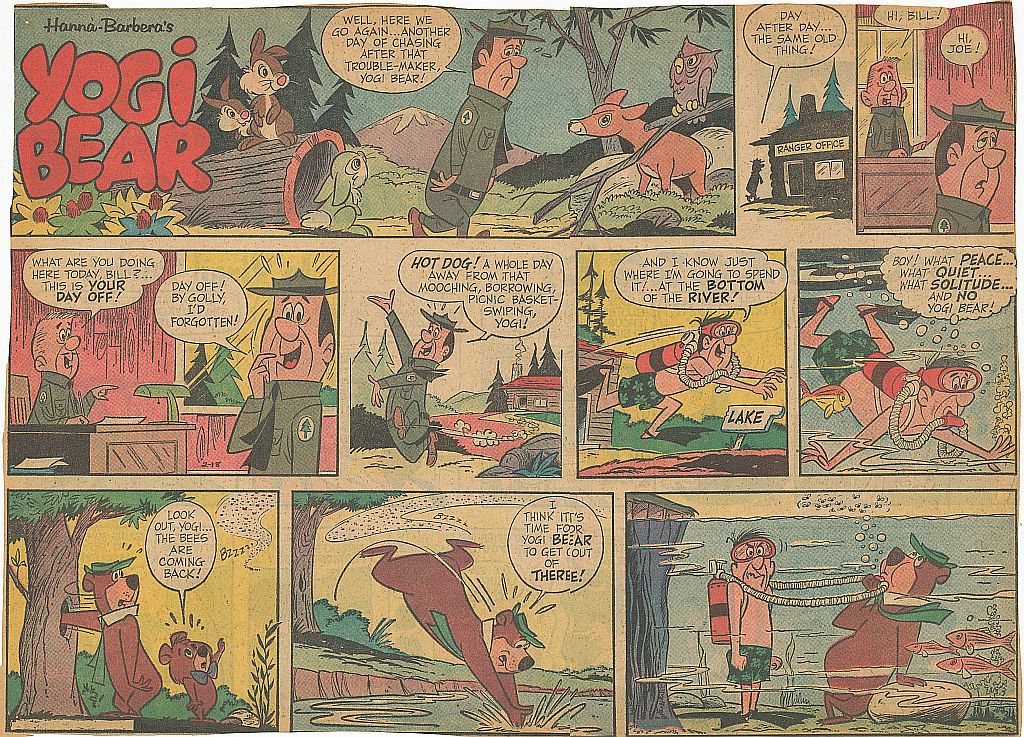
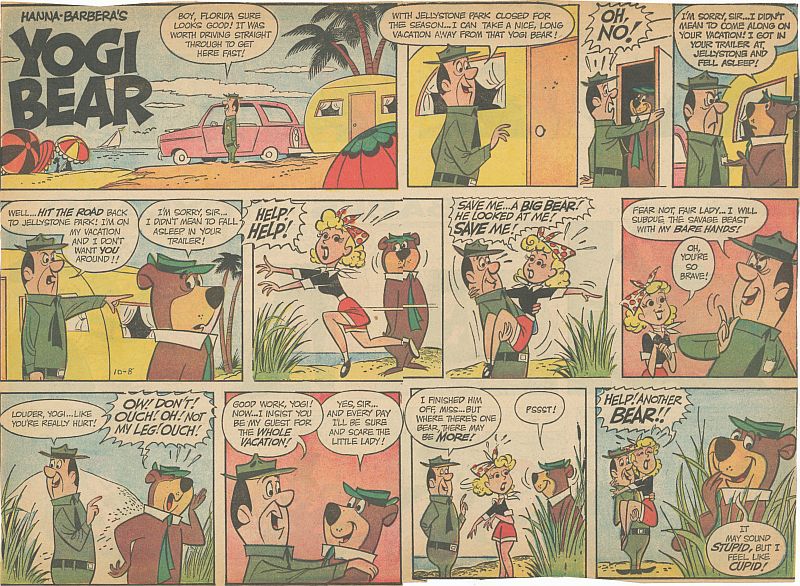
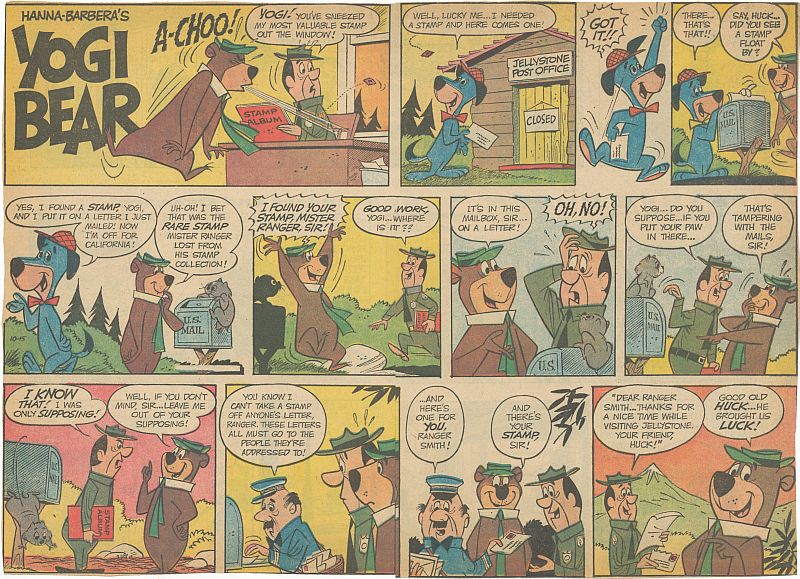
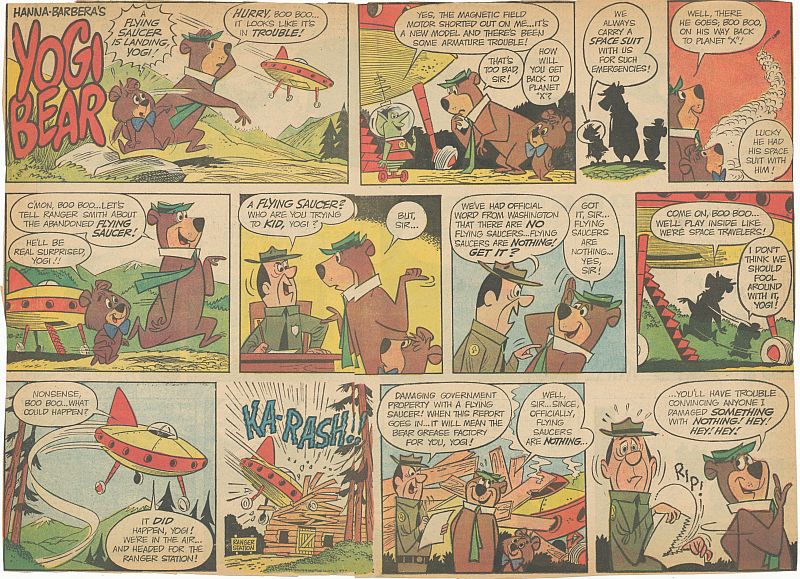
 Â Yogi this time, for the month of February, 1962, features four strips which are probably a collaboration between Gene Hazelton and Harvey Eisenberg. The 2-25 really looks like Harvey’s work to me, especially the last panel. The rest of the strips could have been drawn by Hazelton, but the logos look like Harvey’s distinctive letter designs. Make sure you click “Yowp” on the blogroll over to the right, and read what Yowp has to say about these Yogi Bear pages over at his blog. Check out Tralfaz too, always interesting reading. Remember to click all the images above to see them larger and avoid those computer headaches.
 Yogi this time, for the month of February, 1962, features four strips which are probably a collaboration between Gene Hazelton and Harvey Eisenberg. The 2-25 really looks like Harvey’s work to me, especially the last panel. The rest of the strips could have been drawn by Hazelton, but the logos look like Harvey’s distinctive letter designs. Make sure you click “Yowp” on the blogroll over to the right, and read what Yowp has to say about these Yogi Bear pages over at his blog. Check out Tralfaz too, always interesting reading. Remember to click all the images above to see them larger and avoid those computer headaches.
John Bohnenberger, R.I.P.
“John The Magician” by Catherine Hill
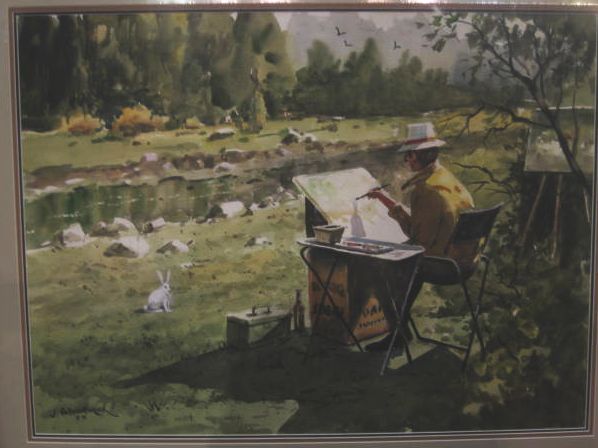
John Bohnenberger’s version of “John The Magician”

John’s Divisionist Still-Life
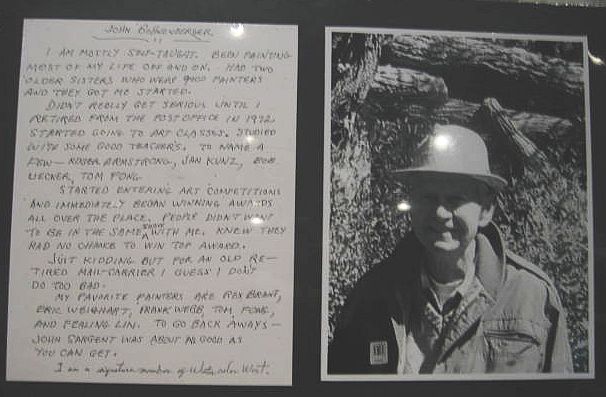
A Rare Written Statement about John by John.
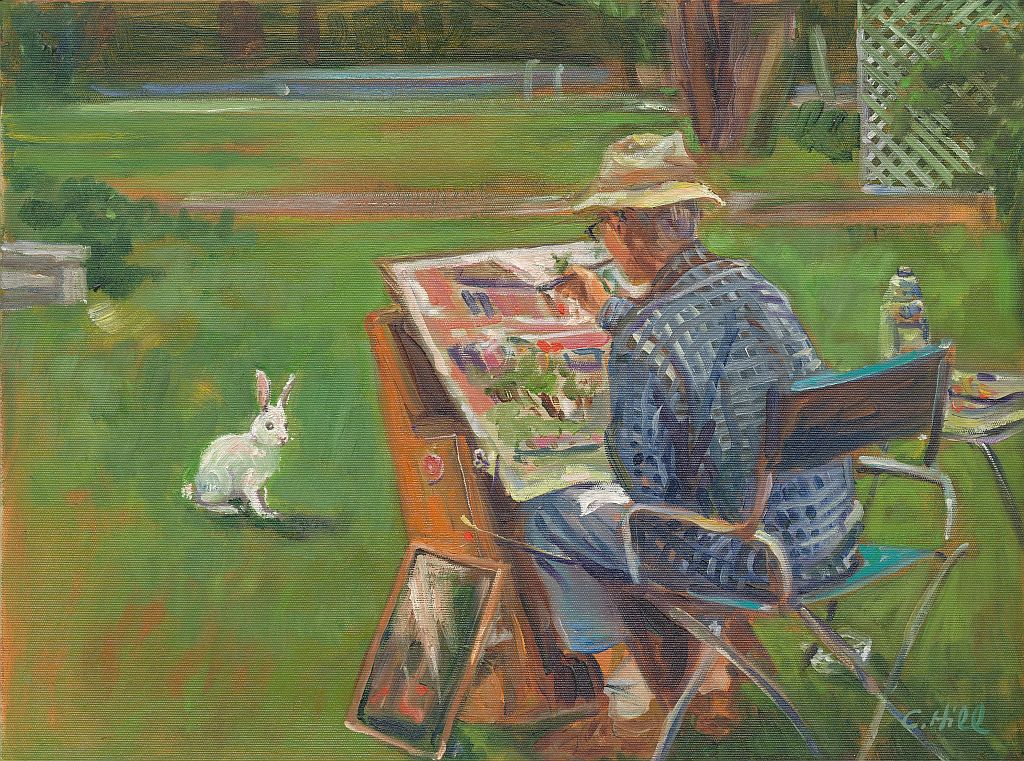
What can you say about such a dear friend and great watercolorist as John Bohnenberger. He left us early in January, but his work will always be here. He belongs with the best California watercolorists, such as Hardie Gramatky, Phil Dyke, Charles Phillipi and Millard Sheets. He studied with Roger Armstrong, a great watercolorist and comic strip artist (assistant to Clifford McBride). The first painting you see up top is Cathy Hill’s oil tribute to John Bohnenberger; “John the Magician”. Our Thursday Morning Irregulars Painting group was painting at the home of Guy Rose, another historic California artist, and Cathy was moved to capture the elusive Mr. John B. at work. He always carried an old video display box with him, notched to hold his drawing board. Here is Cathy’s statement to go along with her painting:
I remember seeing his bold watercolor paintings many years ago. I thought, “Who is this amazing artist?”. Finally, in a San Gabriel Art Association show, someone said, “There’s the great John Bohnenberger”–Where? I looked. There! I saw a thin little guy with a hat. I was impressed. Later I got to know him.
Mark and I painted with John on Thursdays in a plein air group from the San Gabriel Art Association. As the group changed, sometimes John and Mark and I were the only ones to show up. John always said if he went a day without painting, he didn’t feel right. If he was really happy with his painting that day, he would slap it down and say: “Eat your heart out!” We loved it! He must have had enough award ribbons to stitch them together to make 12 quilts! John was an inspirational sight–throwing water wildly from his brushes and using his self-made desk table from a VHS display box that he tied around his legs (for wind defense) and folded into a carrying suitcase. The last time I saw him was at Julie Abreau’s funeral. She was a wonderful person and watercolor artist. She gave rides in her van to John Bohnenberger and Walter Zetlmaier on Thursdays. She called them “my boys”.
John’s work had a bold and sure-of-itself quality, but he was shy about his talent, always avoiding doing demos, and was intimidated by professional artists. But all the professional artists were in awe of him. Painting seemed to come magically and easily to him–even abstract watercolors.
He was truly John the Magician.
I was always begging John for a spot at his watercolor classes, but he turned me down. He said, “You don’t want to be in a class with a lot of old ladies.” (He taught at the retirement home where he lived. Here is John’s statement about himself (original is upstairs):
I am mostly self-taught. Been painting most of my life off and on. Had two older sisters who were good painters and they got me started.                                                                  Â
 Didn’t really get serious until I retired from the post office in 1972. Started going to art classes. Studied with some good teachers. To name a few–Roger Armstrong, Jan Kunz, Bob Uecker, Tom Fong.                                                                                             Â
Started entering art competitions and immediately began winning awards all over the place. People didn’t want to be in the same show with me. Knew they had no chance to win top award. Just kidding, but for an old retired mail-carrier I don’t do too bad.       My favorite painters are Rex Brandt, Eric Weignart, Frank Webb, Tom Fong and Fealing Lin. To go back aways–John Sargent was about as good as you can get.               I am a signature member of Watercolor West.
Cathy and I were very surprised to find that John had done his own version of Cathy’s “John The Magician”. My photo of his painting is second from the top. He really expanded the composition, and depicted himself painting by a river, with Cathy’s rabbit keeping him company. This is one of the few watercolors John did of himself painting. I’ve also included a snapshot of one of his fine abstract still-lifes. He was just as good at non-representational pictures as he was at painting “reality”. He actually preferred to work from photographs, painting on location didn’t “feel right”. Yet, his paintings from photographs never feel like he was bound by them, but he used the photo as a point of departure and made beautiful paintings of them. John was a master of value, light and shadow as well as color. He knew what to leave out, as well as what to paint. As he got older, John no longer drove, and he turned down rides he was offered, so we saw him less and less. He was a no-show at his one man show that the San Gabriel Art Association did for him last year. He was in the hospital at the time. However, just before they took the show down, John magically appeared and broke his shyness to chat with the patrons about art. Cathy and I didn’t see him there, as we didn’t know he had recovered sufficiently to be at the gallery. How we wish we could have seen him one more time!
John admired “pro” artists, he often told me he wished he could have worked in the animation industry. Maybe he liked comics too! Here’s some:
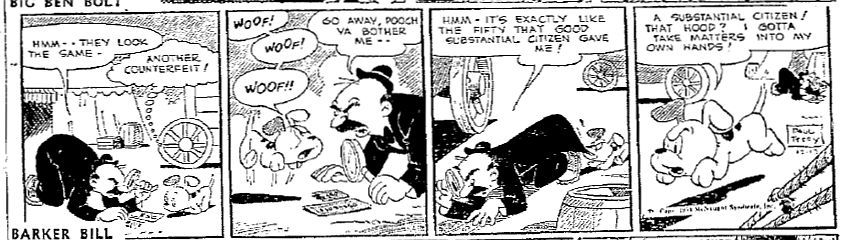

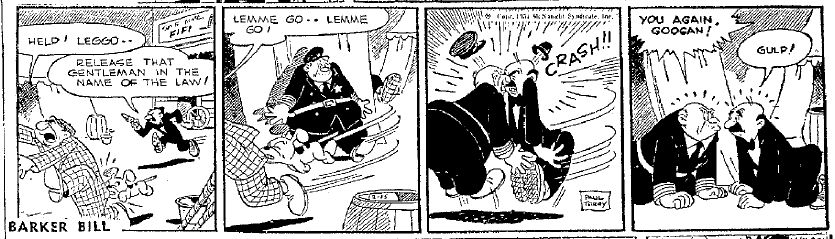

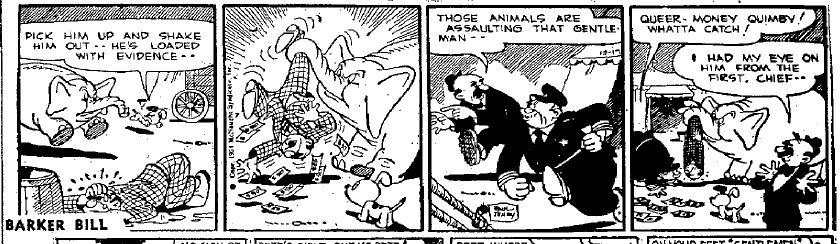

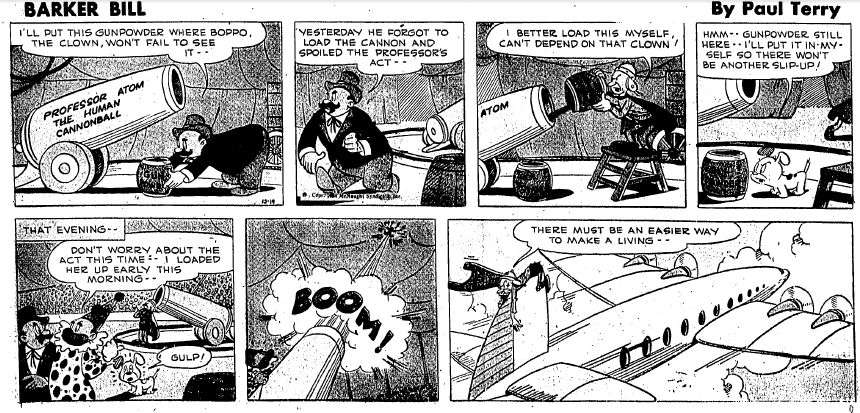
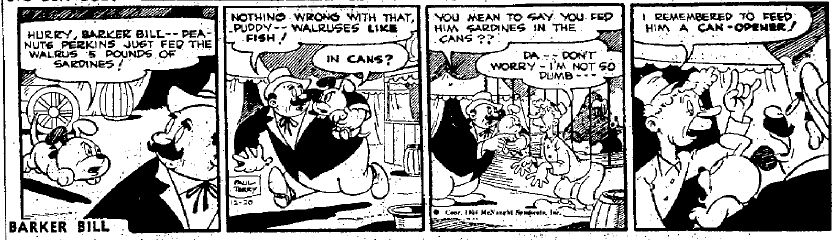
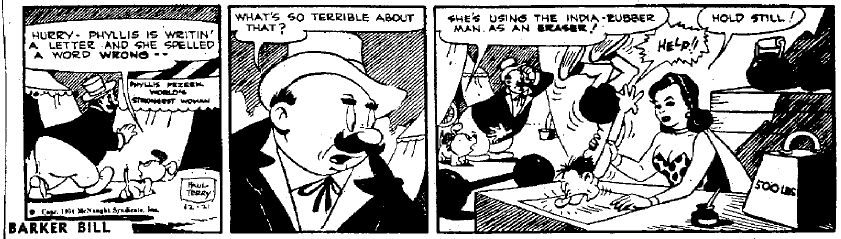
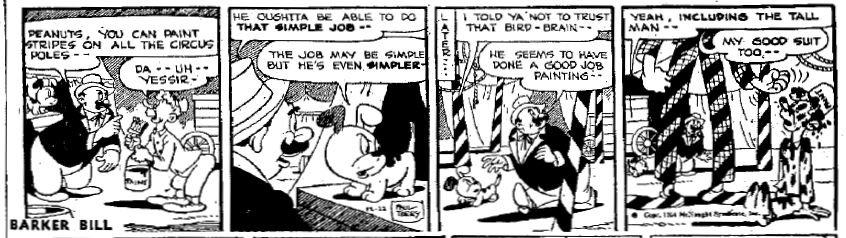
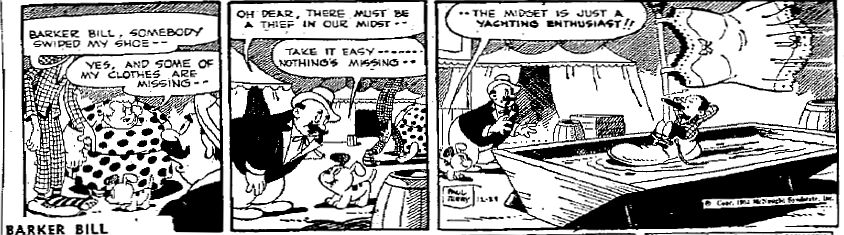
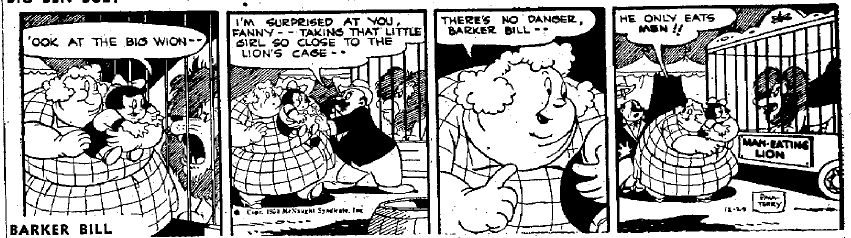
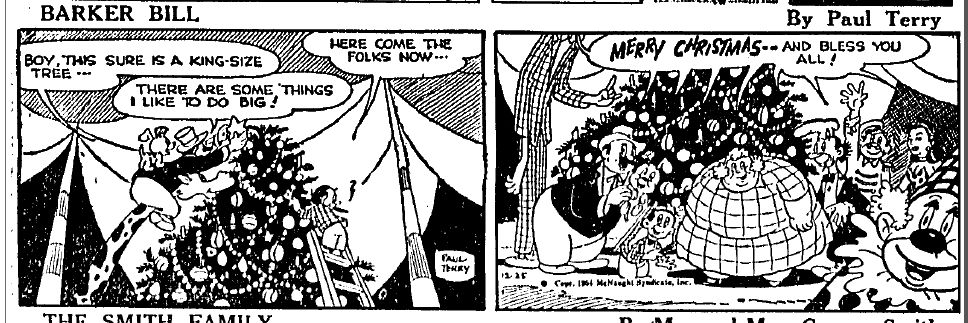
 Â Barker Bill, from 12-13 to 12-26-1954, including the rare Christmas strip! Puddy defeats “Queer-money Quimby” the counterfeiter, after all, he’s 1/16th police dog. The little Gelt is still hungry for greenbacks. In the strips from 12/20 on, the sideshow cast is featured in circus gags, including “Peanuts Perkins”, a classic dumb-guy who is sort of the strip’s Zero. In the Sunday page for 12-26, we see Bob Kuwahara’s version of Kiko, the kangaroo! He is drawn a bit more realistically than the animated Kiko, and carries Puddy in his pouch.
 Barker Bill, from 12-13 to 12-26-1954, including the rare Christmas strip! Puddy defeats “Queer-money Quimby” the counterfeiter, after all, he’s 1/16th police dog. The little Gelt is still hungry for greenbacks. In the strips from 12/20 on, the sideshow cast is featured in circus gags, including “Peanuts Perkins”, a classic dumb-guy who is sort of the strip’s Zero. In the Sunday page for 12-26, we see Bob Kuwahara’s version of Kiko, the kangaroo! He is drawn a bit more realistically than the animated Kiko, and carries Puddy in his pouch.

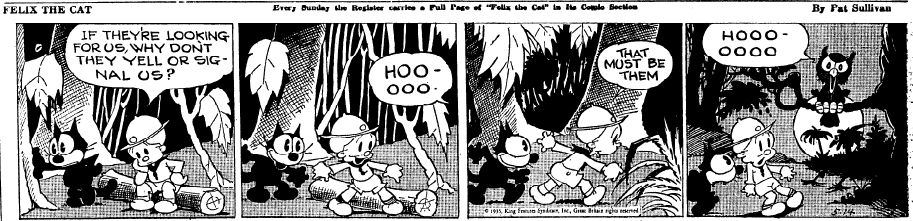

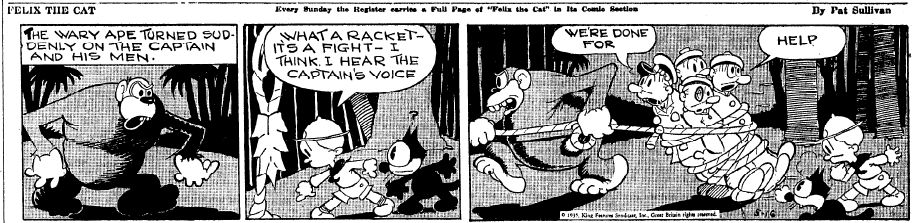

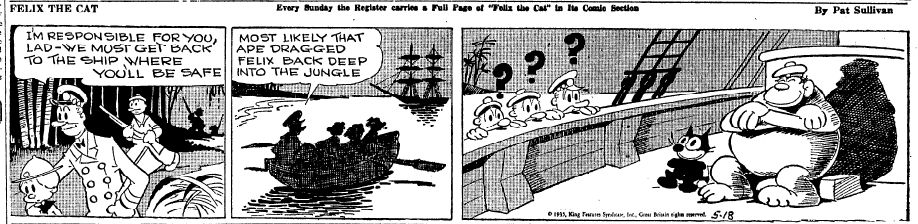
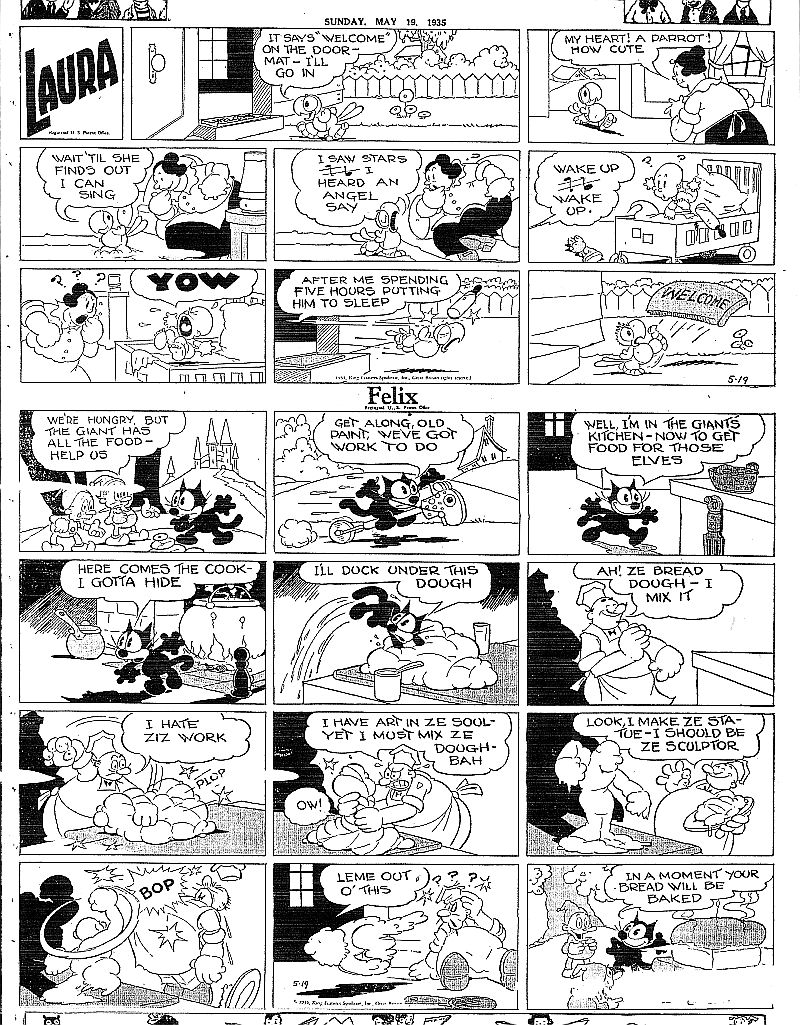 Â Felix from 5-13 to 5-19-1935 continues Danny’s adventures on the Ape’s island. The Ape ties up the sailors who are trying to rescue Danny and Felix, but Felix leads the Ape back to the ship. The mascot is a hero again! In the Sunday, Felix is still cavorting with giants in Dreamland, securing dough for some Elves from the baker Giant. I love the “sock” in the 10th panel, Messmer and Segar really had a knack for action fighting poses.
 Felix from 5-13 to 5-19-1935 continues Danny’s adventures on the Ape’s island. The Ape ties up the sailors who are trying to rescue Danny and Felix, but Felix leads the Ape back to the ship. The mascot is a hero again! In the Sunday, Felix is still cavorting with giants in Dreamland, securing dough for some Elves from the baker Giant. I love the “sock” in the 10th panel, Messmer and Segar really had a knack for action fighting poses.
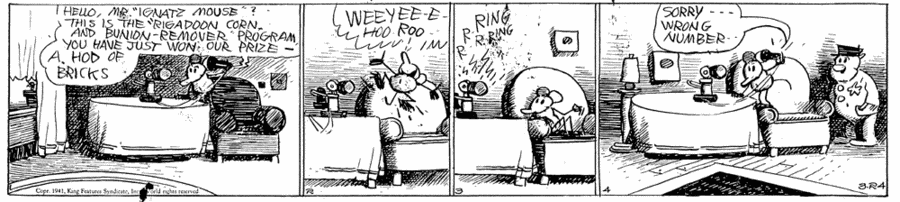
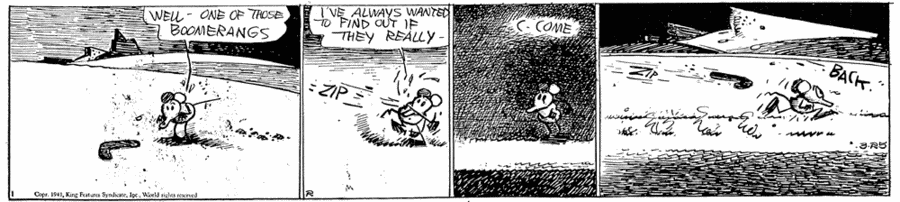
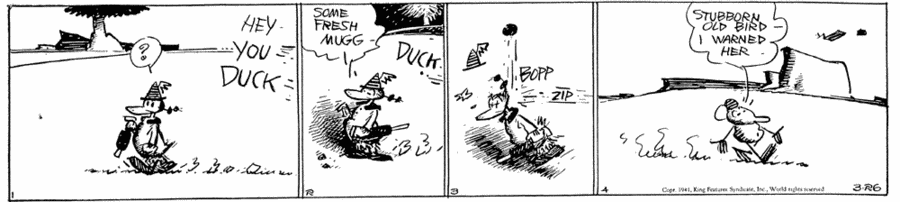
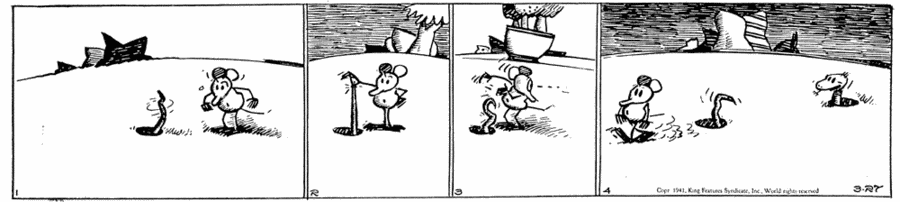
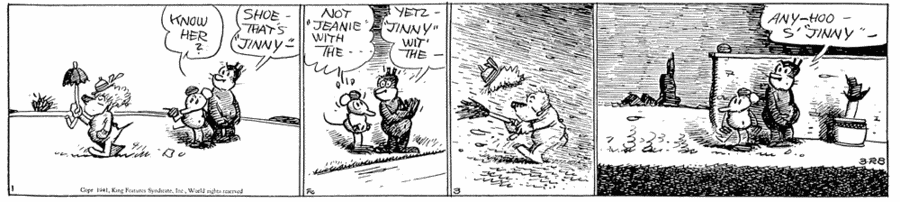
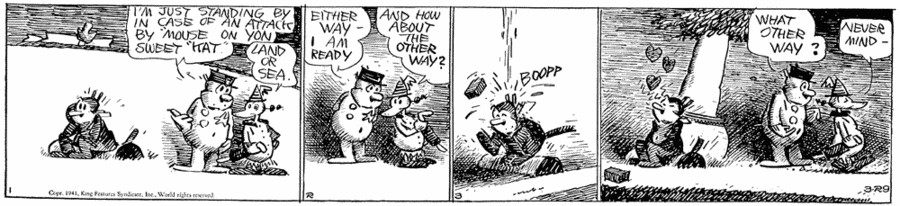 Â A lot of good ol’ brick-boppin’ gags in Krazy this time, from 3-24 to 3-29-1941. I like the snake gag in the 3-27, this looks like one of the “iconic” Herriman strips that an author would put in a “high/low” art book. Beautifully designed daily.
 A lot of good ol’ brick-boppin’ gags in Krazy this time, from 3-24 to 3-29-1941. I like the snake gag in the 3-27, this looks like one of the “iconic” Herriman strips that an author would put in a “high/low” art book. Beautifully designed daily.
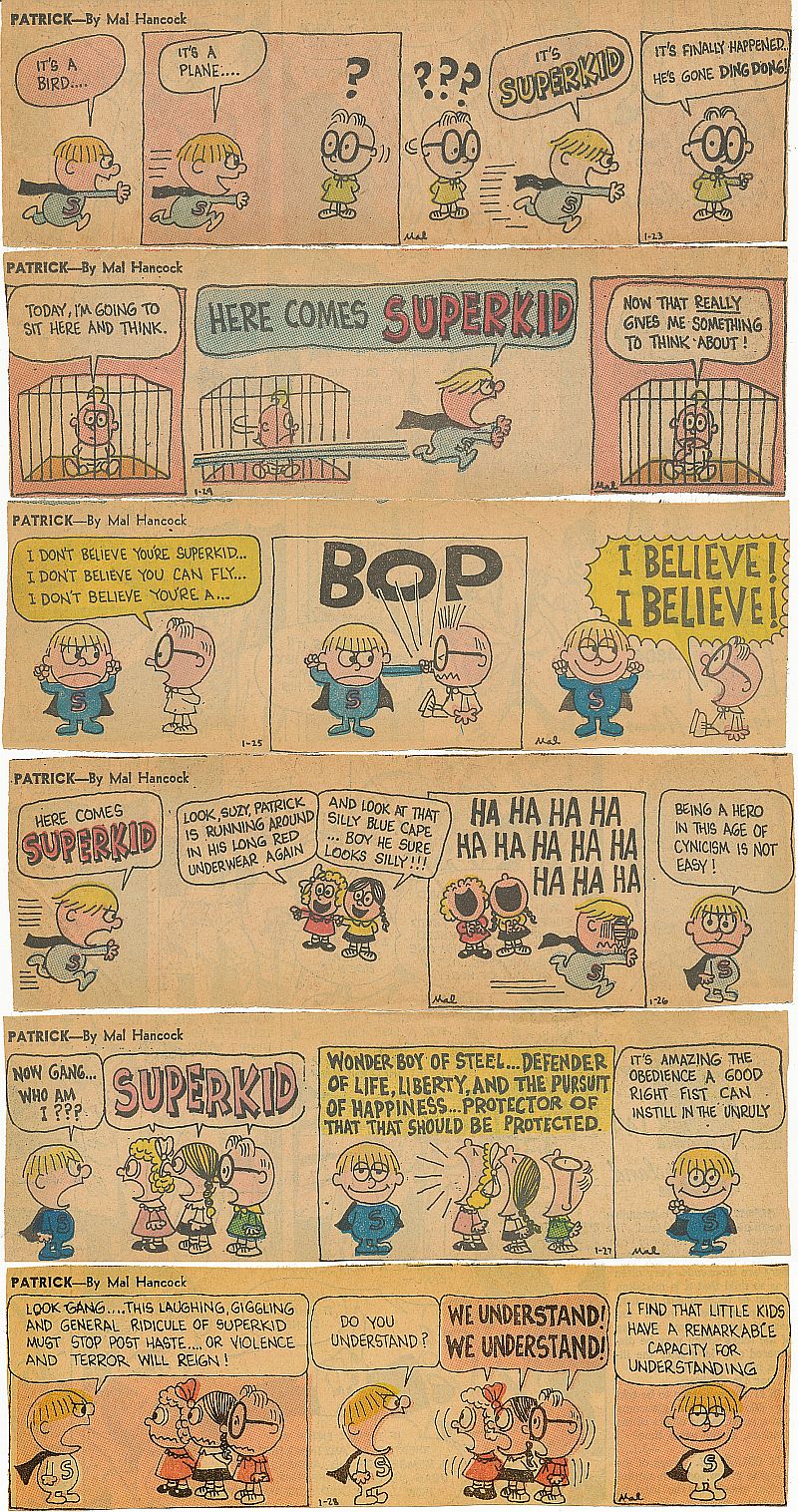  Patrick runs roughshod, or is it “supershod”, as Superkid! He lords it over Godfrey, Suzy and Elsa; his brother Nathan can’t understand what Patrick is up to. Maybe Godfrey is right, and Patrick has gone “Ding Dong”. If it hadn’t been for my brother’s unselfish efforts in clipping this strip, we wouldn’t have such nice color scans to read today. I hope the next post will be released under happier circumstances. Farewell John!
First Post of 2012
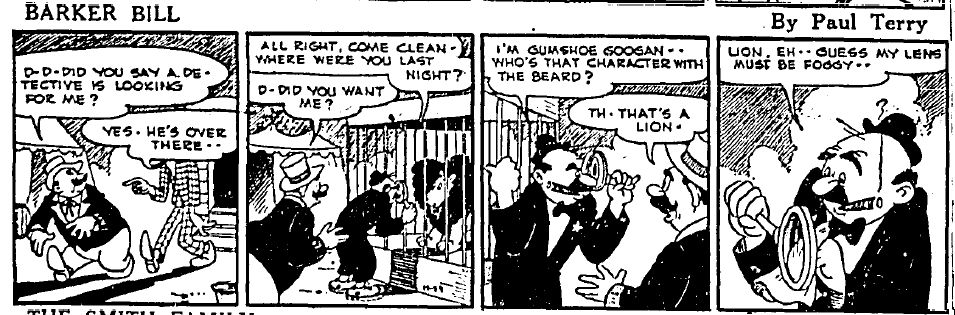
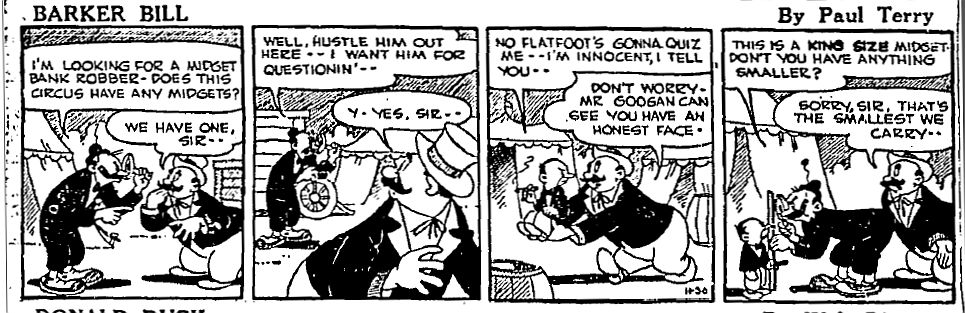
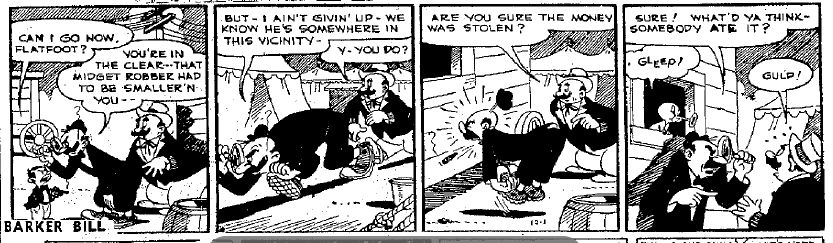
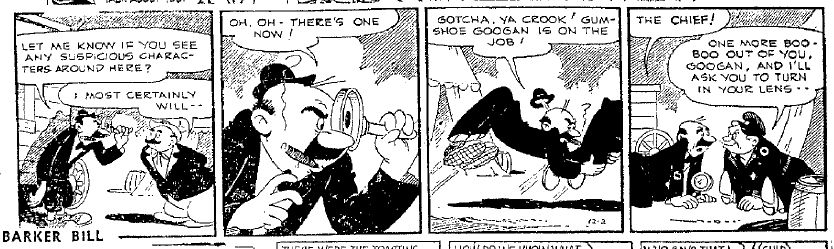
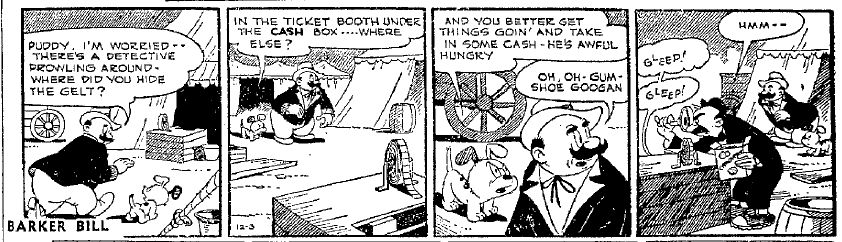
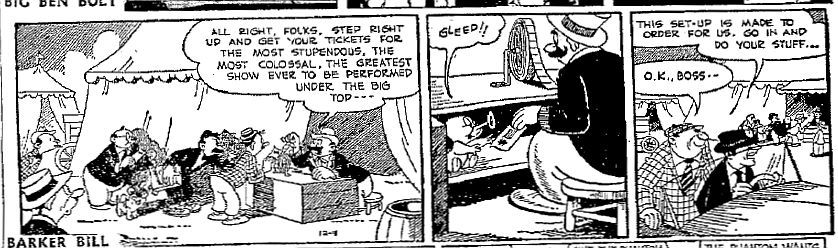

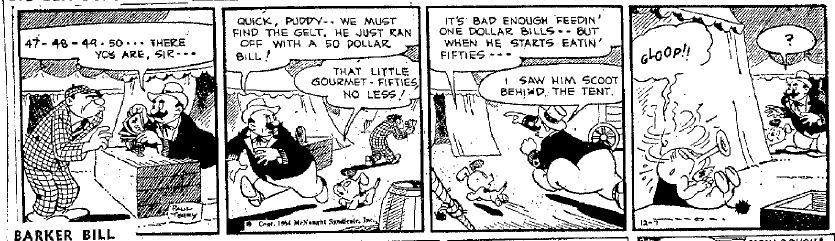
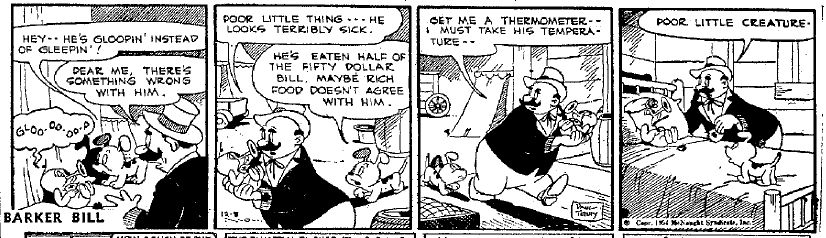
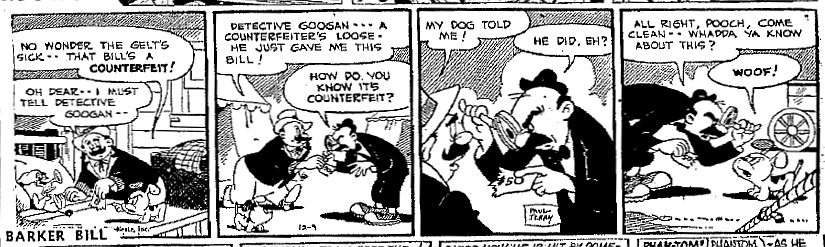
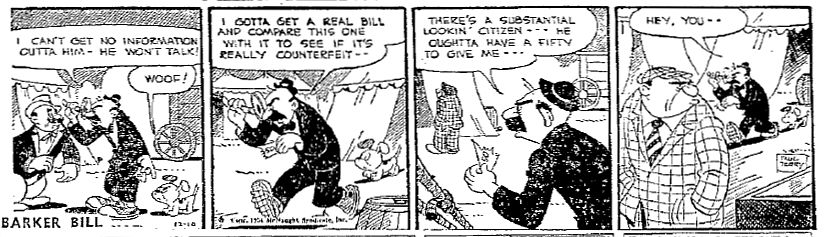
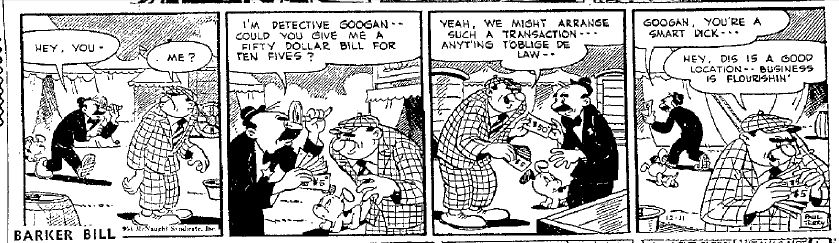
Hi Readers, welcome to the first post this year. Barker Bill continues the “Gelt” story line from 11-29 to 12-11-1954. Gumshoe Googan, police detective, is on the job, looking for stolen money. The Gelt eats a counterfeit $50 bill, which makes him sick. Googan is so dumb that he changes five tens for one on the counterfeit fifties. More Kuwahara hi-jinks next time. All but the first two strips this time were courtesy of Yowp. Make sure you visit his blogs, “Yowp” and “Tralfaz” by clicking on the links in the blogroll.
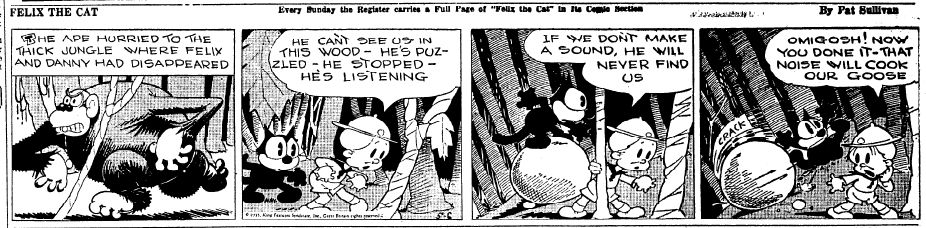
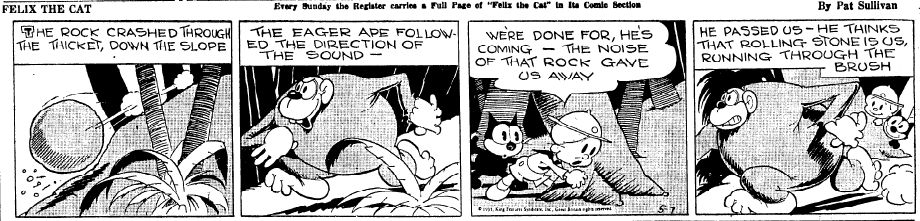

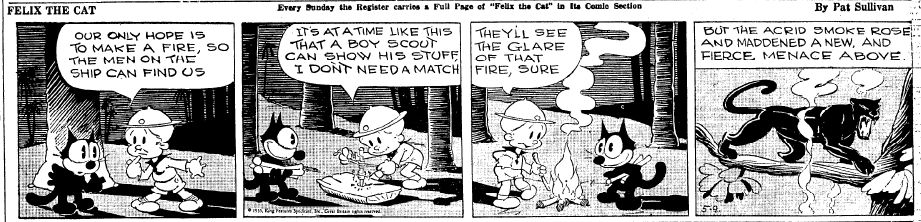

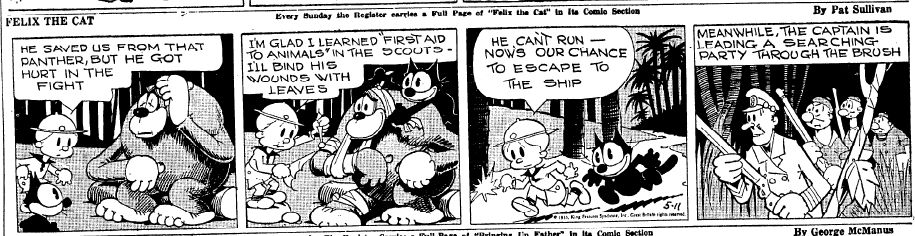
 Â Felix, from 5-6 to 5-12-1935, continues the adventures of Danny Dooit and Felix on the tropical island. They escape from the ape, only to be attacked by a panther, an adroit design halfway between real and cartoon. The ape clobbers the panther with a coconut and they fight. I love that beautiful silhouette of Felix and Danny in the 5-8. The Sunday has Felix still stealing food from the Giant, and fending off a dog who is after Felix’s buried bone. Note that Felix has three fingered white gloves in this page. Looks like the deadly Mouse fever has hit Felix’s Dreamland.
 Felix, from 5-6 to 5-12-1935, continues the adventures of Danny Dooit and Felix on the tropical island. They escape from the ape, only to be attacked by a panther, an adroit design halfway between real and cartoon. The ape clobbers the panther with a coconut and they fight. I love that beautiful silhouette of Felix and Danny in the 5-8. The Sunday has Felix still stealing food from the Giant, and fending off a dog who is after Felix’s buried bone. Note that Felix has three fingered white gloves in this page. Looks like the deadly Mouse fever has hit Felix’s Dreamland.
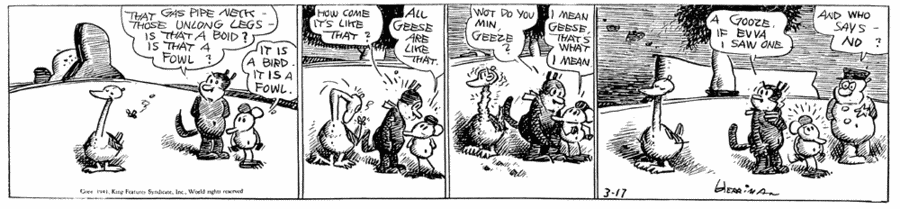
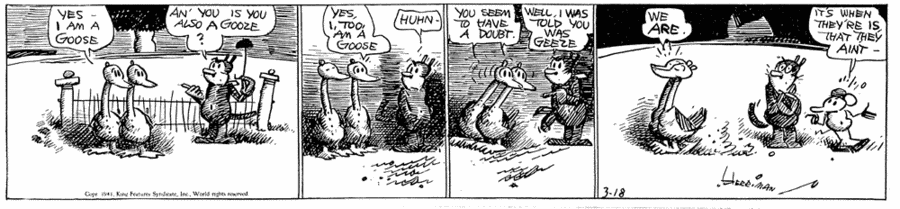

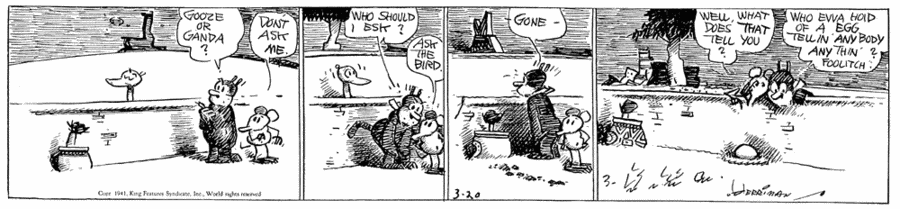
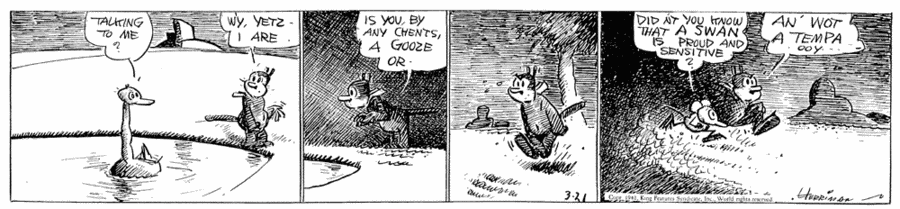
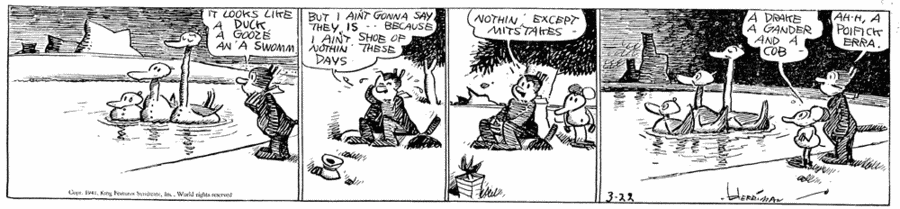 Â Krazy this time, from 3-17 to 3-22-41 tries to sort out Goose, Geese, Ganders, Drakes and Cobs, among other waterfowl. He encounters a bad tempered “Swomm” in the 3-21.
 Krazy this time, from 3-17 to 3-22-41 tries to sort out Goose, Geese, Ganders, Drakes and Cobs, among other waterfowl. He encounters a bad tempered “Swomm” in the 3-21.
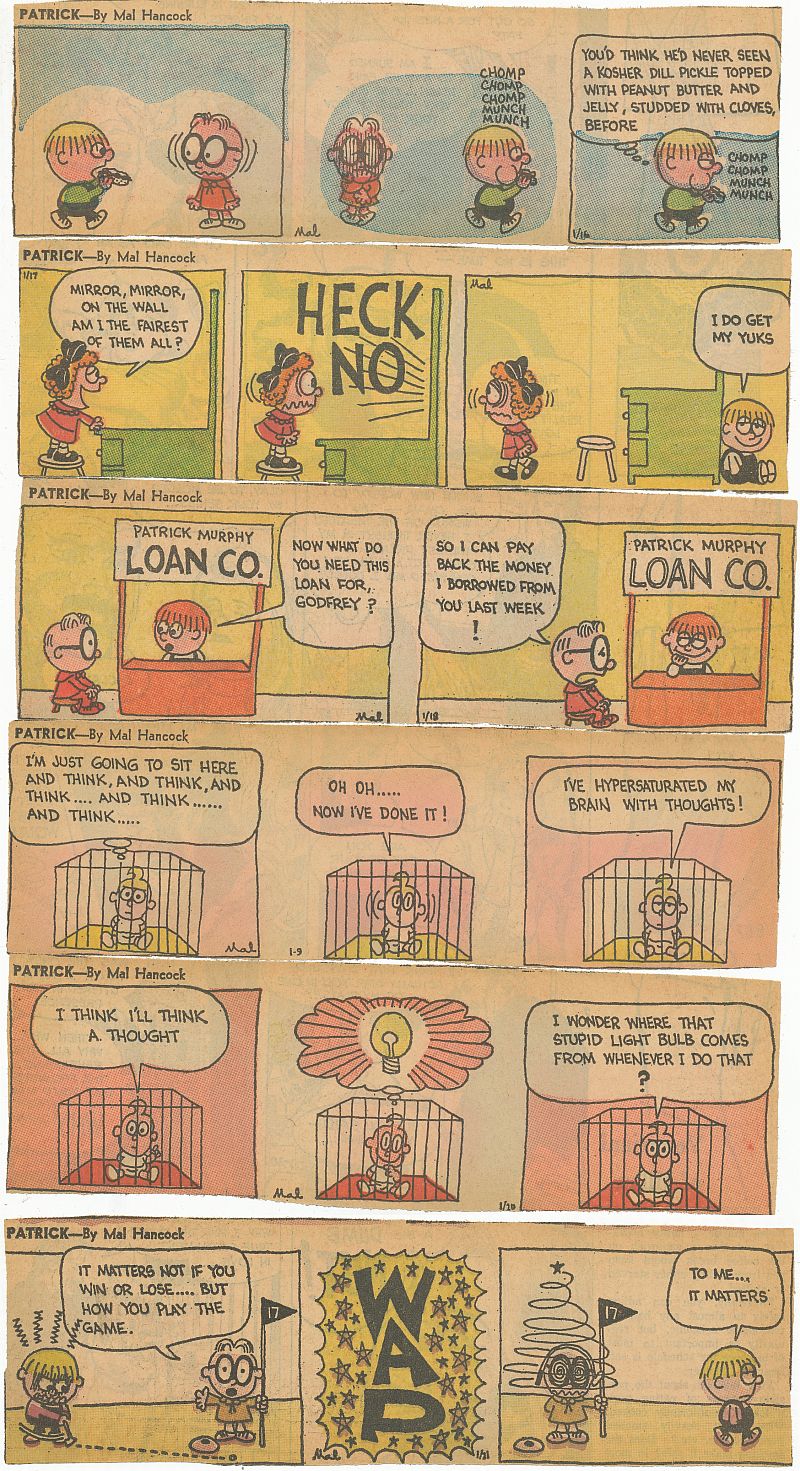 Patrick, from 1-16 to 1-21-1967, features Patrick emulating the early Charlie Brown in the 1-17, frustrating poor Elsa. Godfrey takes his usual lumps, and Nathan the baby makes fun of an icon of Comicana.
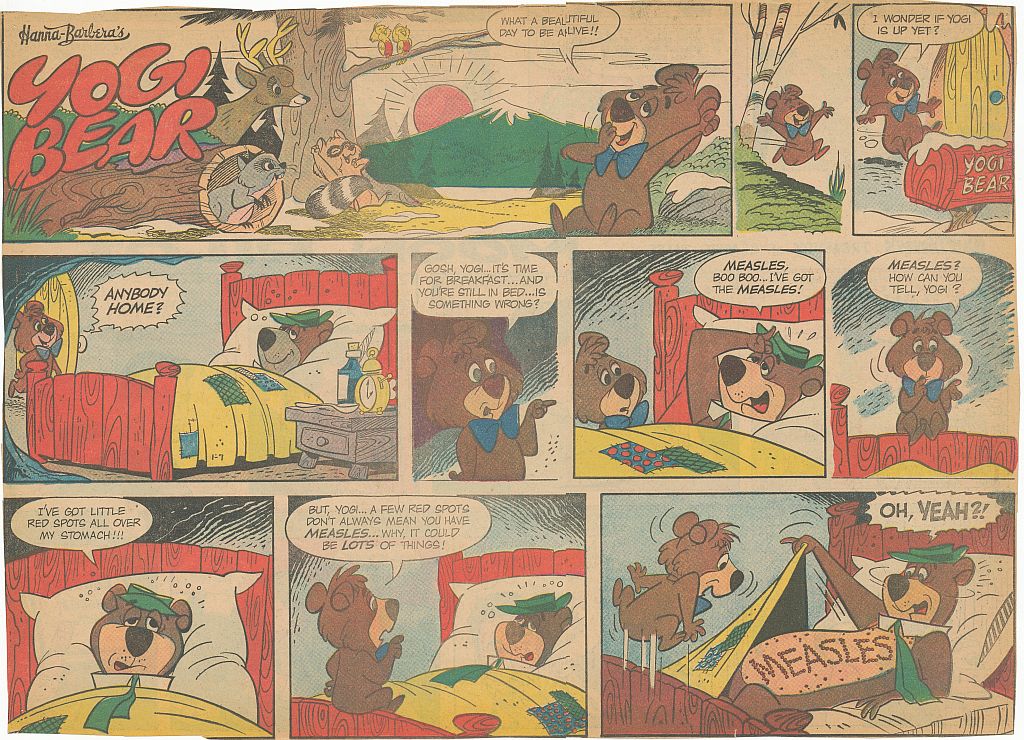
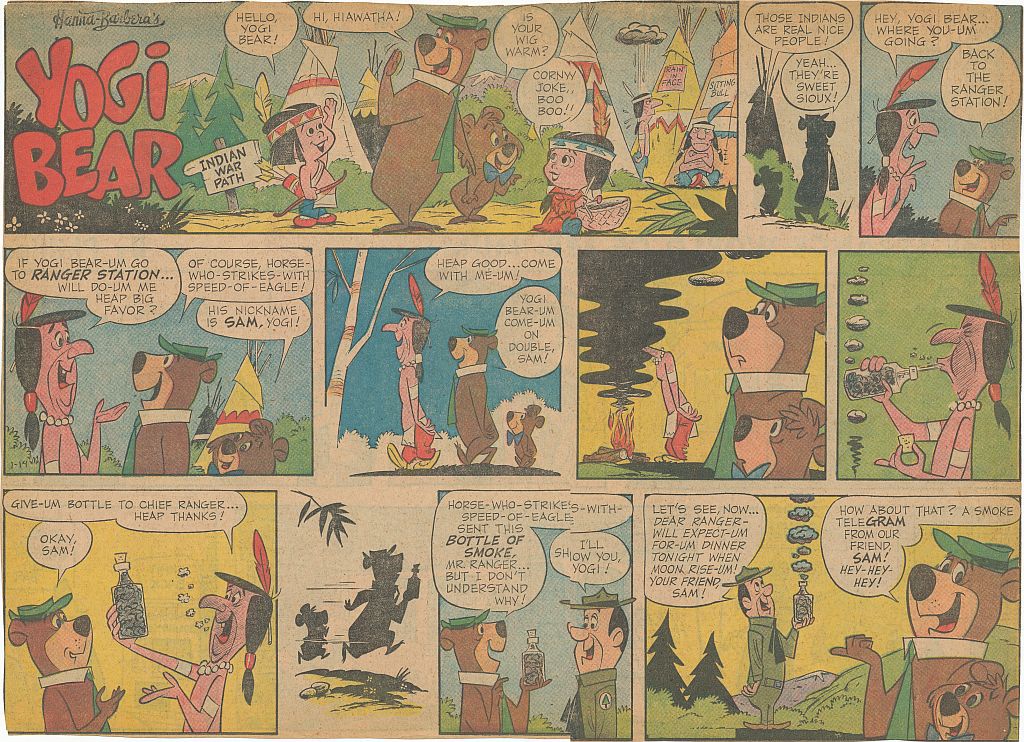
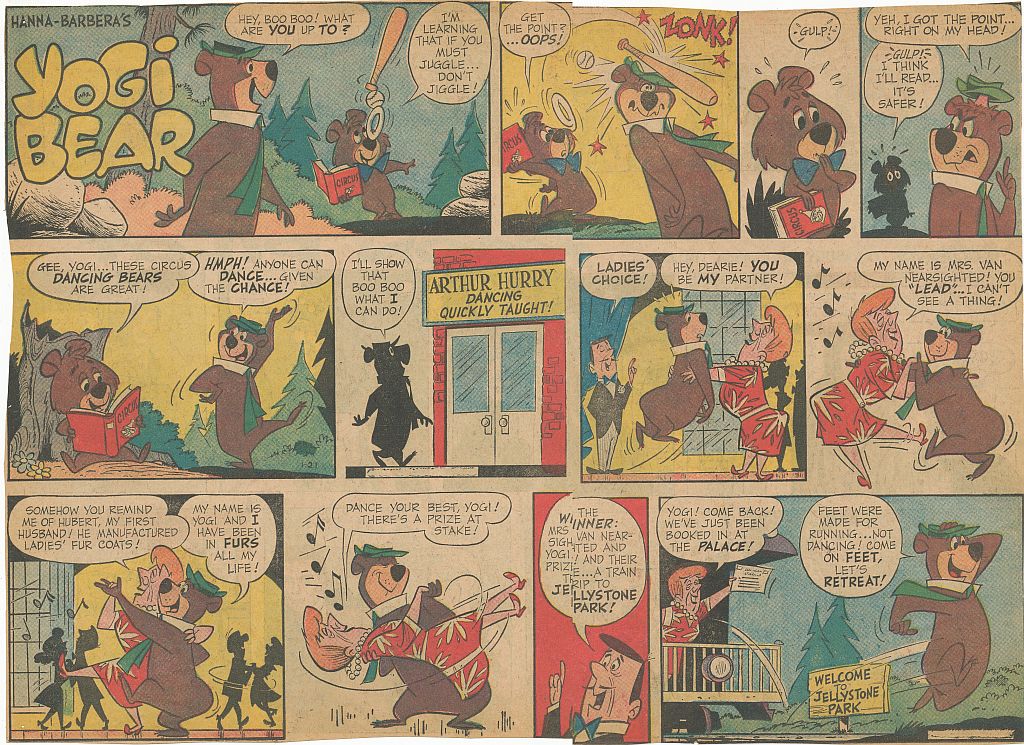 Here come the monthly Yogi pages in imitation of Yowp’s fine example. They are from 1-7 to 1-21-1962. Go over to his blog for notes on the strips and see a black and white “tab” version of the 1-28 strip with Quick Draw McGraw as a guest character. The art on the 1-14 and 1-21 episodes and perhaps the 1-7, seem to be the work of Harvey Eisenberg. Some of my readers don’t read me too often because they don’t like to read comics on the Internet. Mike Barrier gets terrible headaches when he tries to read them. My solution, always click on the small strips to enlarge them, and get a Logitech Mouse! There is a little wheel in the center of the mouse. When you spin it, it blows up the contents of the page in front of you. You can even fill the screen with the image, which makes the artwork and inking really stand out for study. If you get this tool, maybe your head won’t hurt so bad. Thanks again to our kind suppliers, my brother Kurt, the good dog Yowp and the fine people at ProQuest newspaper archive and the Glendale Public Library. See you soon.
Happy New Year’s Post
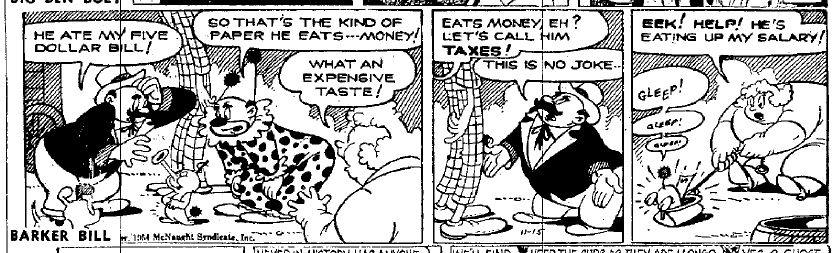
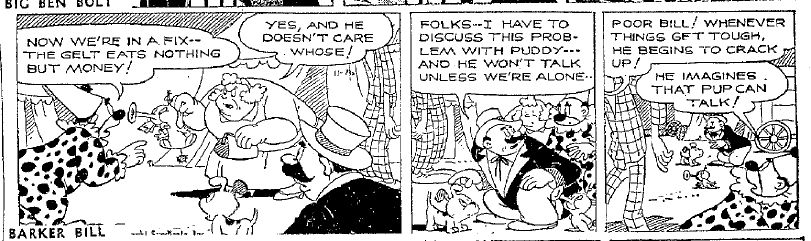
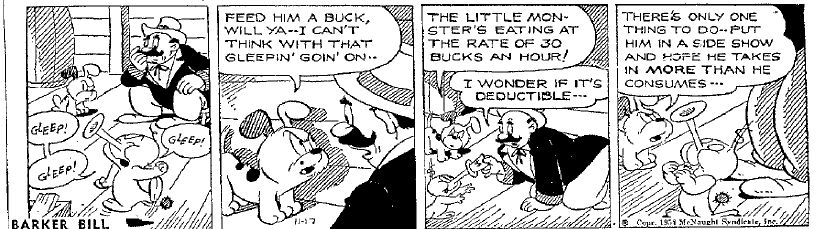
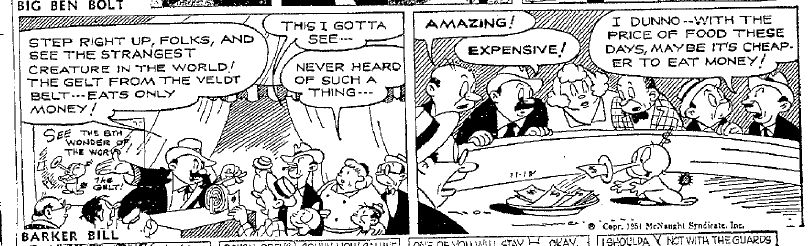
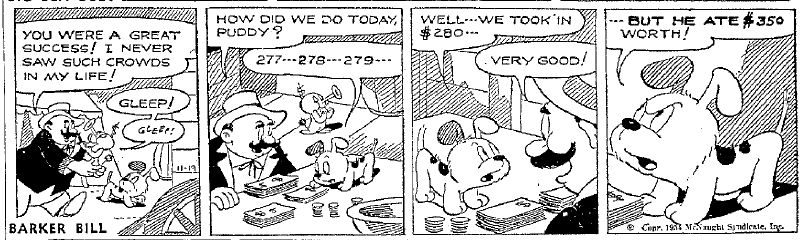
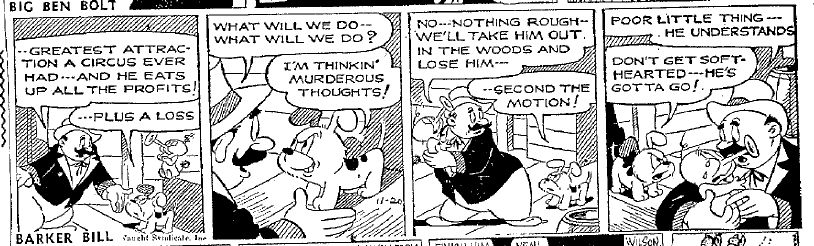

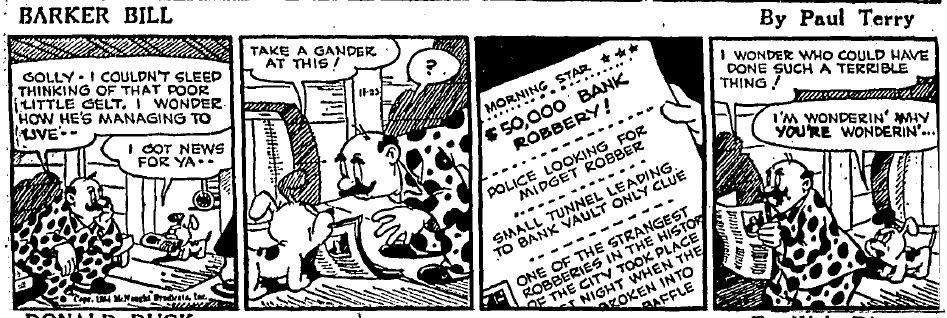
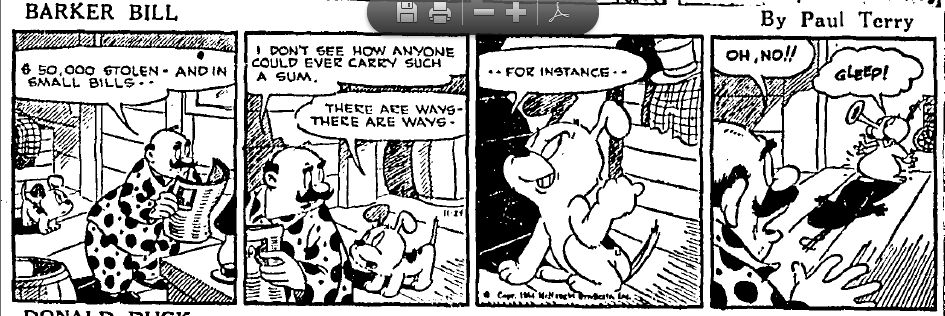
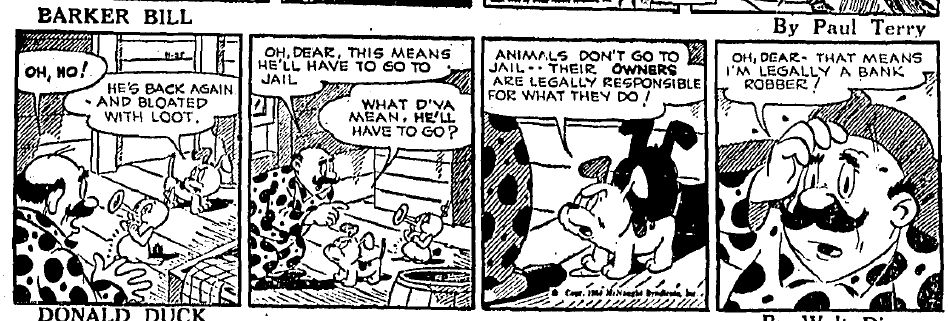
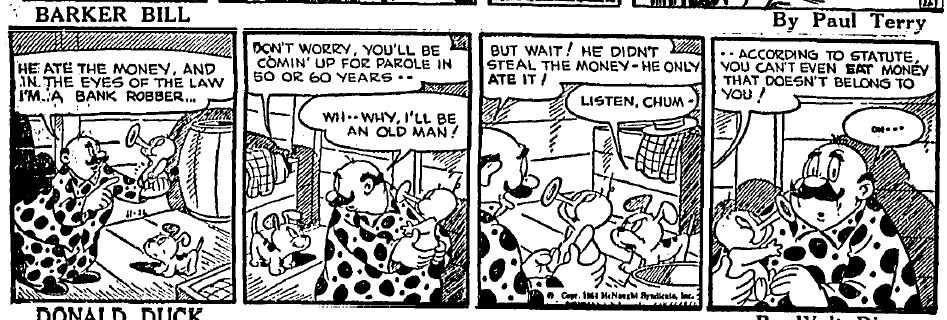
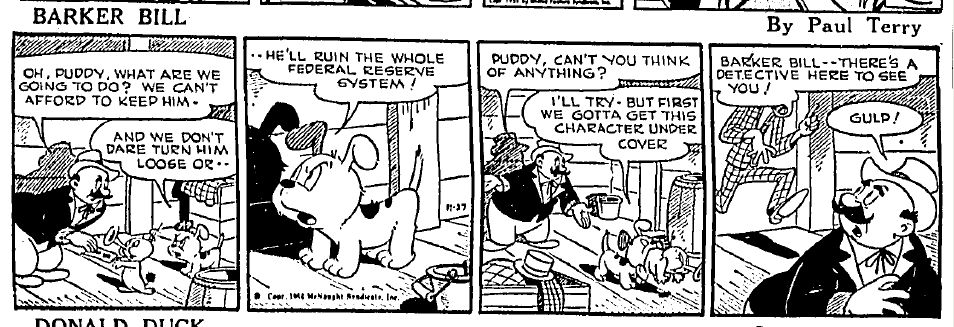
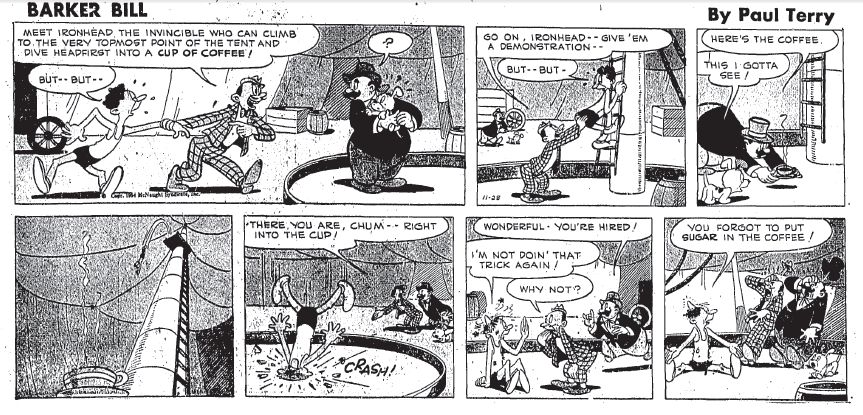
Happy New Year, everybody! As we ring out the old one, let’s welcome the new year with some old comic strips. Here is Barker Bill from 11-15 to Sunday, 11-28-1954. The first six dailies were sent to me by Yowp and were culled from the Winnipeg Free Press. The second batch of six dailies and the Sunday page are by courtesy of the Glendale Public Library and the ProQuest collection of the Boston Globe. Barker Bill and Puddy try to exhibit the money-eating Gelt as a circus attraction, but he literally eats up all the profits. The Sunday page from 11-28 was the earliest one that the Boston Globe carried, featuring Ironhead the Invincible. The Globe ran Barker Bill for only about 6 months and used the Sunday page infrequently, but it’s a revelation to me that Barker Bill even HAD a Sunday page. I have no idea if this is the first Sunday or not, perhaps one of my readers can fill us in.

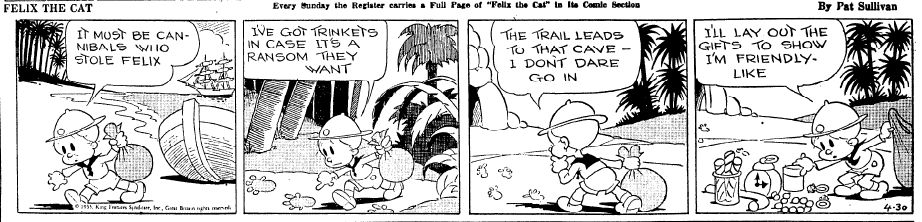
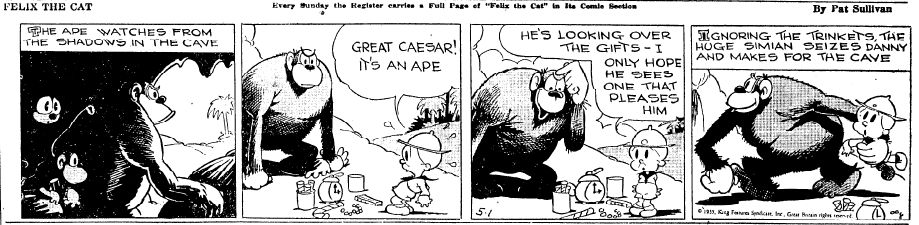
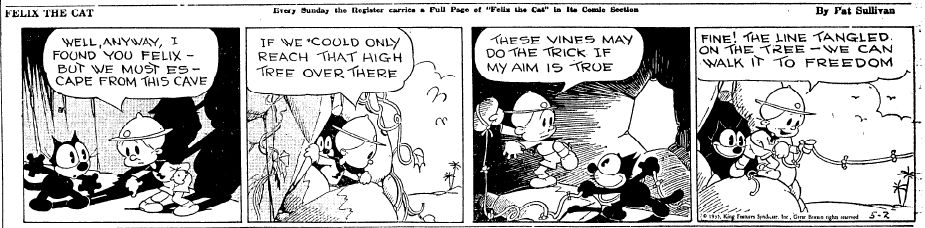
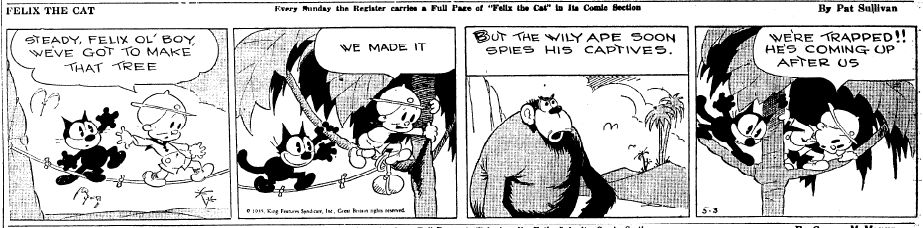
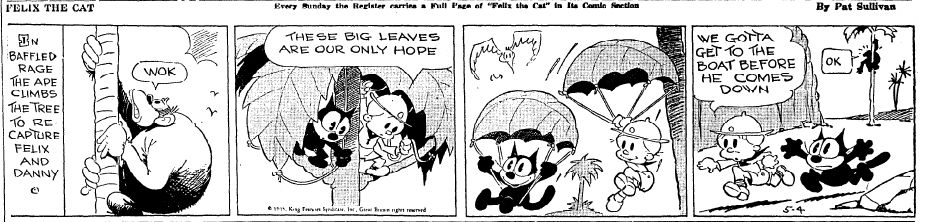
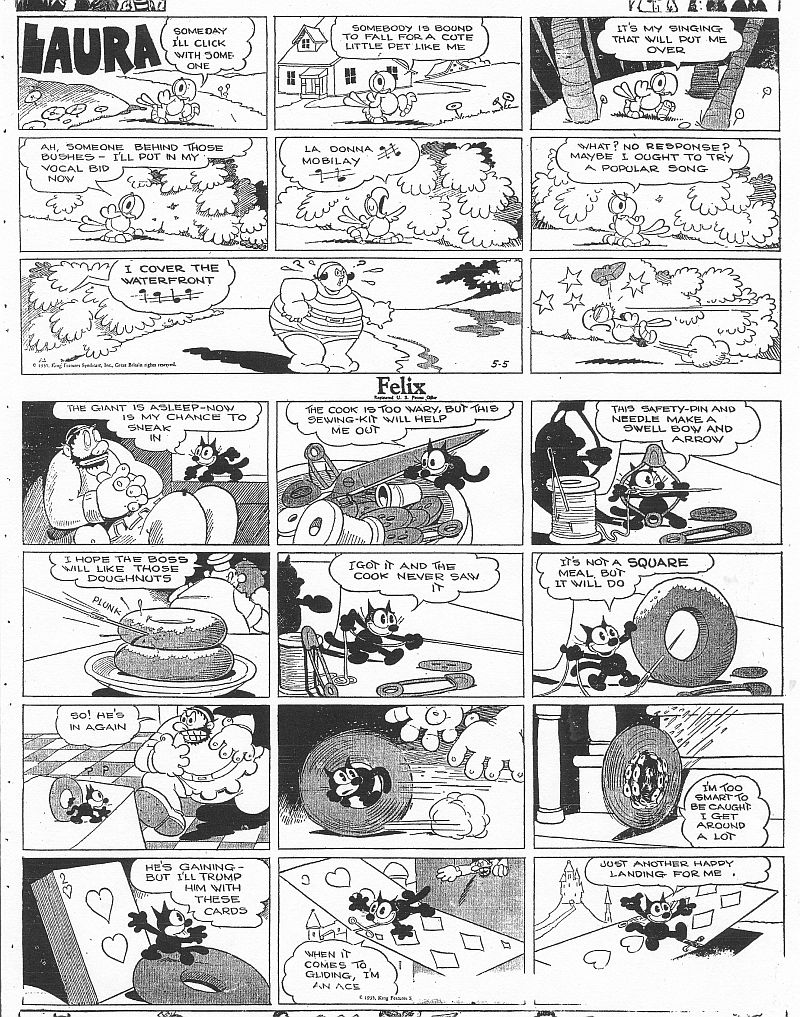
Felix (from 4-29 to 5-5-1935) continues the “Ape” saga, as Danny notices that Felix has been catnapped and pursues the Ape to the island, only to be caught himself. The Sunday page continues the adventures of Felix in Dreamland, using lots of cherce puns as Felix uses doughnuts and playing cards (“When it comes to gliding, I’m an ace!”) to elude the Giant. I like the gag in the “Laura” topper as the hapless parrot sings “I Cover the Waterfront” to a corpulent lady bather.
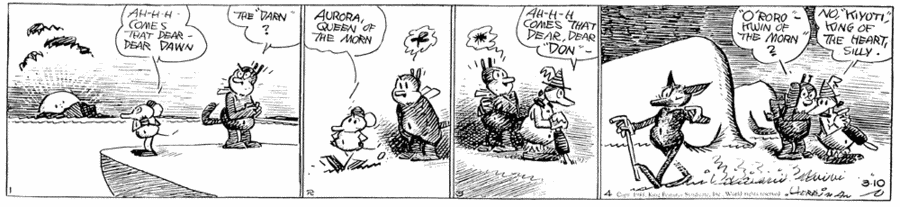
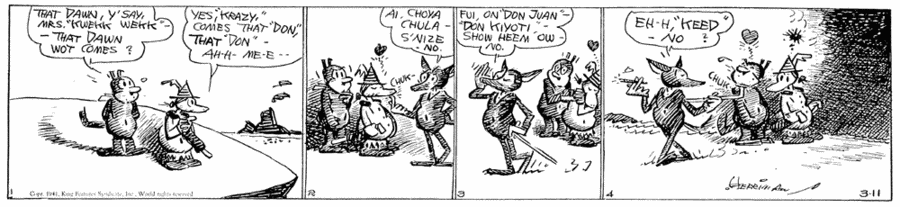
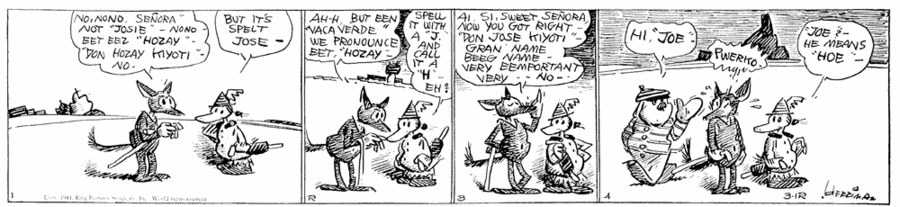
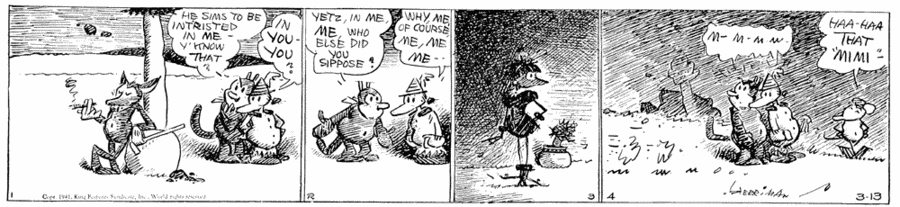
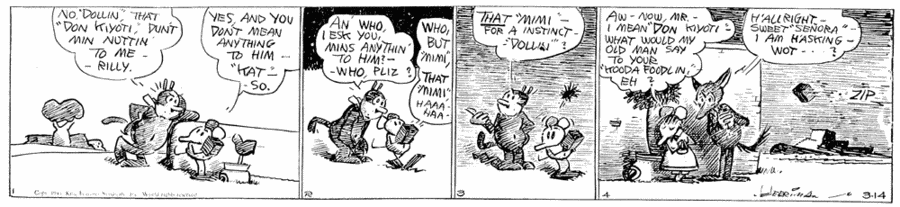
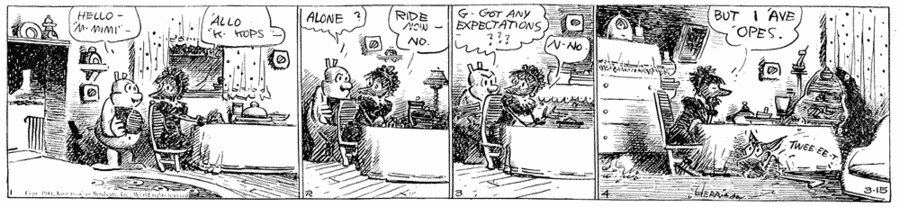
In Krazy (3-10 to 3-15-1941) the handsome Don Jose Kiyoti cuts a wide swath through the women of Coconino. He flirts with Krazy, Mrs. Ignatz Mouse and Mimi, the Poodle. The Don hides under Mimi’s table in the 3-15, after all, she’s the lady nearest in size to the “Dawn”.
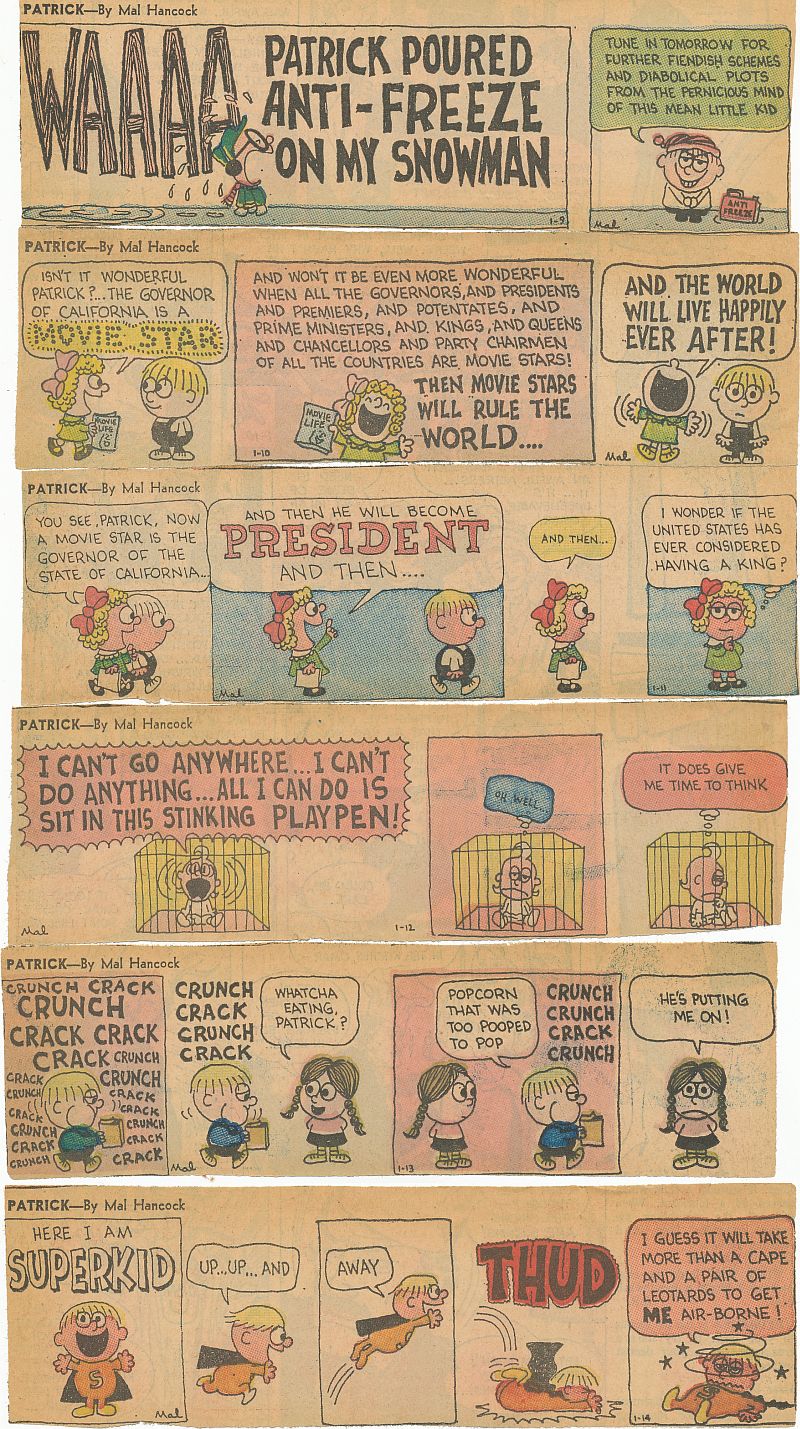
In Patrick (1-9 to 1-15-1967), Elsa predicts the future in the 1-11 strip. Ronald Reagan became the Governor of California in 1966, and won the Presidency in 1980. It might have seemed silly and funny that a little star-struck girl was wowed by a MOVIE STAR as Governor in 1967, but she was certainly accurate in anticipating what would happen to that STAR. In the 1-15, we have the first appearance of Patrick’s alter ego: “Superkid”. Over the next few months, you’ll see Patrick use and abuse that alias. A little side note, I was attending the Kansas City Art Institute in 1967 and had no access to the St. Louis Post-Dispatch, so my “kid brother”, Kurt, was kind enough to clip these strips for me, and ultimately, you! We all owe him big time. It’s been another year of hopes and delayed hopes, let’s give several Elmer Blurt imitations for 2012. See you then.
The Christmas Post 2011
  Merry Christmas, Happy Chanukah to all my readers! The record cover pictured here is one of those childhood memories that refuse to leave the brain. The song “Practice Makes Perfect”, on side two, sung by Bil Baird as The Dooley, pops into my mind almost every week, mostly unbidden. If you listen to the record: www.archive.org/details/TheWhistlingWizardGoldenRecord, you will hear Practice Makes Perfect about half-way in, the record runs six minutes. Please excuse the hum in the background, as this was recorded off Cathy’s old turntable at 78RPM. My mother must have bought this record for me when I was two or three years old. She probably sang “Practice Makes Perfect” along with the record to encourage me to practice the piano. In those days I had a little 78 phonograph that was shaped like a tall cylinder with stars on the side of it, and with a rather large tone arm that probably damaged the records as I played them. I loved repetition, and literally played most of my records to death. Thanks to Ebay, I found a beat-up, but still playable copy, and the memories came flooding back. I remembered “Practice Makes Perfect” as a lot more shrill and silly than it is here, but the melody and most of the lyrics are the same as I remember. The shrill overtones that I thought were on there might have come from the tinny little amplifier of the old Star sided record player. “The Whistling Wizard” was one of the few Big Golden Records releases, most Golden Records were little. It featured the cast of the first color television series, broadcast on CBS in 1951. The color system used, “field sequential”, was cumbersome and ultimately not adopted for regular telecasts. There don’t seem to be any kinescopes available of the show, certainly none in color, and I can’t remember if I ever saw it broadcast or not. I loved Bil Baird’s marionette and hand puppet designs, especially Heathcliff the horse and Charlemagne, the lion. Charlemagne later on morphed into Champy the Lion, who starred on the old Wheaties TV commercials from 1956. Baird’s puppets looked like a combination of Tony Sarg (Bil’s mentor) and Eastern European puppet design. Baird’s first show before “Wizard”, was “Life With Snarky Parker” directed by Yul Brynner. Heathcliff the talking horse was a holdover from Snarky’s show. Baird was a big deal on TV in the mid-1950s before the puppet world was eclipsed by Jim Henson’s Muppet designs. Baird did a couple of specials with Art Carney, one of which was “Art Carney Meets Peter and the Wolf”. Copies are available of that one, and the marionette work was impressive, especially the wolf. Carney really entered the spirit of the story and made the puppets seem even more alive by his very warm relationship with them. Look around on You Tube for it.
A while ago, I experimented with reading Dorothy Parker and other stories aloud, and making them available on the blog. They weren’t too popular, maybe I’m not much of a reader, but here’s a “Christmas Leftover” that I’m handing out, Chapter 24 of Felix Salten’s “Bambi”. In Salten’s original, Bambi does not live happily ever after with Faline, and the old Stag is almost at the end of his life. Bambi’s father takes Bambi to a lonely place in the forest where a man has died as the result of a shooting accident. As he observes the bleeding corpse, Bambi learns that man is not all-powerful, as many of the animals believed, but vulnerable, and capable of being killed like all the other creatures of Earth. This idea isn’t featured in the Disney cartoon; Salten’s story is quite a lot darker. If you care to hear me read it: www.archive.org/details/BambiChapter24ReadByMarkKausler. Click over to Archive.org and listen. It runs 7.40Â minutes or so.
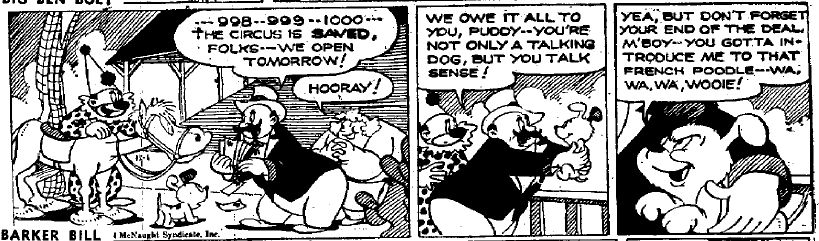
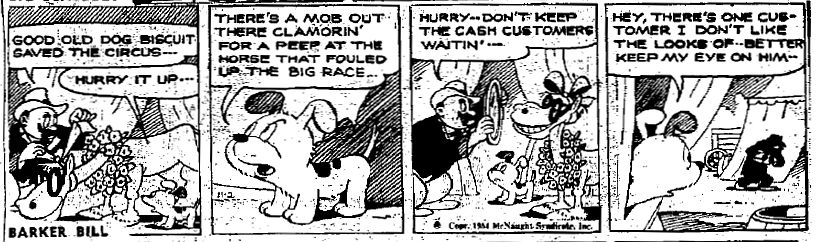


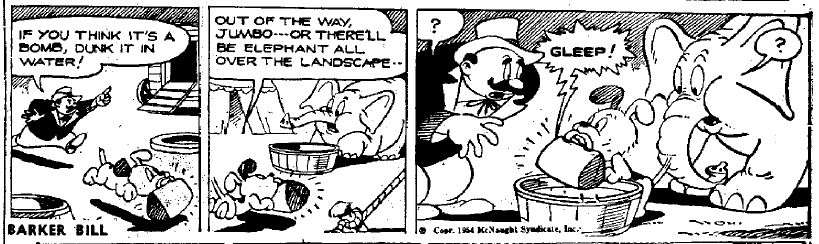
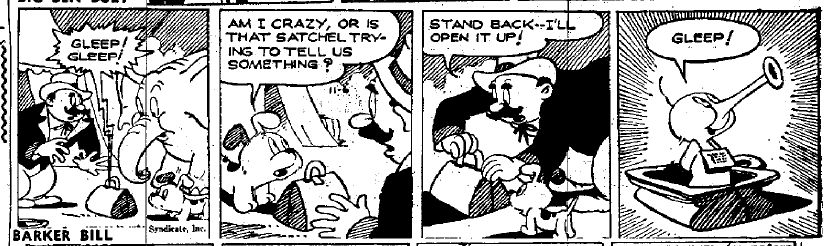
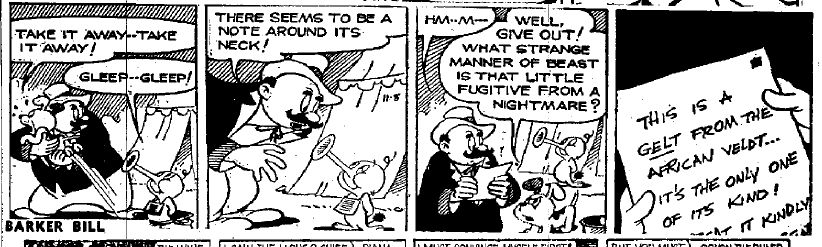

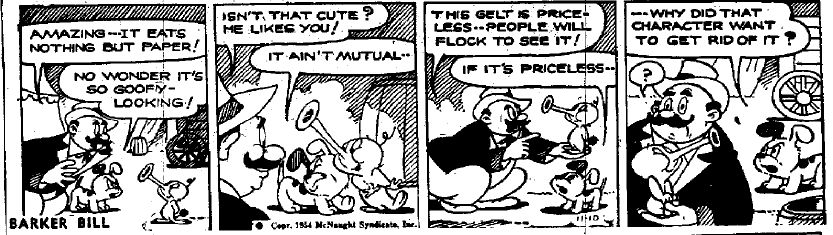
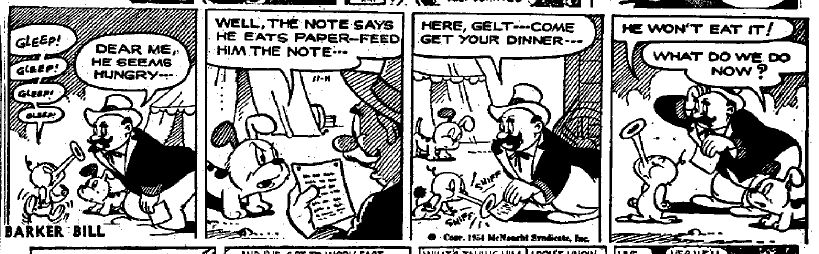
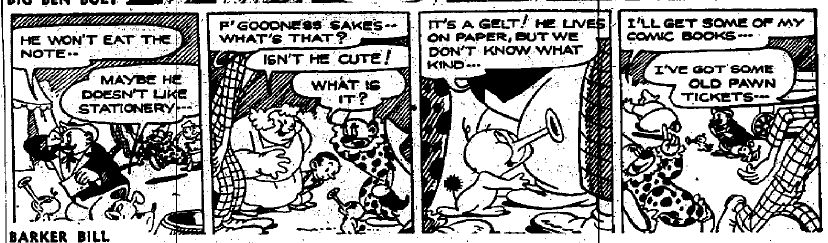
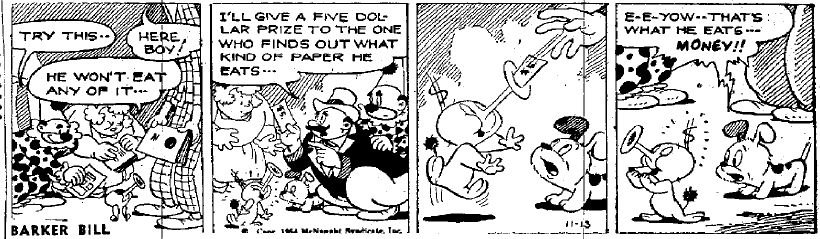 Â Barker Bill from 11-1 to 11-13-1954, comes to us by courtesy of Yowp, remember to click on the Blogroll to your right to access his two fine blogs, Yowp and Tralfaz. Bill discovers the Gelt from the African Veldt in the beginning of the story that I started two posts ago with greatly inferior copies of the strips. The missing episodes are now filled in, and we will continue the money-eating Gelt’s adventures next post.
 Barker Bill from 11-1 to 11-13-1954, comes to us by courtesy of Yowp, remember to click on the Blogroll to your right to access his two fine blogs, Yowp and Tralfaz. Bill discovers the Gelt from the African Veldt in the beginning of the story that I started two posts ago with greatly inferior copies of the strips. The missing episodes are now filled in, and we will continue the money-eating Gelt’s adventures next post.

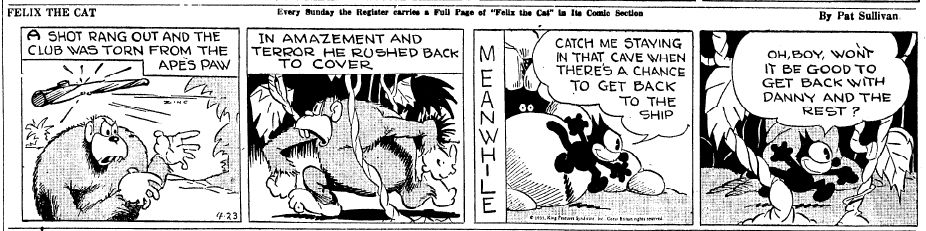
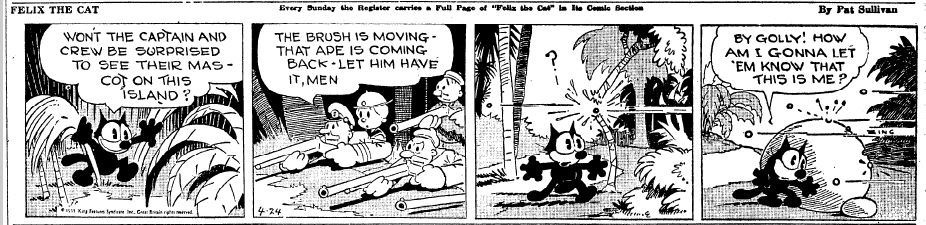
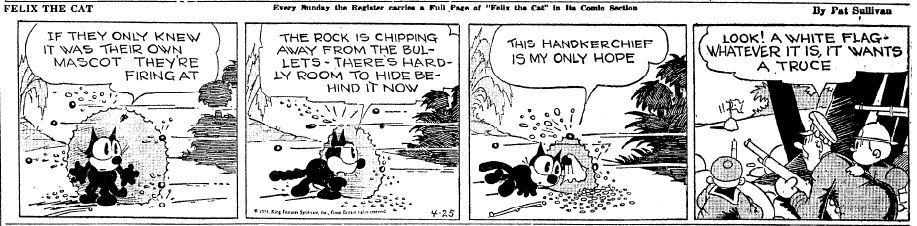
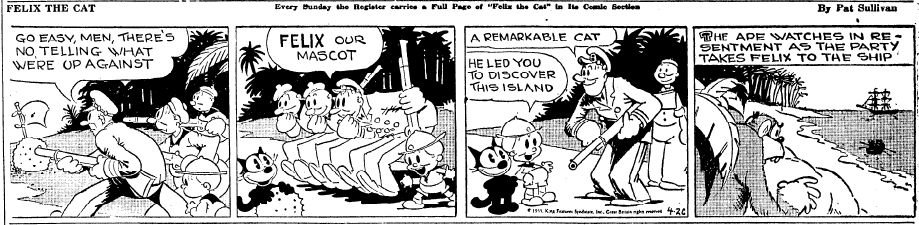
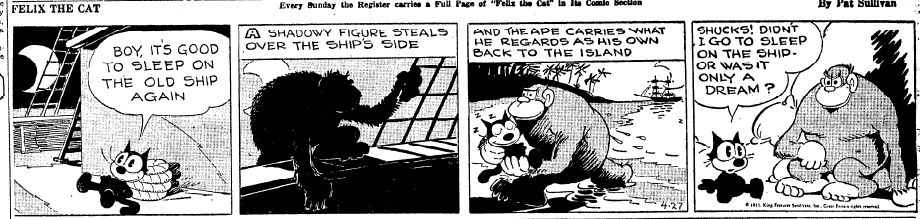
 Â Felix, from 4-22 to 4-28-1935, is hauled away to the Ape’s den. Felix makes his escape from the den, and is picked up by Danny and the ship’s crew. In a silhouette panel that reminds me of the movie “King Kong”, the Ape sneaks aboard ship in the 4-27, and takes Felix to his den once more. In the Sunday, Felix is still in Dreamland, and escapes from the Giant by bouncing away with the help of the eraser end of a giant pencil!
 Felix, from 4-22 to 4-28-1935, is hauled away to the Ape’s den. Felix makes his escape from the den, and is picked up by Danny and the ship’s crew. In a silhouette panel that reminds me of the movie “King Kong”, the Ape sneaks aboard ship in the 4-27, and takes Felix to his den once more. In the Sunday, Felix is still in Dreamland, and escapes from the Giant by bouncing away with the help of the eraser end of a giant pencil!
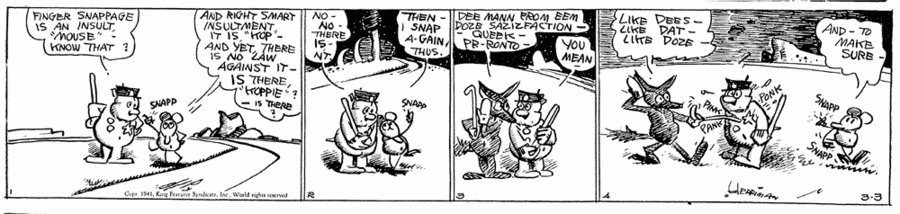


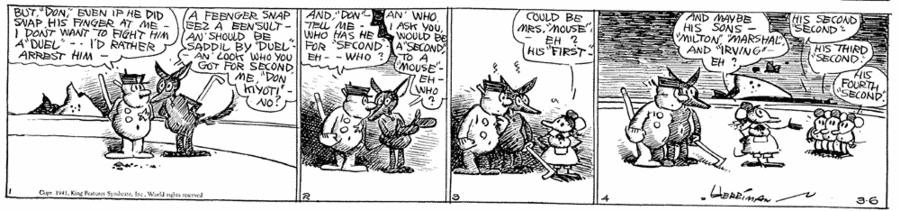

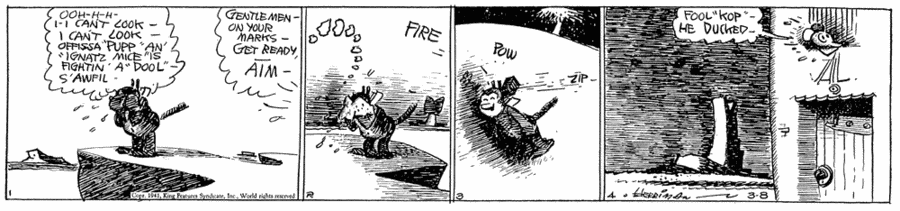  Krazy, from 3-3 to 3-8-41, features one storyline for the week: “The Duel”. Don Kiyoti encourages Offissa Pupp to fight a duel with Ignatz after Ignatz defiantly snaps his fingers at the Pupp. Don Kiyoti serves as Pupp’s second and Ignatz’s wife and kids serve as the Mouse’s seconds, thirds, fourths and fifths. The duel ends in a brick toss which misses Offissa Pupp and hits….should I tell you?
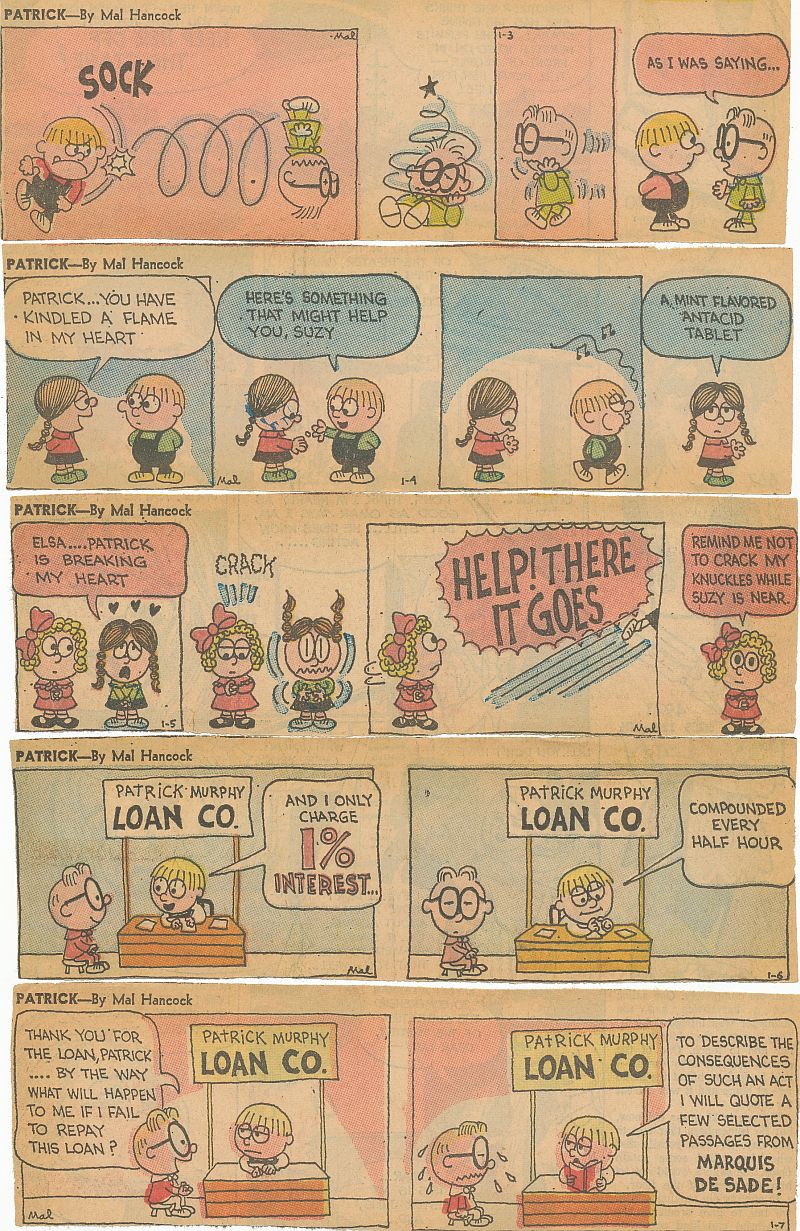 Â Patrick, from 1-3 to 1-7-1967, really has a Schulz flavor this time. Elsa and Suzie’s antics in the 1-5 remind me of Violet and Patty, if a bit more manic, and Patrick’s loan company reminds me of Lucy’s Psychiatry Booth, and even more of Skippy’s various businesses in the 1930s. I don’t remember if Skippy threatened Marquis de Sade tactics on his clients, but maybe Percy Crosby didn’t think Skippy should be that precocious. Stay away from undercooked Christmas Goose folks, and recycle your wrapping paper. We’ll see you again after Ol’ Sam Nicholas has returned to the Toy Factory.
 Patrick, from 1-3 to 1-7-1967, really has a Schulz flavor this time. Elsa and Suzie’s antics in the 1-5 remind me of Violet and Patty, if a bit more manic, and Patrick’s loan company reminds me of Lucy’s Psychiatry Booth, and even more of Skippy’s various businesses in the 1930s. I don’t remember if Skippy threatened Marquis de Sade tactics on his clients, but maybe Percy Crosby didn’t think Skippy should be that precocious. Stay away from undercooked Christmas Goose folks, and recycle your wrapping paper. We’ll see you again after Ol’ Sam Nicholas has returned to the Toy Factory.
More “Barkers” From Yowp
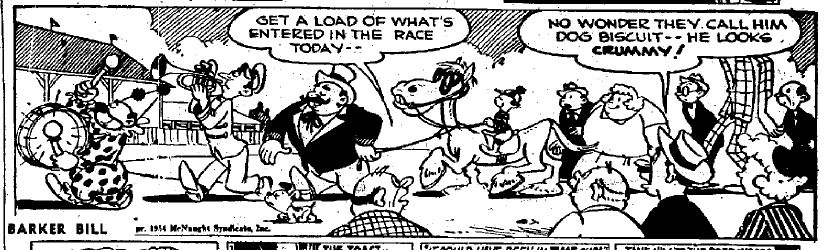
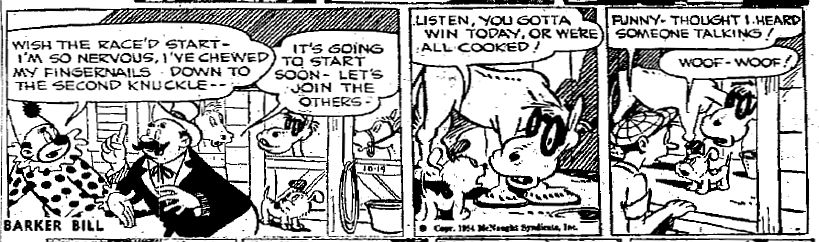
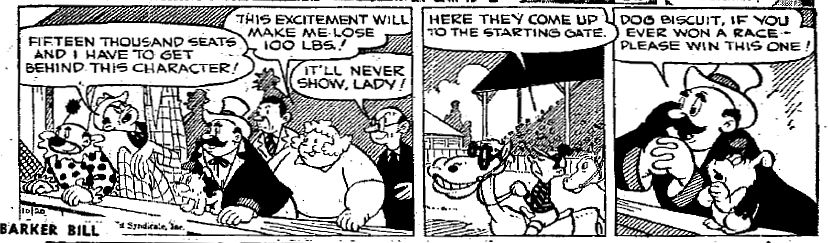
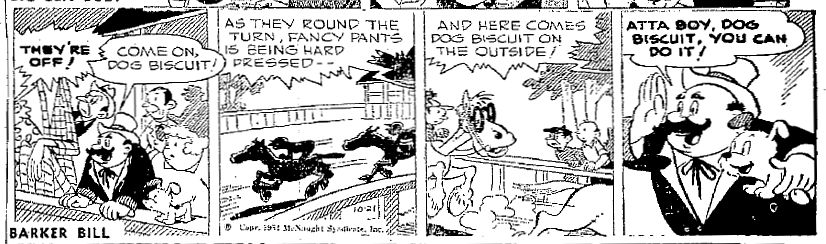
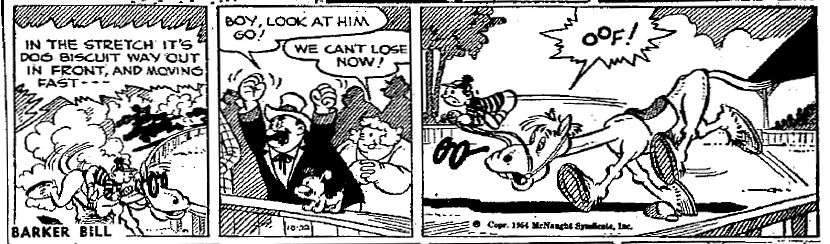
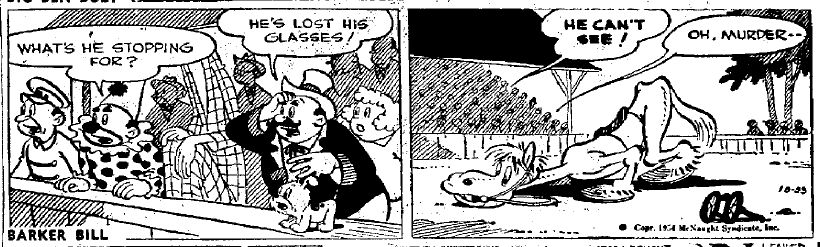
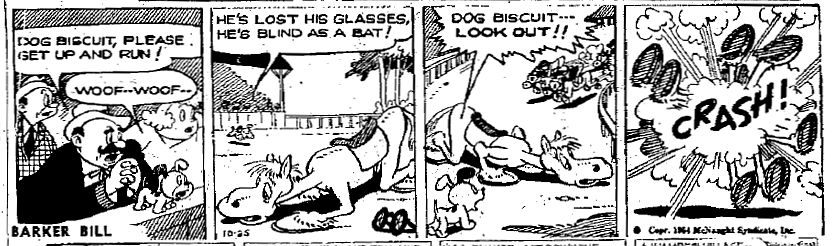
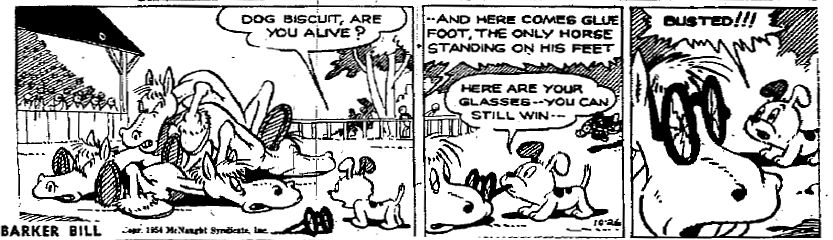

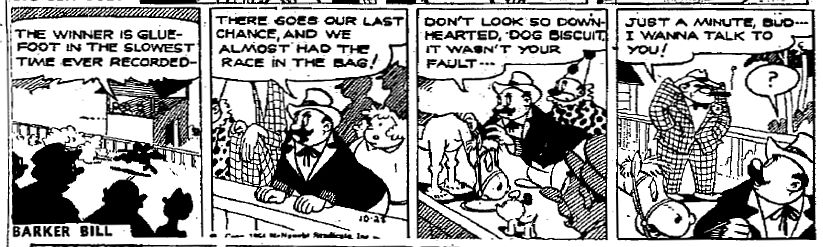
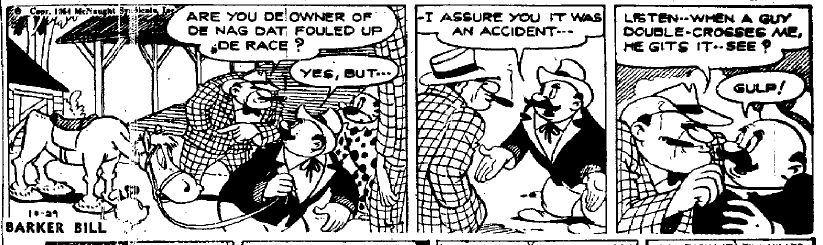
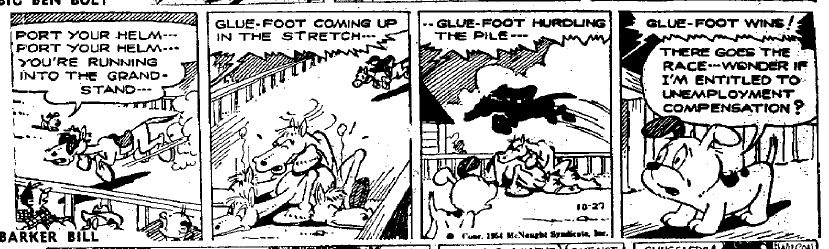
  Thanks to Yowp, who downloaded these strips, here are the Barker Bill dailies from 10-18 to 10-30-1954. In the last blog post, during the 10-8-54 strip, Barker Bill  speculated about Dog Biscuit’s resemblance to a TV personality. That would have to be Dave Garroway, who was known for his big smile and dark, horn rimmed glasses. Dave was the host of NBC’s Today show from 1954 to 1961, so this would have been during his heyday. In these strips, Dog Biscuit the horse, breaks his glasses and loses the race, upping the odds on Glue Foot, the slowest horse. Glue Foot wins, and “Longshot Louie” pays off to Barker Bill!
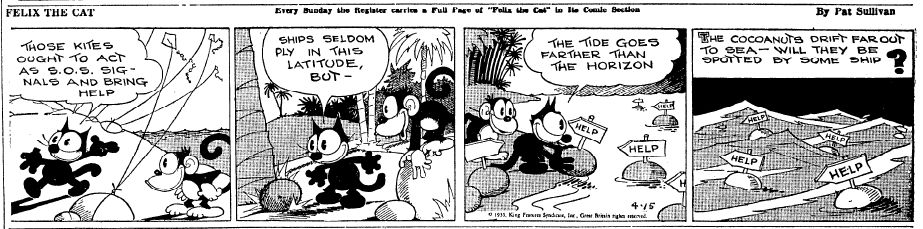
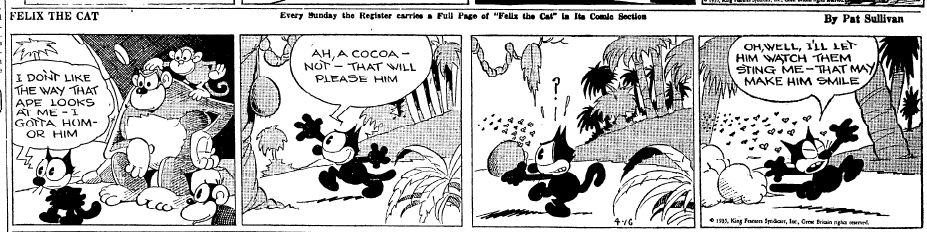
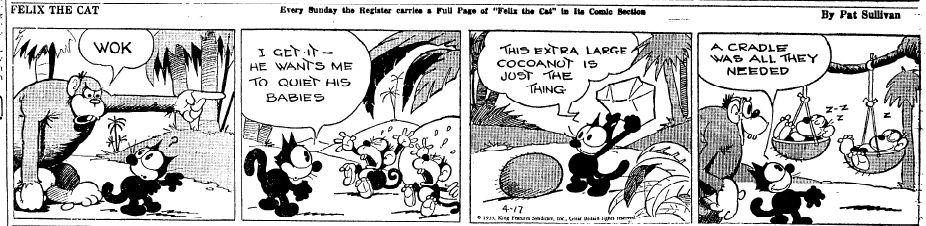
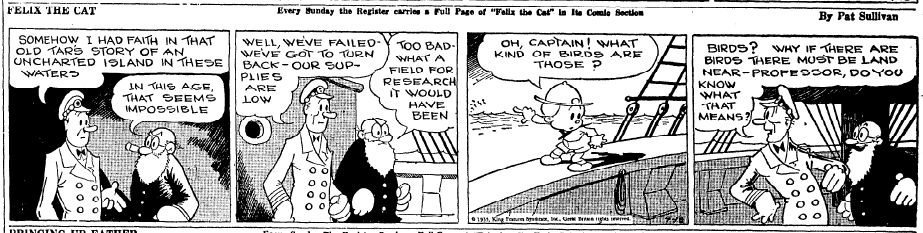

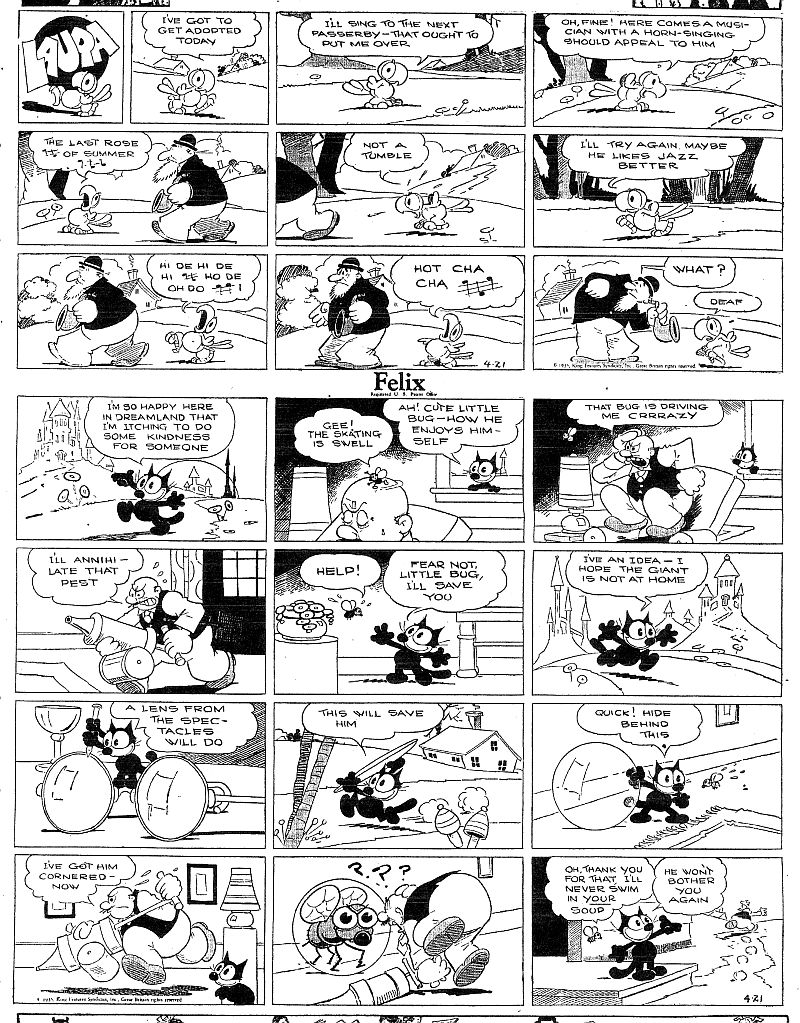 Â Felix, from 4-15 to 4-21-1935 continues his adventures on the tropical island. Felix has to babysit the big ape’s little ones, but the ship is not far behind and spots birds flying toward the island. Will Felix be rescued? In the Sunday, Felix continues to stick to Dreamland, and rescues a little fly with the help of the Giant’s glasses.
 Felix, from 4-15 to 4-21-1935 continues his adventures on the tropical island. Felix has to babysit the big ape’s little ones, but the ship is not far behind and spots birds flying toward the island. Will Felix be rescued? In the Sunday, Felix continues to stick to Dreamland, and rescues a little fly with the help of the Giant’s glasses.

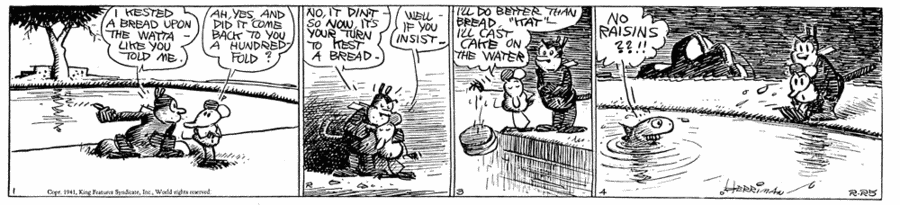


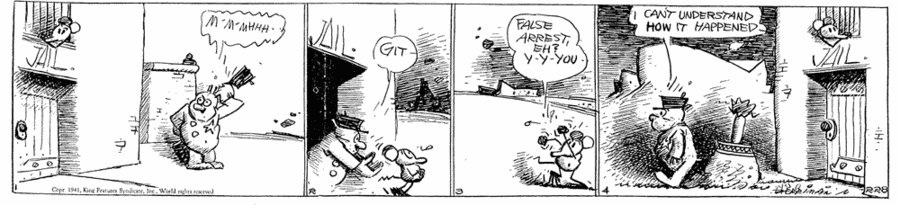
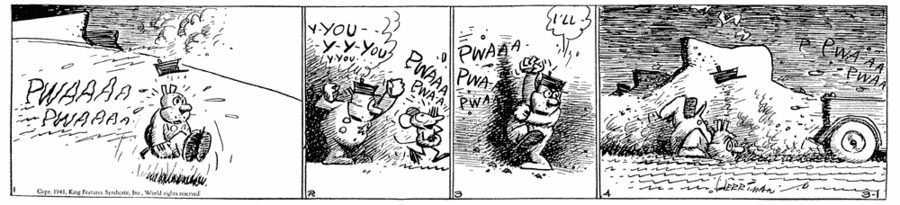 Â In the strips from 2-24 to 2-19-1941, Krazy casts his bread upon the waters, and Ignatz gets away with a brick toss during Offissa Pupp’s “see no evil” routine. Ignatz spends time in Jail and razzes Pupp in the 2-29.
 In the strips from 2-24 to 2-19-1941, Krazy casts his bread upon the waters, and Ignatz gets away with a brick toss during Offissa Pupp’s “see no evil” routine. Ignatz spends time in Jail and razzes Pupp in the 2-29.
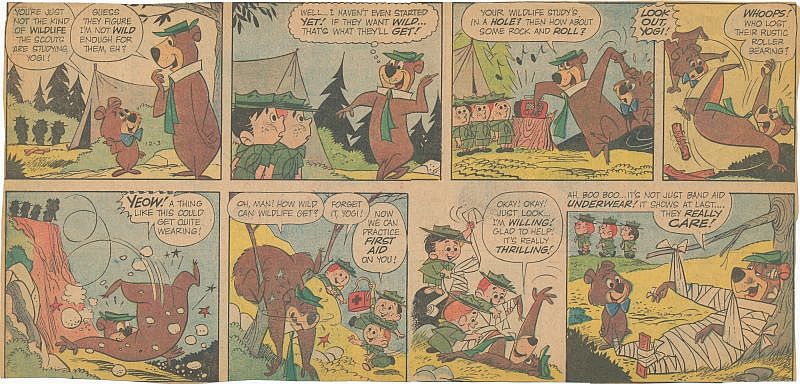
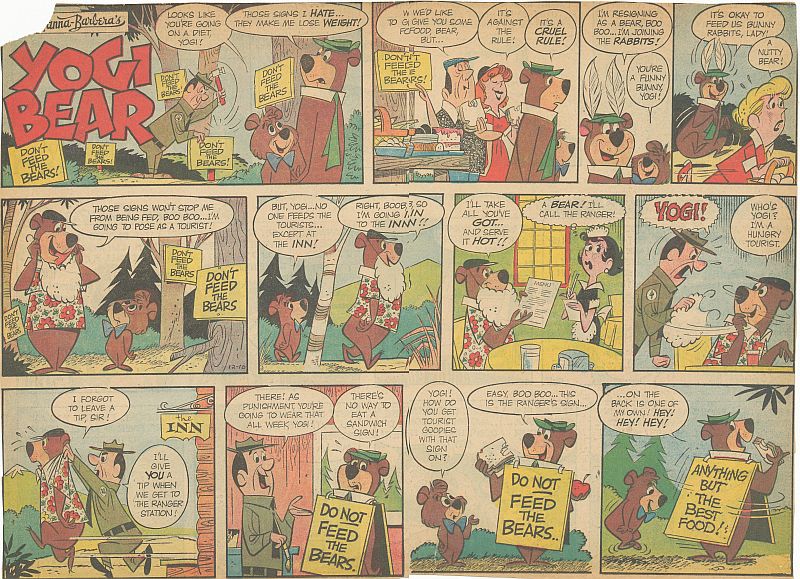
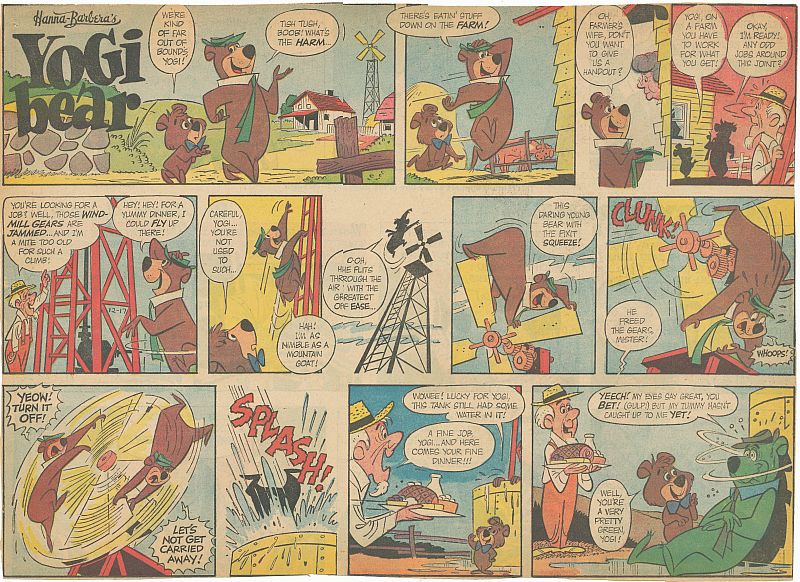

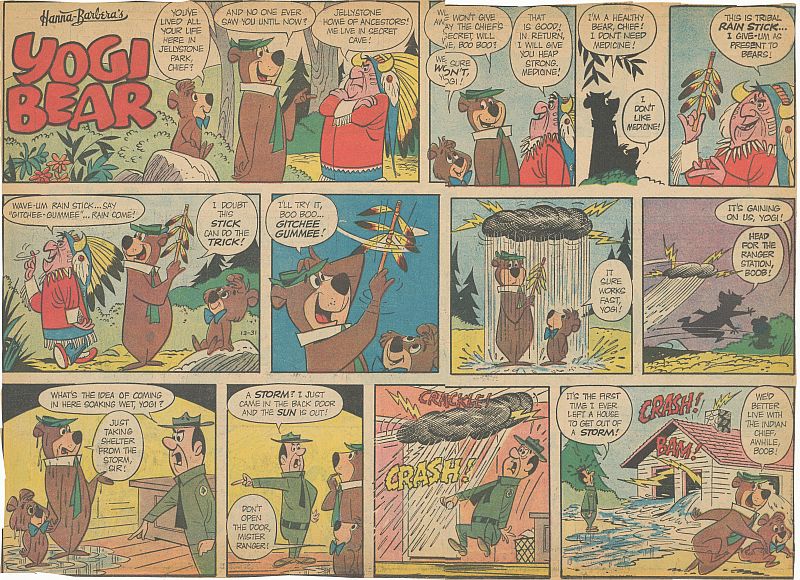
Scanned off my collection of clipped Yogi Sunday pages from the St. Louis Post Dispatch, are the December, 1961 strips. Go over to Yowp’s website and read his notes on them, then kindly come back here, click to enlarge, and read them in color and mostly half-page size (the 12-3 is only third-page).
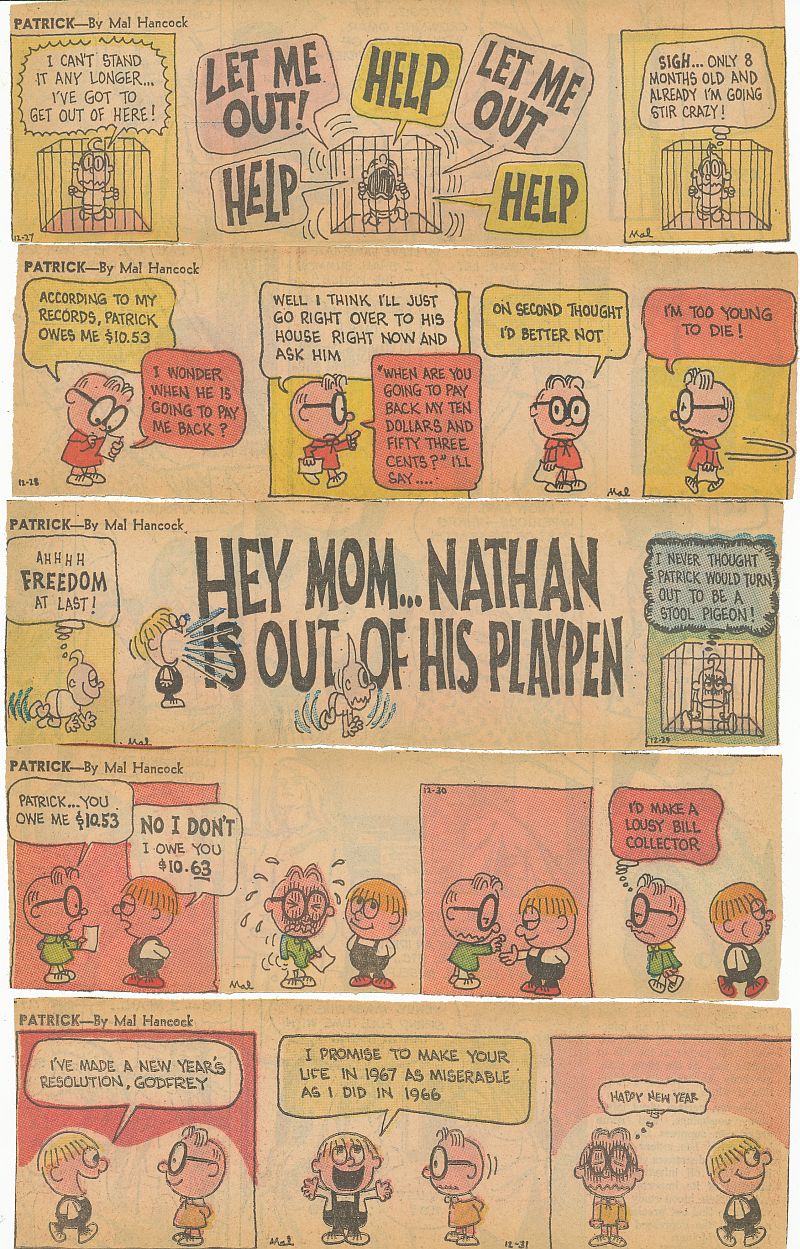
Patrick this time, finishes off the strips from 1966, 12-27 to 12-31. Nathan is going stir crazy, and Patrick tricks Godfrey out of a dime at the same time that Godfrey tries to collect $10.53 from Patrick. Patrick promises that Godfrey’s new year will be as miserable as 1966 was in the 12-31. The Post-Dispatch did not publish on Jan. 1st, 1967, so the next Patricks will start with the 1-3-67. I hope to do a special Christmas post next time.
Barker Bill-Take Two
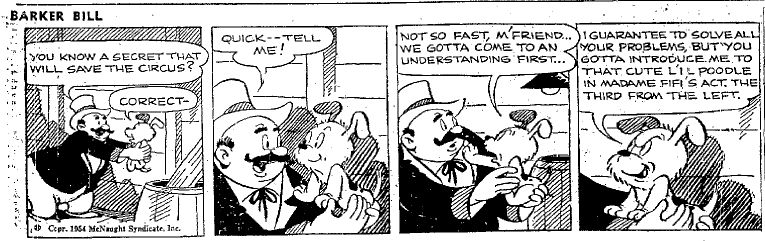
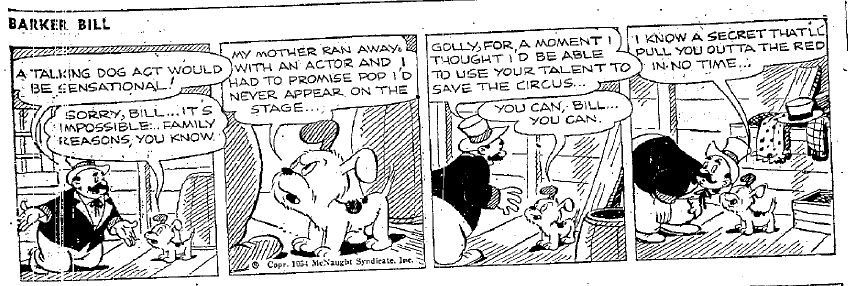
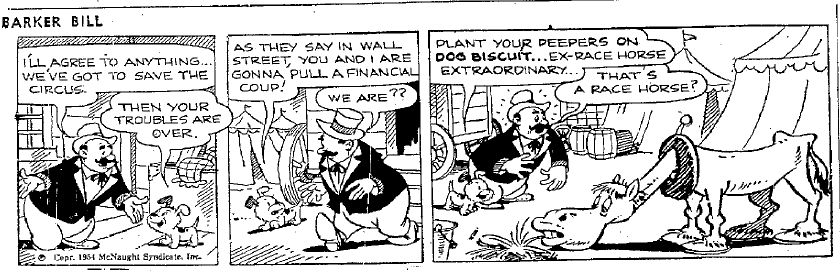
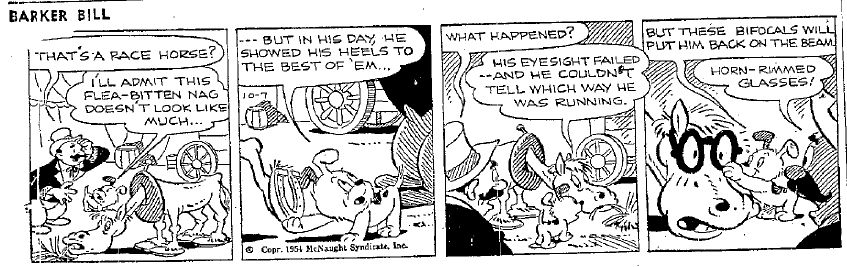
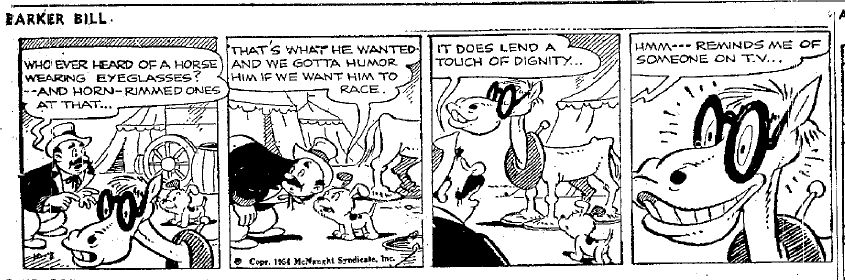

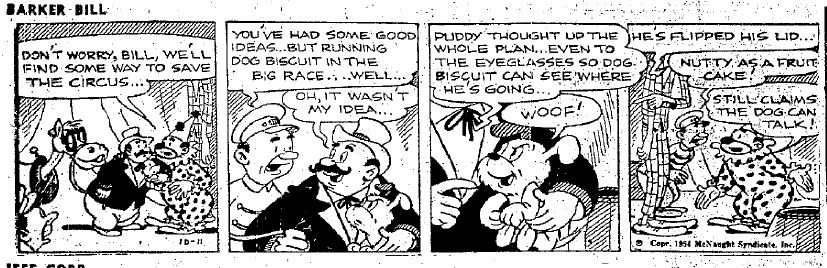

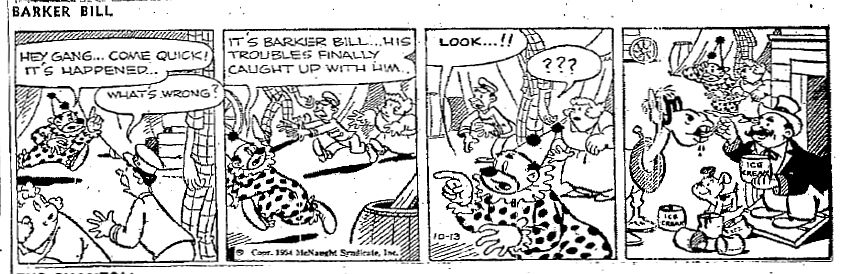
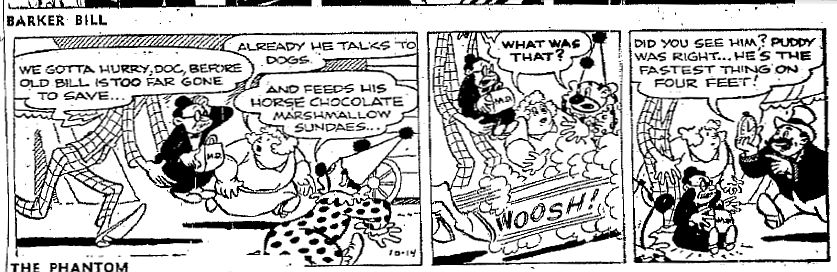
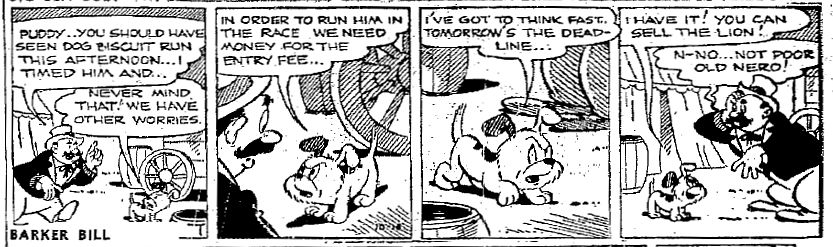
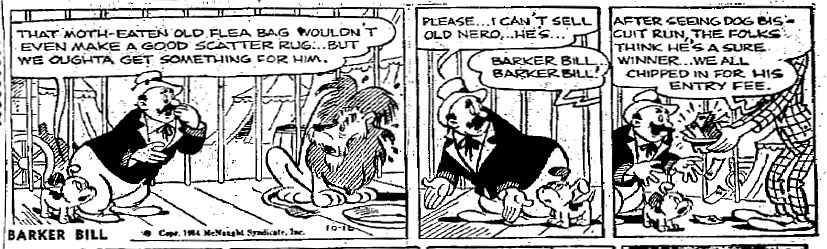 Â Thanks to Yowp, who now has two blogs, which touch on animated cartoons and related topics, we have the first three weeks of the Barker Bill daily available to read. If you want to see the first week, from 9-27 to 10-2-54, head over to the new Tralfaz blog: http://tralfaz.blogspot.com/2011/11/barker-bill-by-bob-kuwahara.html. There you will be able to see the first week of the strip. I’ve reprinted the second and third weeks above, 10-4 through 10-16-1954. The first weeks involve Barker Bill’s efforts to save his circus from going under by getting into the race horse game. Puddy the Pup’s ability to speak English (but only to Barker Bill), together with his brilliant mind, come into play here as well. The Winnipeg run of the strip is much better than the Greensburg one I started with, having much fewer dropouts in the art. So, I’m starting over. Make sure you visit Tralfaz and Yowp’s blogs often. He almost always has something interesting to read.
 Thanks to Yowp, who now has two blogs, which touch on animated cartoons and related topics, we have the first three weeks of the Barker Bill daily available to read. If you want to see the first week, from 9-27 to 10-2-54, head over to the new Tralfaz blog: http://tralfaz.blogspot.com/2011/11/barker-bill-by-bob-kuwahara.html. There you will be able to see the first week of the strip. I’ve reprinted the second and third weeks above, 10-4 through 10-16-1954. The first weeks involve Barker Bill’s efforts to save his circus from going under by getting into the race horse game. Puddy the Pup’s ability to speak English (but only to Barker Bill), together with his brilliant mind, come into play here as well. The Winnipeg run of the strip is much better than the Greensburg one I started with, having much fewer dropouts in the art. So, I’m starting over. Make sure you visit Tralfaz and Yowp’s blogs often. He almost always has something interesting to read.
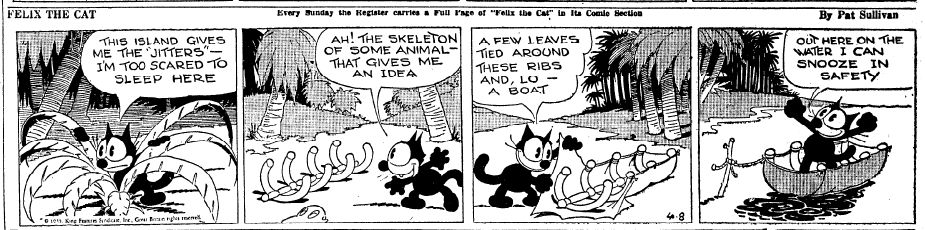
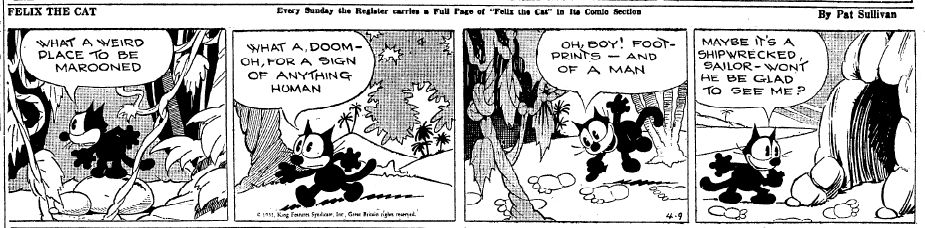
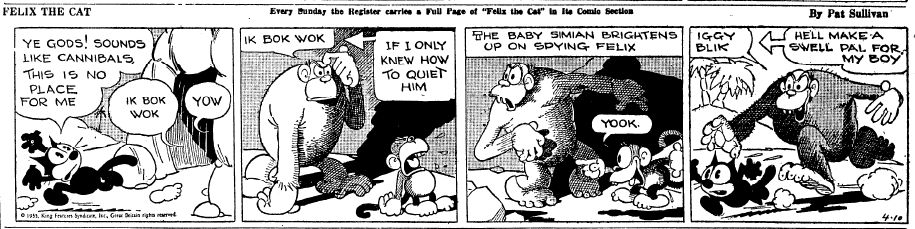
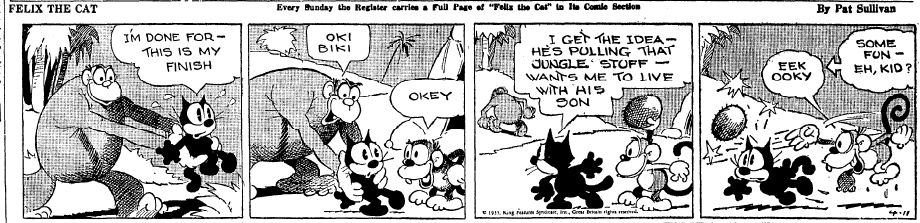
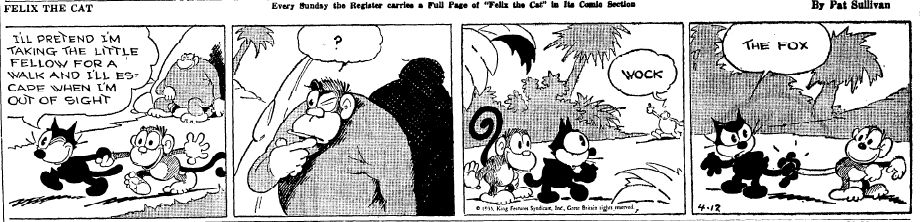

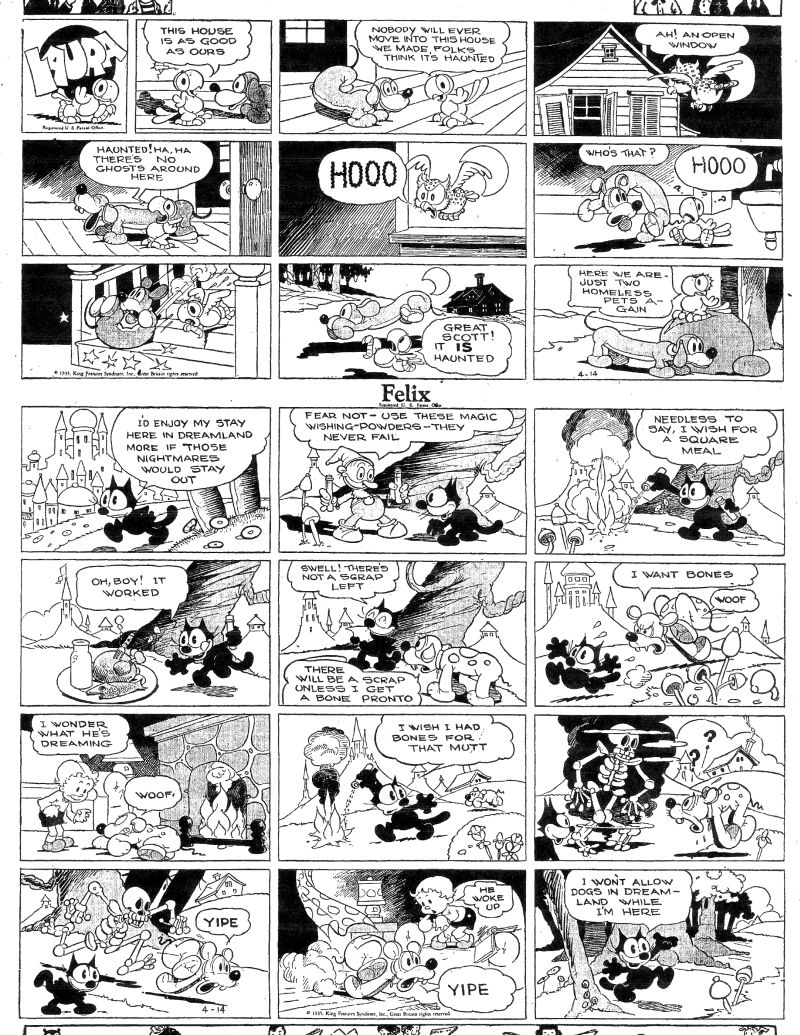
Felix (4-8 to 4-14-1935) lands on the desert island and busies himself trying to survive. He devises kites and sends them up, hoping to attract the ship’s attention. In the Sunday, Felix controls a dog’s dream invasion of Dreamland, conjuring up a human skeleton!
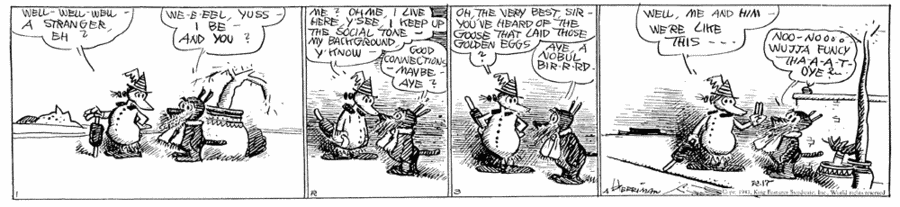
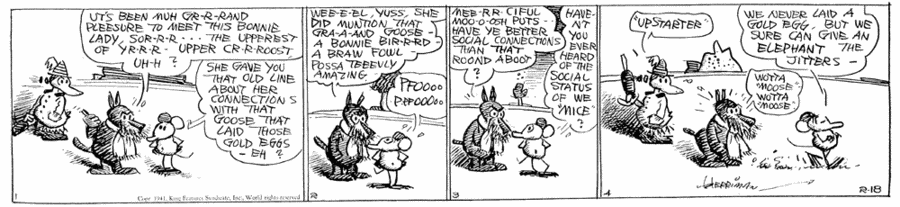
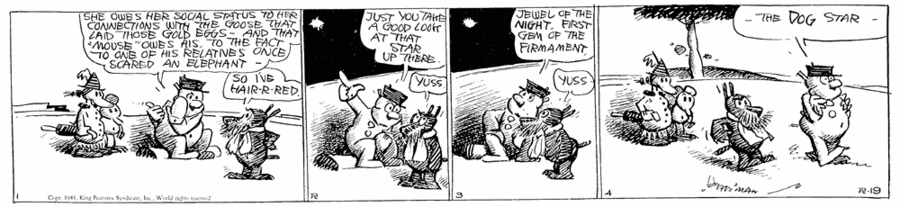
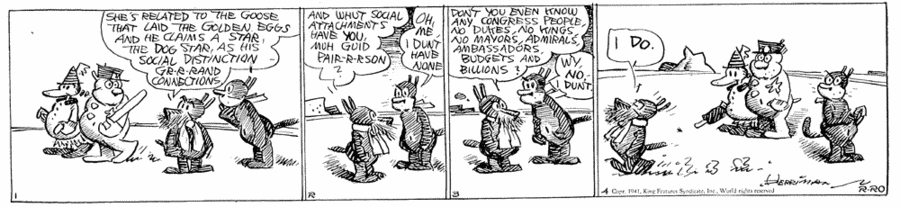
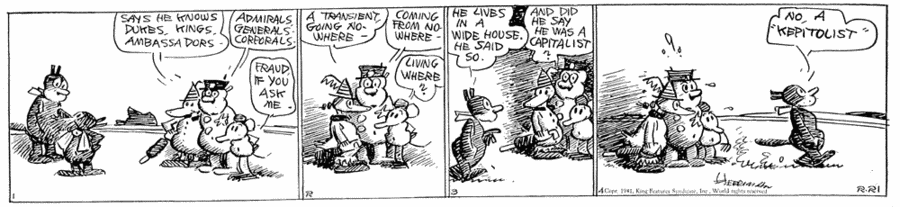
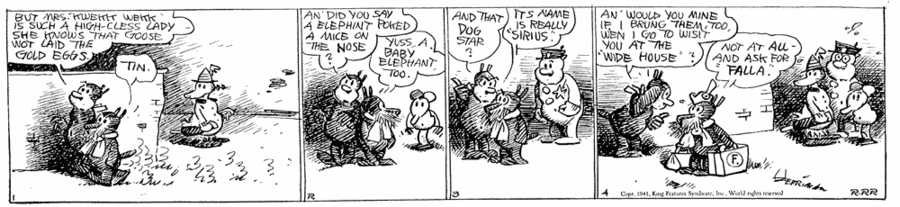
Krazy (2-17 to 2-22-1941) has a special guest this week. A scotch terrier with a very thick brogue, compares notes with Mrs. Kwakk-Wakk and all the prominent citizens of Coconino, concerning high-class social connections. In the 2-22, the scotty reveals that he is Fala, President Roosevelt’s famous dog. This storyline must have appealed strongly to Garge Herriman, as he loved scotch terriers as well.
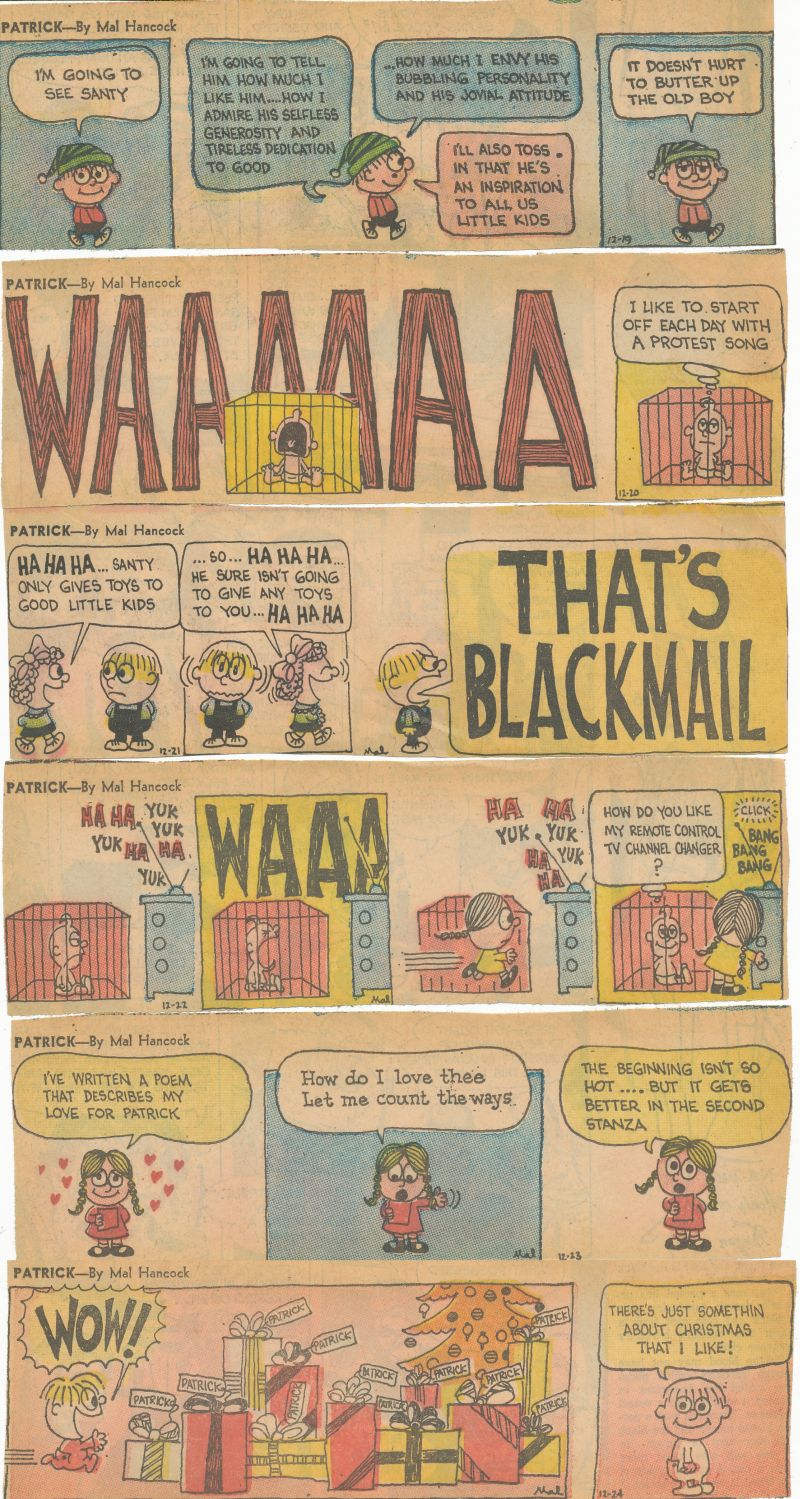 Â Patrick (12-19 to 12-24-1966), struggles with his greed on Christmas week. The 12-24 strip says it all. Nathan keeps interacting with his constant companion, the TV set.
 Patrick (12-19 to 12-24-1966), struggles with his greed on Christmas week. The 12-24 strip says it all. Nathan keeps interacting with his constant companion, the TV set.
Happy Thanksgiving to everyone! Jerry Beck and I didn’t have a table at the CTN Expo as it turns out, and I didn’t stick around. Maybe next year things will work out better, and I’ll have some interesting artwork to sell. Friends who never comment on my blog tell me that they really enjoy it and read it regularly. It’s very gratifying to be reaching so many good folks! Keep your bicarbonate handy.
Bob Kuwahara’s “Barker Bill”
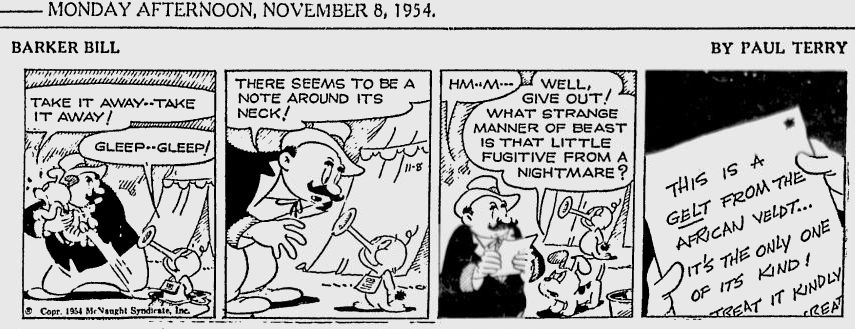
One of the “Holy Grails” of cartoon comic strips turned up in the Google News Archive! Direct from the Greensburg Daily Tribune we bring you some of the dailies that appeared in 1954-55, signed by Paul Terry, but drawn by Bob Kuwahara. Bob created “Marvelous Mike”, which has been reprinted almost complete here on this blog. The “Barker Bill” strip is a “hoomerous kontinooity”, with a touch of fantasy. I’m not sure exactly when “Barker Bill” started, but this strip from Nov. 8, 1954 is the earliest one in the Greensburg paper. We start mid-story as Bob Kuwahara introduces the “Gelt” from the African Veldt, a strange little character who does astonishing things (like eating paper money) to make Barker Bill’s top hat fly off. You will note that his hat flys off in nearly every strip, so he’s easily astonished. Puddy the Pup can talk in these strips, and is pretty intelligent, but he will only speak with Barker Bill. This reminds me of “Marvelous Mike”, the intelligent talking baby who would only converse with his sister at first. The Greensburg paper only printed the strip four days out of the week, but at least we have SOME of the strip’s run to read again. It’s a minor work, only ran about a year, and evidently there was a Sunday page. Here are the next 7 strips in the collection:
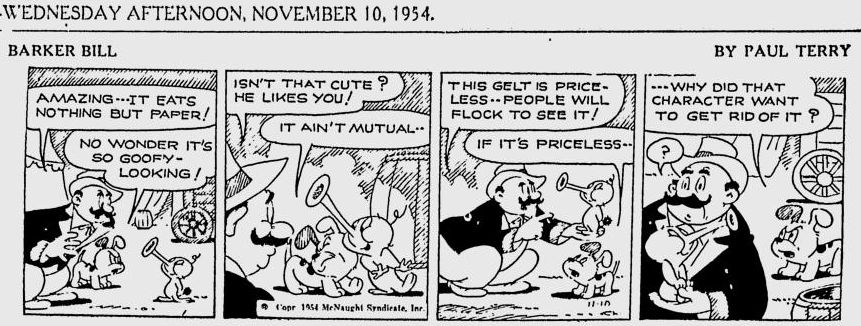

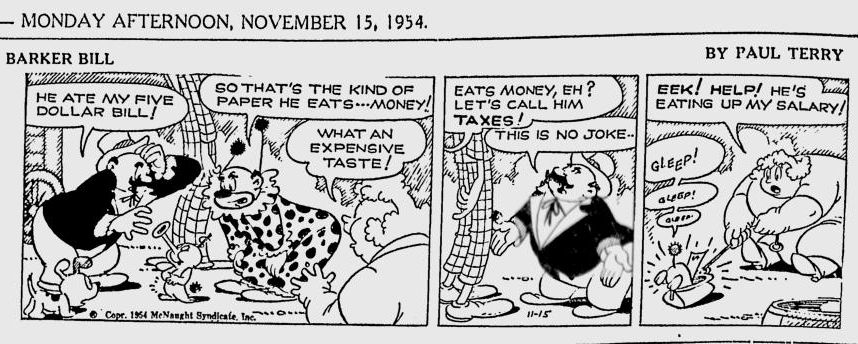
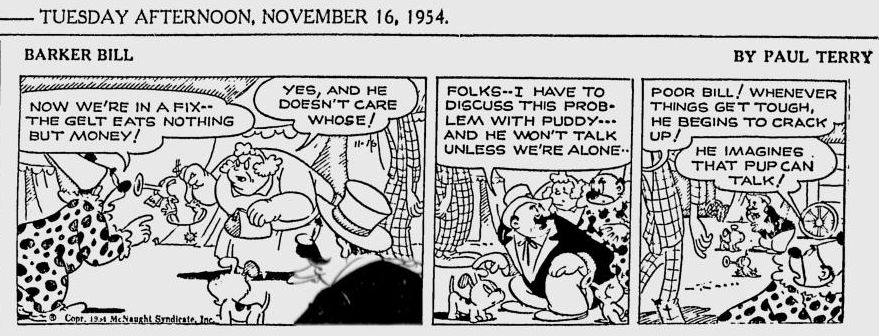
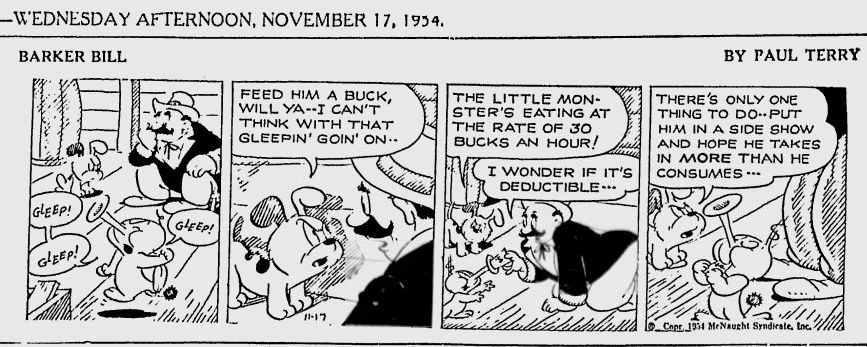
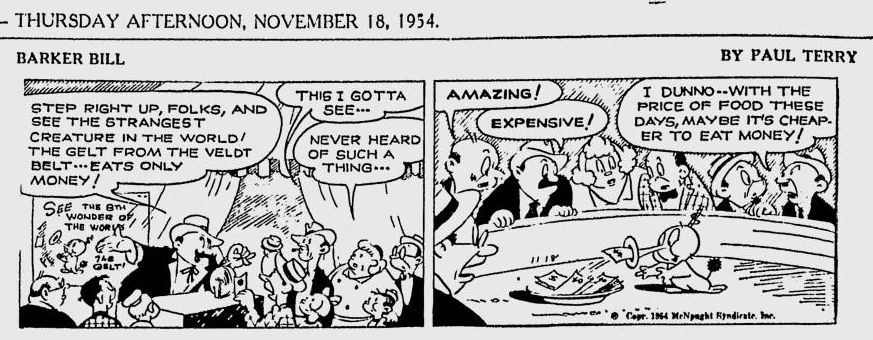  I’m going to try to do these eight strips at a time, due to the strange way the Greensburg Daily Tribune printed them. Barker Bill originally appeared in the 1942 Technicolor cartoon “Happy Circus Days”, directed by Connie Rasinski. The early 1940’s cartoons were about as polished as Paul Terry animateds got. Barker Bill was animated principally by Carlo Vinci in the ringmaster’s first and only screen appearance. About 10 years later, 1953, the Barker Bill Cartoon Show debuted on CBS. This was one of the earliest old theatrical cartoon packages to appear on network TV, and created an audience for Farmer Al Falfa, Kiko the Kangaroo, Puddy the Pup, Dinky Duck and the other citizens of early 1930s Terrytown. Evidently, the show was successful enough that CBS made their offer for Terry’s studio and film backlog, which Paul Terry sold to them in 1955. Even though Paul Terry did not draw the Barker Bill strip, he DID draw Alonzo the Dog, here’s one of them:
 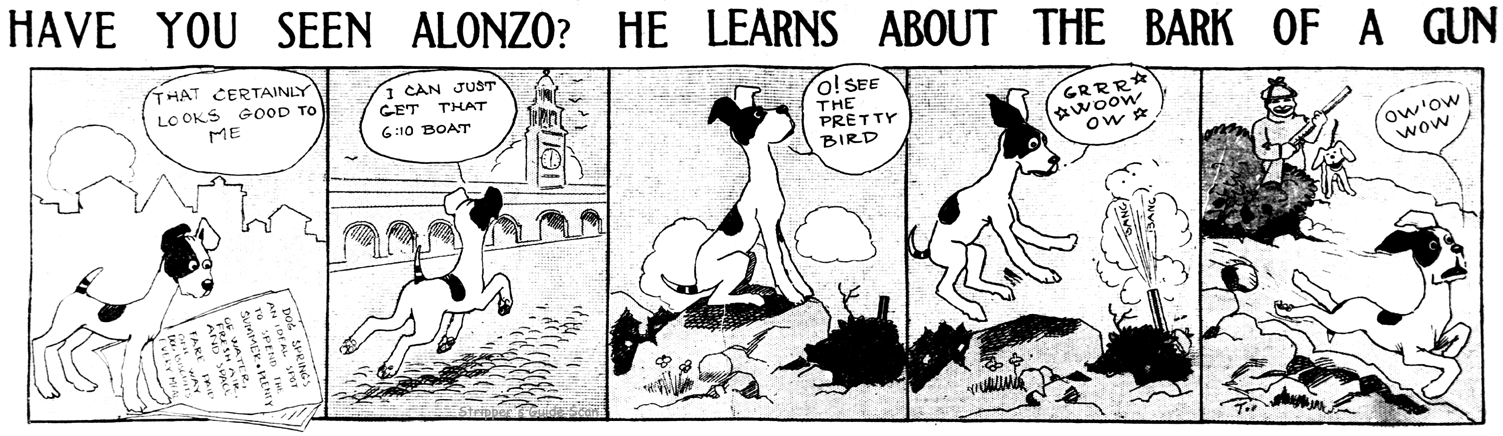  It’s from June 26, 1909, you can see more of them if you go to Allen Holtz’s “Strippers Guide” blog. Click the link over to the right hand side of this page. I love the first and last panel in this strip, it shows the roots of Paul Terry’s slightly off-kilter drawing style that Jim Tyer eventually brought to imperfection in the Terrytoons of the 1950s. Paul’s brother John also worked on Alonzo in 1909. I don’t know if Paul Terry’s byline appeared on any other comic strips, let me know if you’ve heard of any.
 Â
 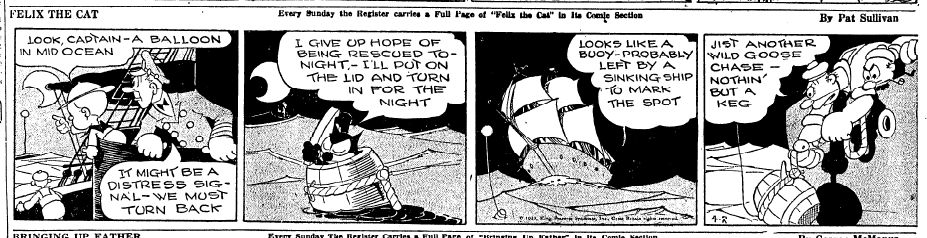
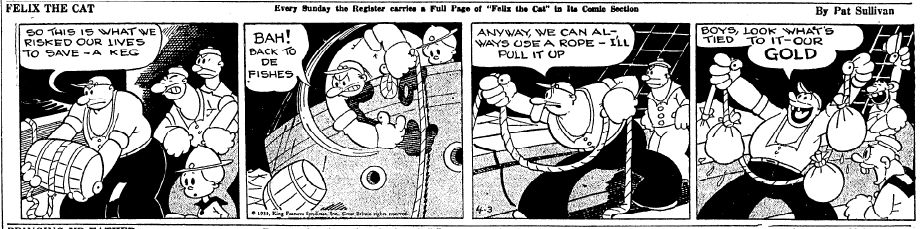
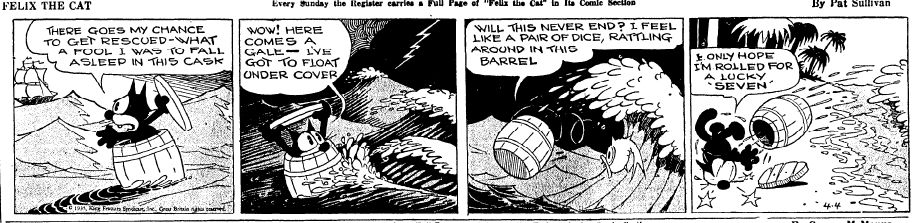
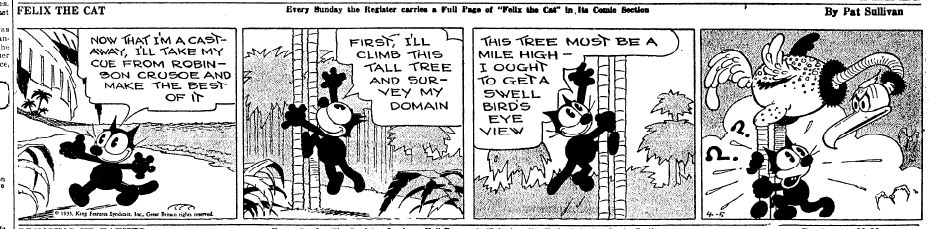
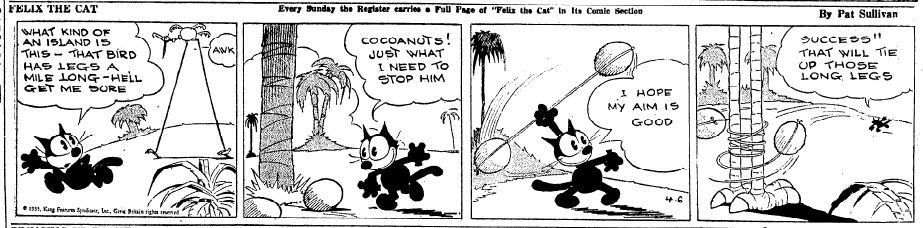
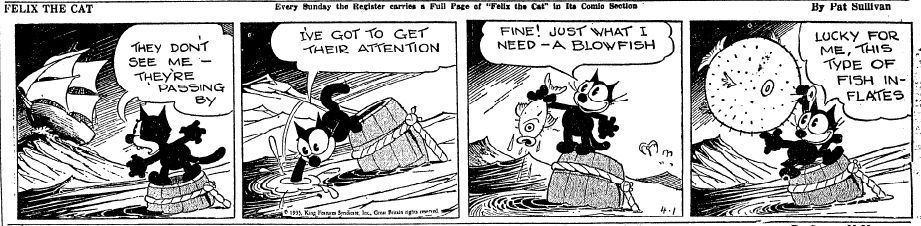
 In the Felix strip, this time from 4-1 to 4-7-1935, Felix’s keg is pulled from the ocean by the ship’s crew, who discover their gold tied to it. However, the keg containing Felix is cast back in the drink without even being opened. Felix’s latest chance to be a hero mascot is scuttled. He winds up on a jungle island, populated by strange birds. In the Sunday, Felix is still in Dreamland and manages to free himself from his bubble prison, saying his favorite word, “fine”, three times in one strip. The “Laura” topper expands to a third-page this week, replacing “The Sunny Side” feature.
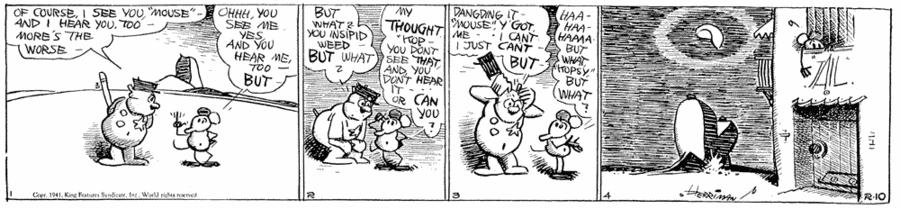
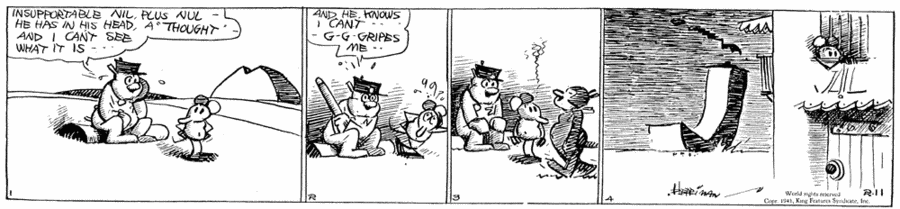
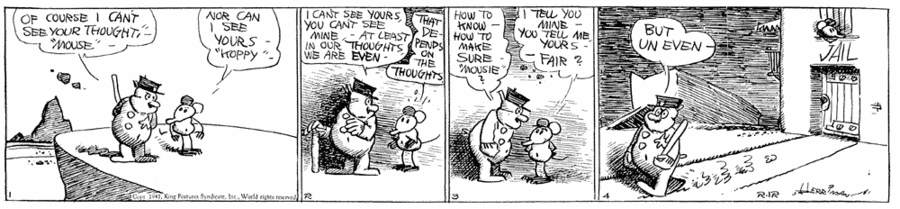
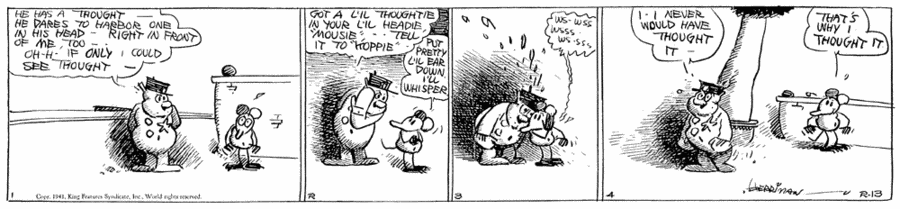
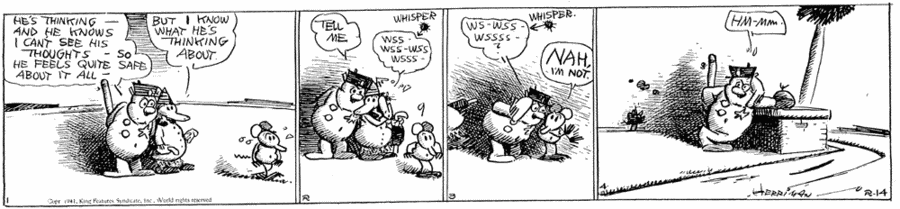
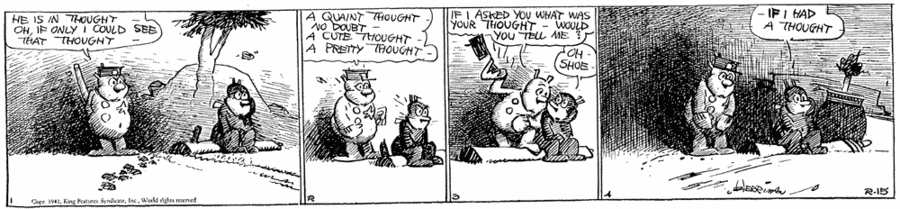  Krazy Kat, from 2-10 to 2-15-1941 has Offissa Pupp longing to become clairvoyant, or at least to read the criminal thoughts of Ignatz. In the 2-15, the Pupp wishes he could read Krazy’s thoughts, but the Kat’s mind is devoid of any, hence the very moody cross-hatching in the last panel of the 2-15.
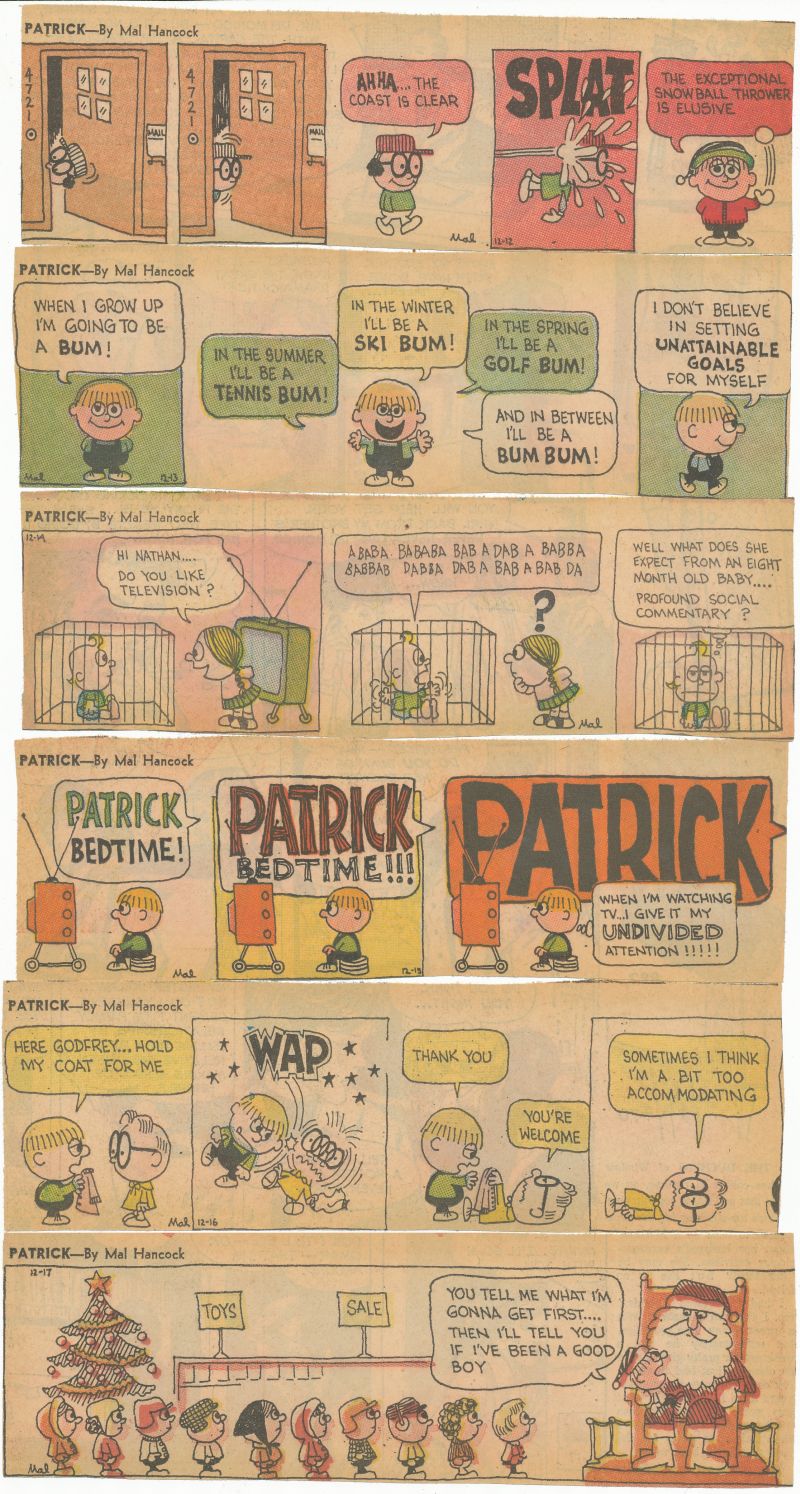 Â In the Patrick strip from 12-12 to 12-17-1966, Godfrey is clobbered twice, once by a snowball, then by Partick’s coat. Television provides amusement for both Patrick and Nathan, and Patrick tries to make a sweetheart deal with Santa in the 12-17.
 In the Patrick strip from 12-12 to 12-17-1966, Godfrey is clobbered twice, once by a snowball, then by Partick’s coat. Television provides amusement for both Patrick and Nathan, and Patrick tries to make a sweetheart deal with Santa in the 12-17.
With any luck at all, I’ll be around the Creative Talent Network Exposition this coming weekend, 11-18 to 11-20-2011. I’ll be at Jerry Beck’s table, come visit us there and maybe buy a cel or two from “It’s ‘The Cat'”, they make great Christmas gifts. A free DVD goes with every cel purchased. Jerry always has great cartoon books and chotskis to dispense as well. See you there!
Progress Report
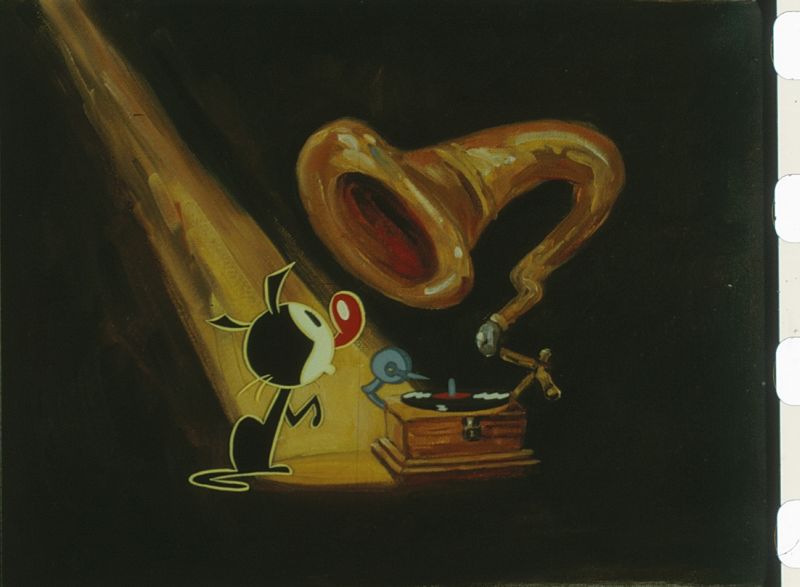
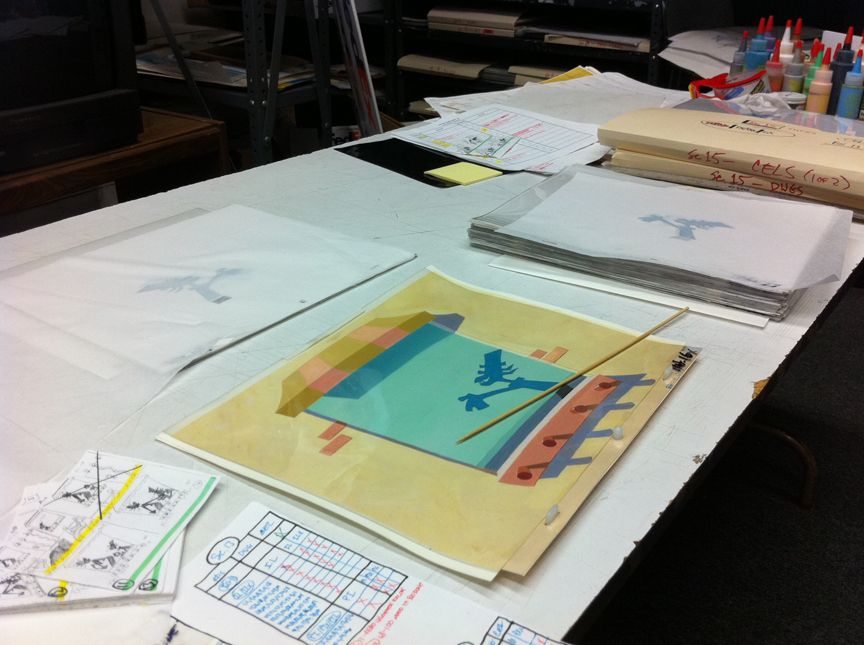
Right now, you’re probably asking yourself, “How’s ‘There Must Be Some Other Cat’ coming along? If you look above, you will see the only 35mm color material that is around right now, an exposure test frame from the “Pre-Credits” sequence, where the Cat flips a stylus on to a record played on an old gramophone. The purpose of the scene is to quiet the audience, and prepare them for the sound of an old acoustic record used on the soundtrack. The background was painted in oil by Catherine Hill, and the cel was inked and painted by Greg Ford Co. Inc. The other photograph is of a checking table at Greg’s Co. with the cels from Sc. 15 on top. The rival cat is whispering sultry nothings into Pearly’s ear in this shot where the characters are silhouettes on the window shade. It looks like there are several more scenes in the background of the photo. On this evidence, I’m basing my hopes for the cartoon’s completion. To my sorrow, it won’t be this year. This little short will have just as difficult a genesis as “It’s ‘The Cat'”. I can only hope that principle photography will begin soon. If you believe in cartoons, don’t send money (because I know you have none), but applaud real loud and think your best positive thoughts that “There Must Be Some Other Cat” can be completed. “The Cat” and I send our thanks.
   Speaking of exposure tests, here are a couple of frames scanned from a test shot for the “Adventures of Red Ryder” serial: 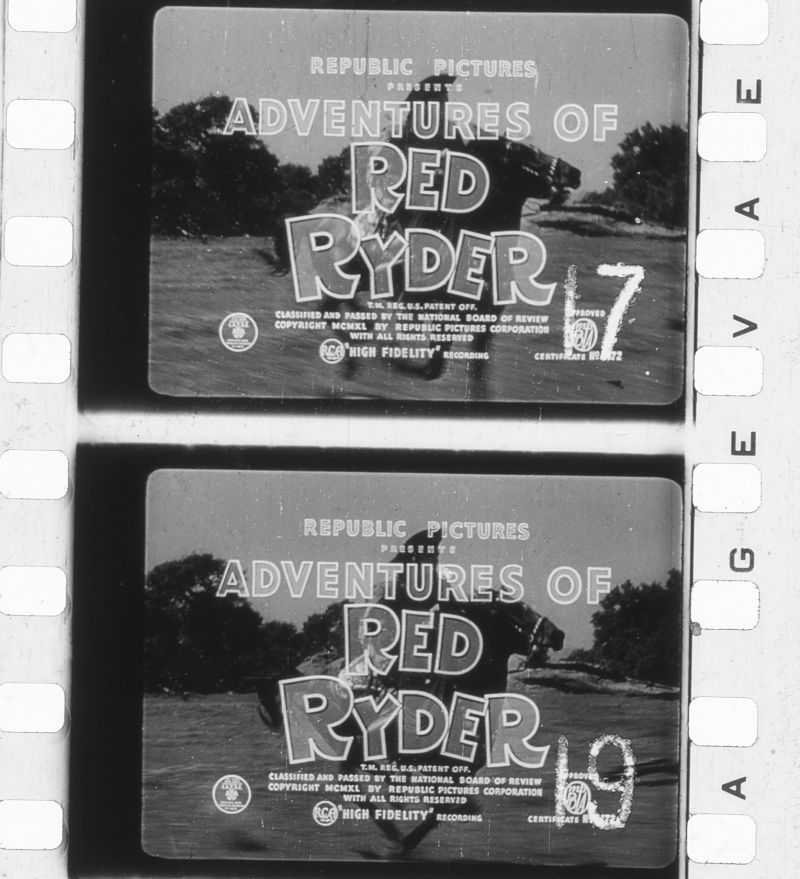  I’ve never had a way of sharing this little strip of film before, so thanks to these computers, you can see it. This Republic serial from 1940, starred Don “Red” Barry as Red Ryder and Noah Beery Sr., along with Tommy Cook of the Our Gang Comedies as Little Beaver. It was based on the comic strip created by Fred Harman, Hugh Harman’s brother, so there is a cartoon connection. The same year, Republic produced another 12 chapter serial, “King of the Royal Mounted” based on the Zane Grey comic strip. The cartoon connection here is that Zane Grey’s brother, Romer, was an early producer of sound cartoons with his “Binko the Cub” series from the early 1930s. They were never finished, although the artwork still exists, you can probably find images from Binko on the Web.
    As an adjunct to Yowp’s post for today, here are three out of the four Yogi Bear Sunday pages he posted, complete and in color: 
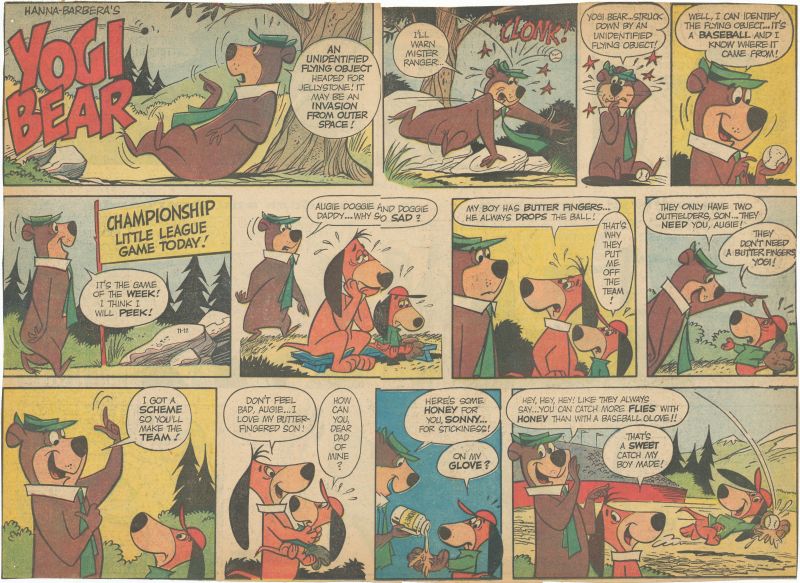
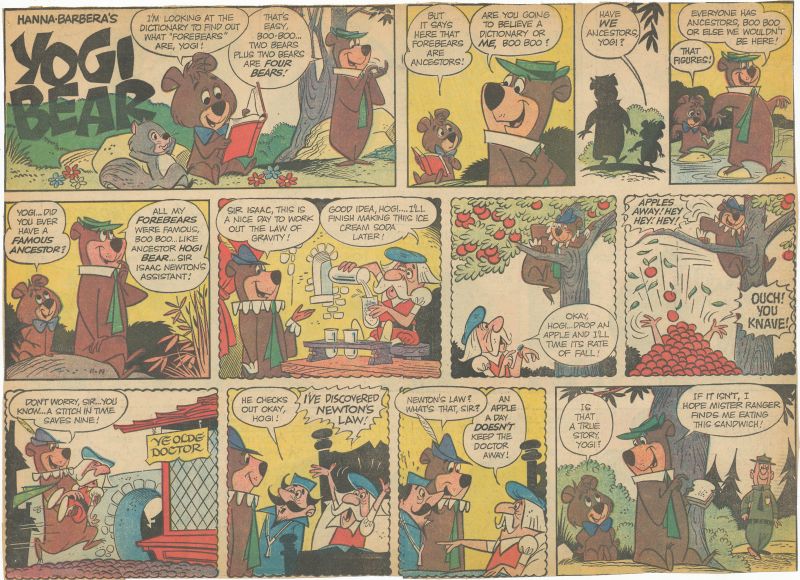 Â These are from Nov. 5, 12th and 19th, 1961. I don’t have the strip from Nov. 26th, sorry. I will now scold my youthful self for failing to save it back in ’61. I especially like the Nov. 12th strip, featuring a guest appearance by Augie Doggie and Doggie Daddy. Please click the thumbnails to view at a readable size.
 These are from Nov. 5, 12th and 19th, 1961. I don’t have the strip from Nov. 26th, sorry. I will now scold my youthful self for failing to save it back in ’61. I especially like the Nov. 12th strip, featuring a guest appearance by Augie Doggie and Doggie Daddy. Please click the thumbnails to view at a readable size.
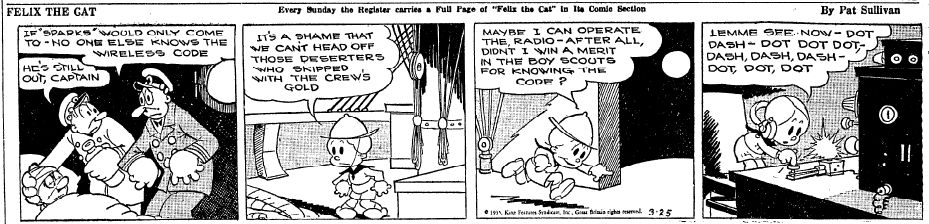
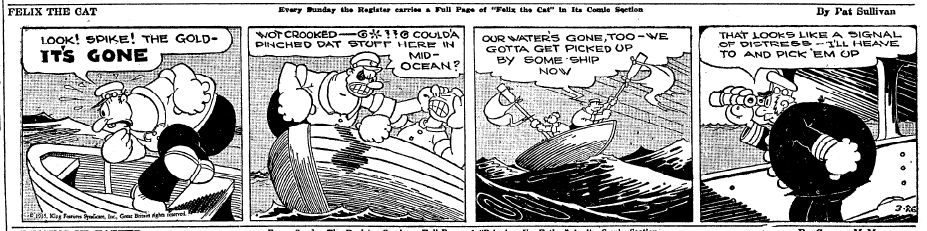
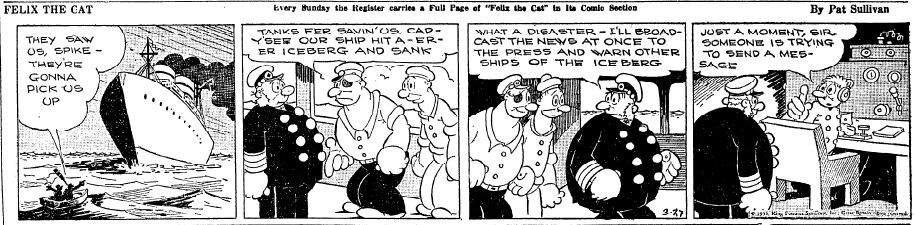

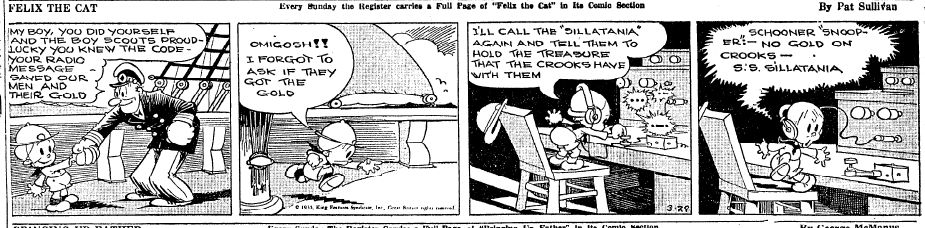

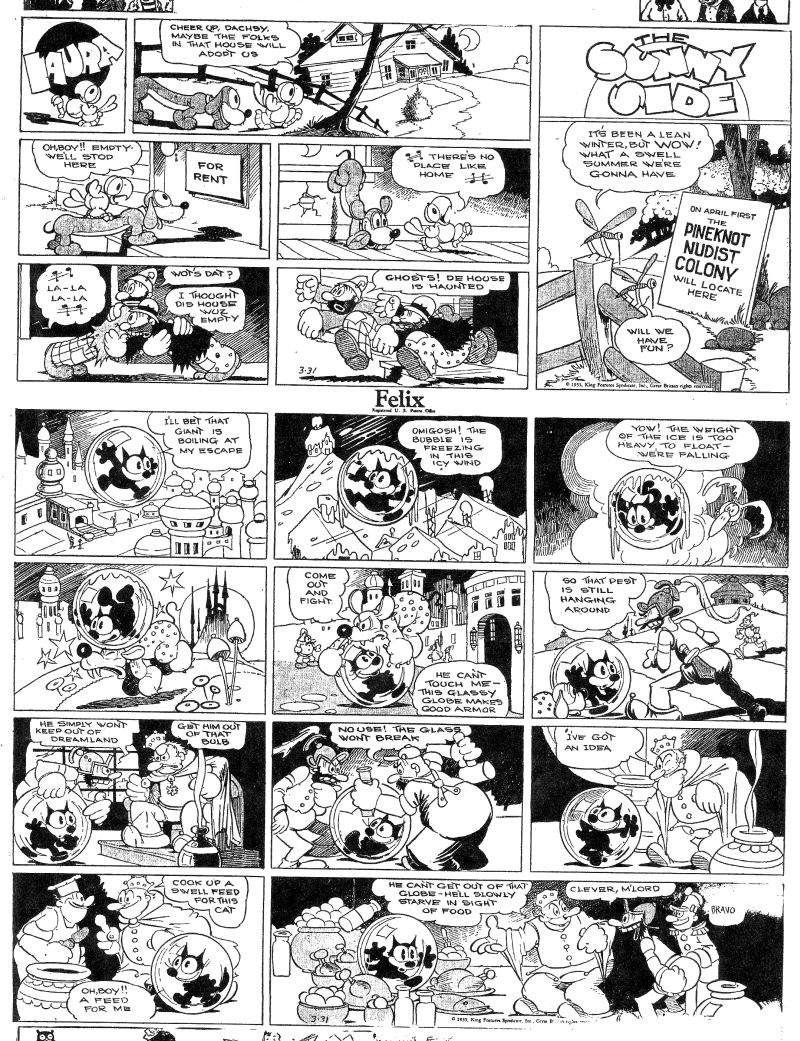
Felix from 3-25 to 3-31-1935, finds Danny using his Boy Scout skills to send a morse code message to the S.S. Sillatania, which picked up “One-Eye” and Spike on the high seas. They don’t have the gold they took with them, but Felix has that stowed. We’ll see if they pick him up next time. In the Sunday, Felix is still in Dreamland, in a frozen bubble from the Giant’s pipe. The King of Dreamland attempts to torture Felix with foodstuffs.
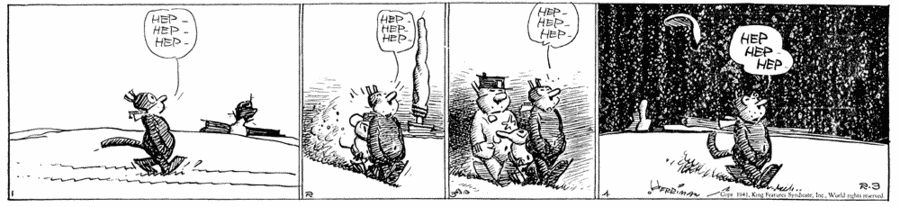


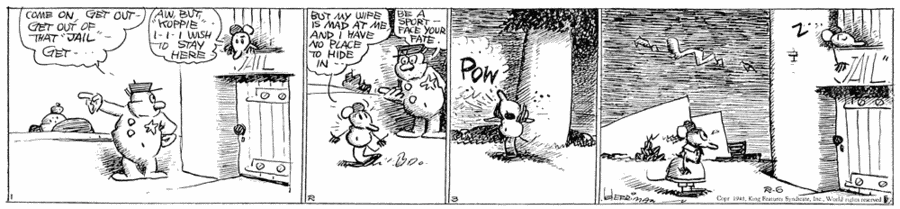
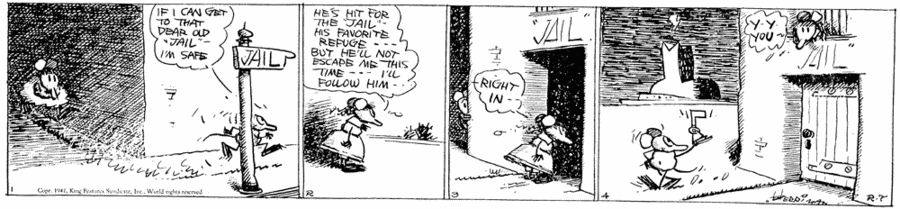

Krazy (2/3 to 2/8/1941) has a very funny continuity this week, featuring Ignatz’s indignant wife, Molly. Offissa Pupp’s jail becomes a refuge for Ignatz, as he uses it to escape his wife’s wrath. I love Ignatz’s vocal impression of the brick’s “Pow” that he uses to get thrown in jail on 2/6, and in the 2/8, both Ig and Offissa Pupp wind up in the clink to escape Molly. It’s the only time I can recall seeing the Pupp in prison.
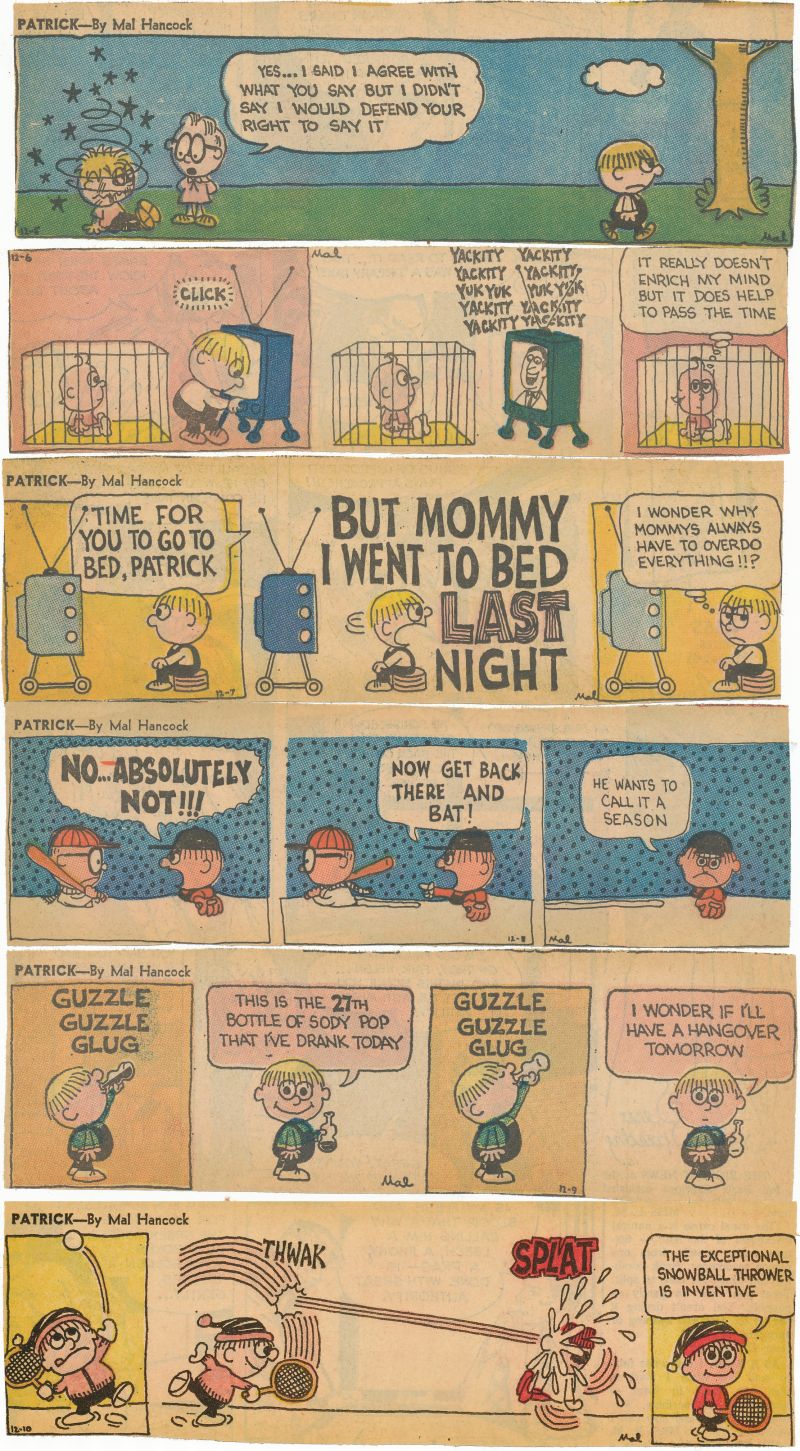
Patrick, from 12/5 to 12/10/1966, finds brother Nathan being “elevated” by television in the 12/6, and Patrick doing a sorta kinda Charlie Brown bit in the 12/8 as he chews out Godfrey for wanting to quit baseball in the deep snow. It’s amazing that Patrick is not obese from drinking 27 bottles of “sody pop”, as he confesses in the 12/9. Enjoy all the strips, folks, and think your best thoughts for “There Must Be Some Other Cat”.
Paul Terry Nitratoons
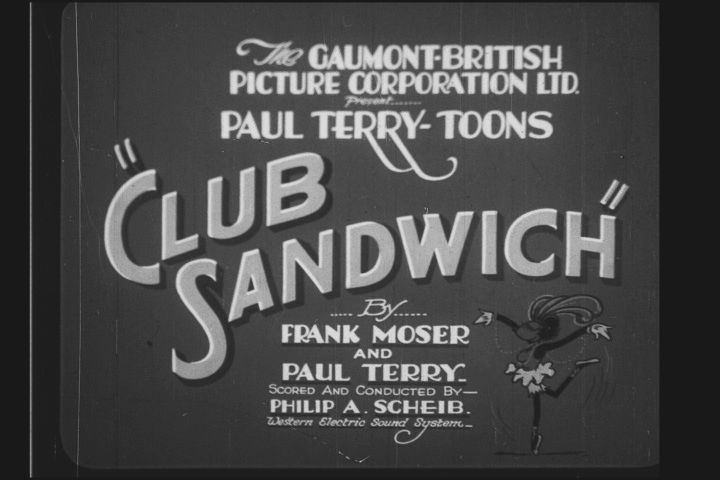
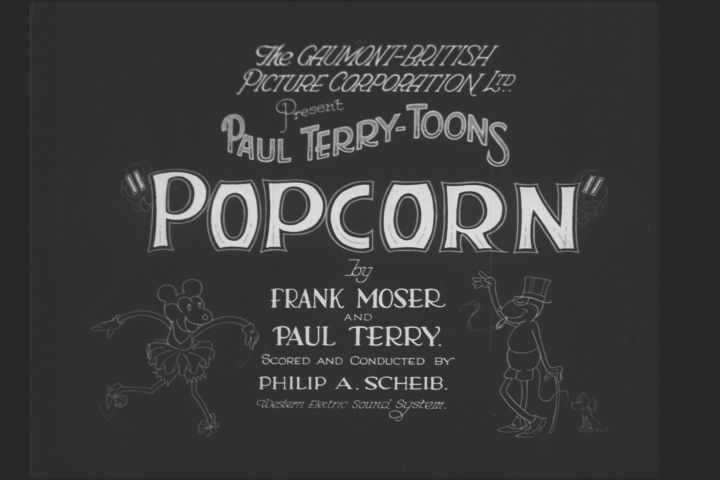
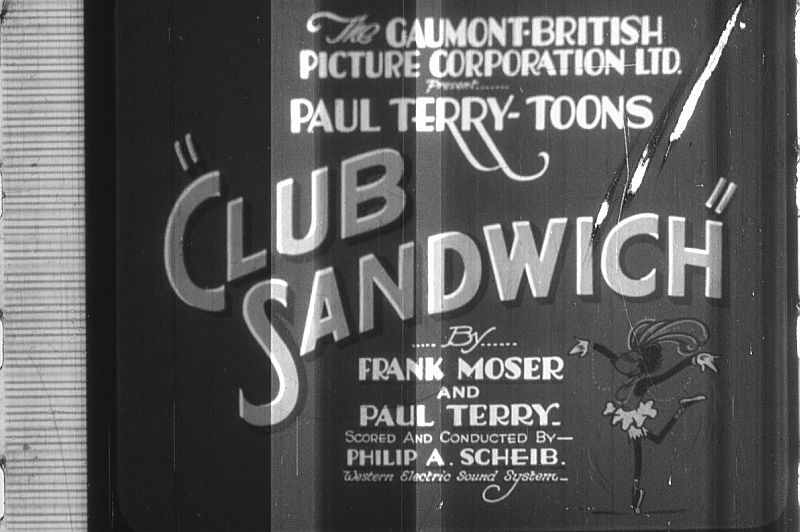
These two 35mm nitrate prints of the 1931 Terrytoons, “Club Sandwich” and “Popcorn” turned up recently on British Ebay. My friend Steve Stanchfield, had the temerity and courage to bid on them, and he won! He then sold them to me, I fixed them up a bit and ran ’em off. “Club Sandwich” is a minor mystery historically, in that Leonard’s book says it’s “on studio records as DANCING MICE”. Actually, that’s the title of the TV version of the cartoon, edited by CBS. For the most part the two versions are alike, until nearly the end of the story, as the mice tie a line to Farmer Alfalfa’s leg and run him through the “gauntlet”, meaning through mouse holes, up and down chimney flues, over the roof and so forth. The propelling instrument for this high velocity drag is a mule: 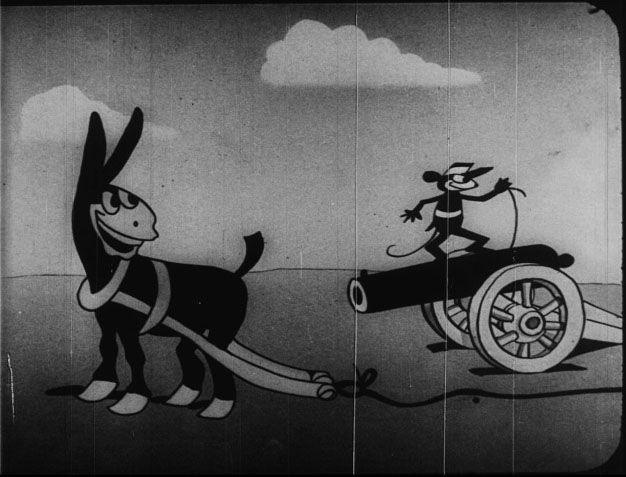  The little mouse shoots the mule with the cannon, causing him to run off at high speed (note the line attached to him). In DANCING MICE, the action cuts just after the cannon is fired, to Farmer Al being dragged. In CLUB SANDWICH, the mule emerges from the smoke:
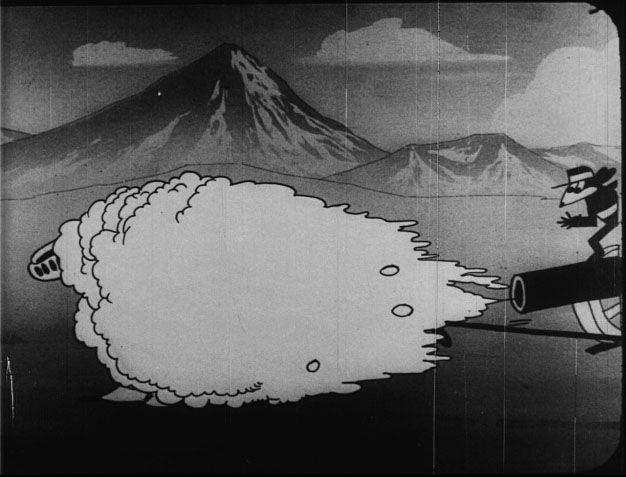
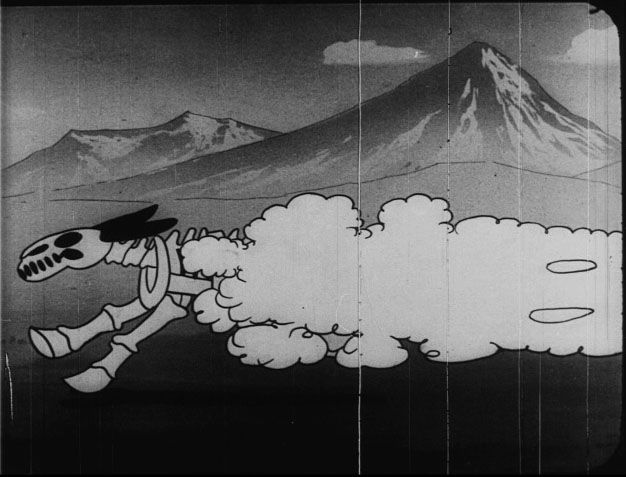
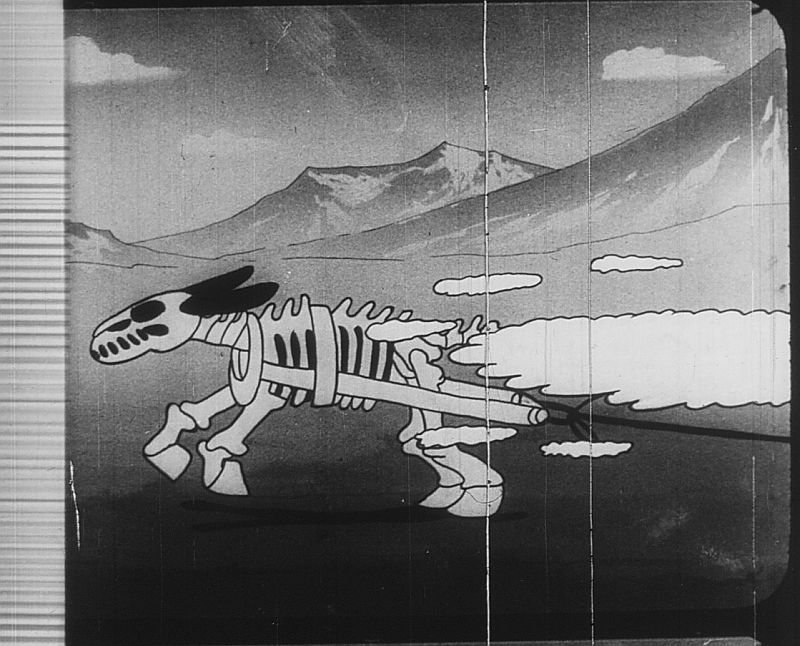 without his SKIN!! Farmer Al is then dragged through all the mouse holes and on to the horizon for the iris down. In DANCING MICE, the last scene is joined in progress, and you can barely see the mule in the distance. In CLUB SANDWICH, the mule’s bones run into the shot in full view of the mice, then Farmer Al enters the frame: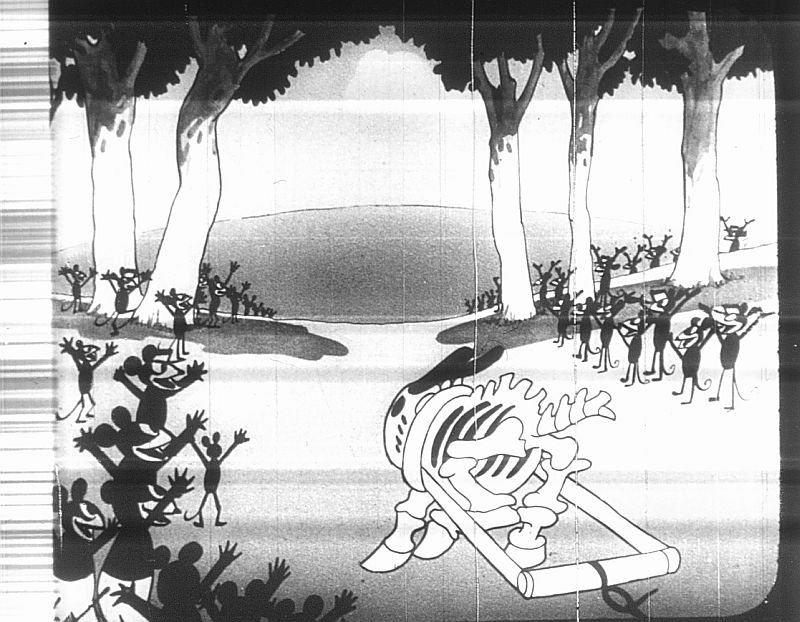
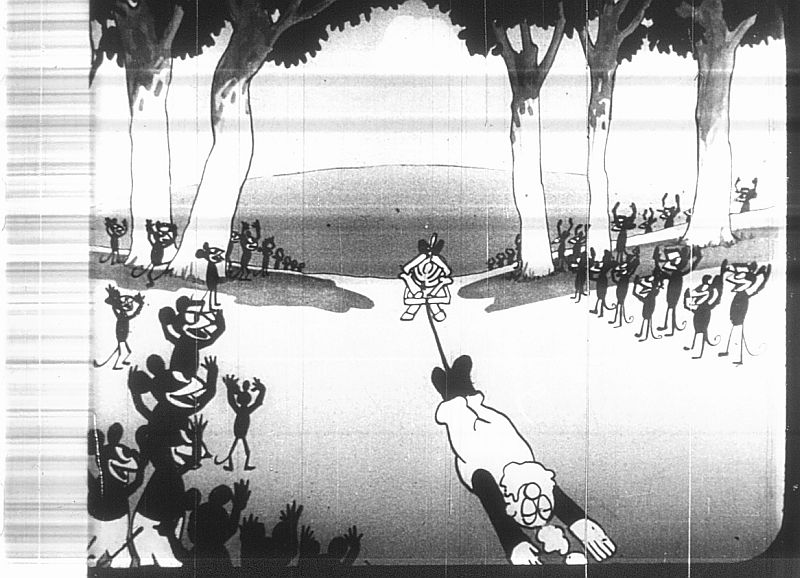 Â The frames with sound track attached were scanned direct from the nitrate print, sometimes they are a little streaky. The rendering of the trees and mountains is beautiful, reminds me of Japanese artists like Hokusai. Far too many of these 1930s Terrytoons exist only in the CBS TV versions, with many cuts and alterations. Obviously somebody at CBS didn’t like bones or skeleton gags as you’ll see in the Terry cartoon “Popcorn”, comin’ up next on this channel. So long to
 The frames with sound track attached were scanned direct from the nitrate print, sometimes they are a little streaky. The rendering of the trees and mountains is beautiful, reminds me of Japanese artists like Hokusai. Far too many of these 1930s Terrytoons exist only in the CBS TV versions, with many cuts and alterations. Obviously somebody at CBS didn’t like bones or skeleton gags as you’ll see in the Terry cartoon “Popcorn”, comin’ up next on this channel. So long to   (note this is the original end title card, the main title cards upstairs are the British titles).
Out next cartoon, “Popcorn” is one of the 1930s Terrytoons that was NOT shown on Television, probably the same CBS censor who cut “Club Sandwich” didn’t care for the haunted house sequence in “Popcorn”. Most of the cartoon is the boy and girl mouse enjoying a day at the county fair, riding the rides, grabbing for the brass ring, etc. When they enter the haunted house “ride”, here are a few things they saw: 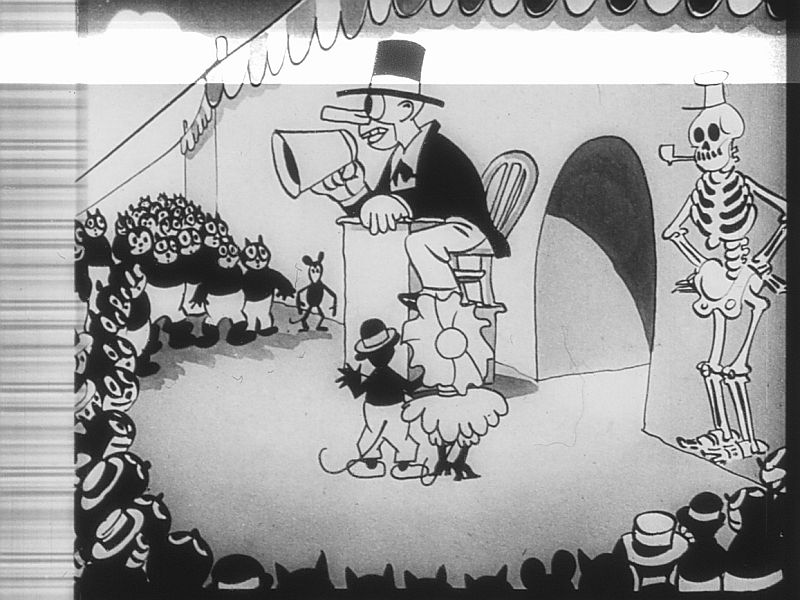 Â The barker outside the haunted house tent, with pipe smoking skeleton on the “poster”.
 The barker outside the haunted house tent, with pipe smoking skeleton on the “poster”. 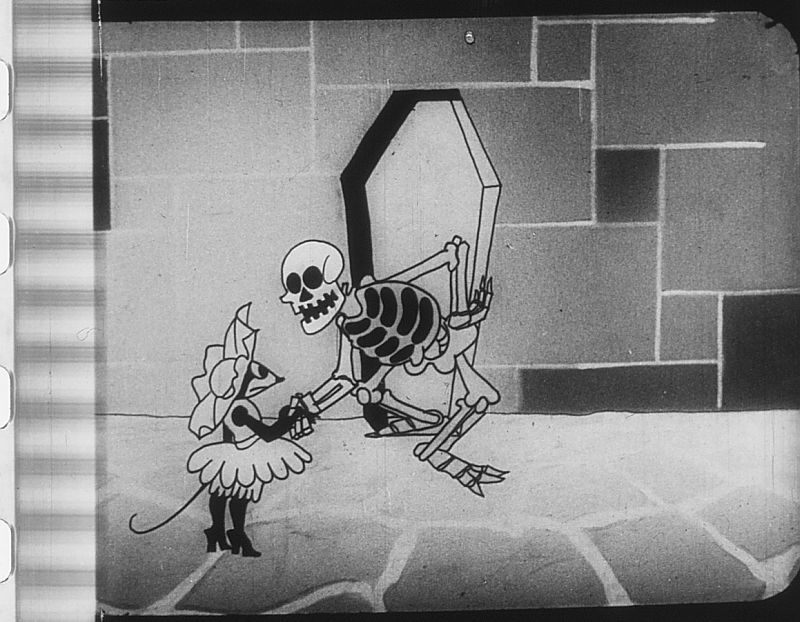 The Girl friend meets one of the residents of the haunted house, who steps out of a coffin-shaped doorway. (Note that the frame grabs show how the early sound films just cut an area out on the left side of the frame to allow for the sound track. The rest of the picture area (or “aperture”) is painted top to bottom. In projection, a lot of this picture information is cut off. Sometimes this is called a “Movietone” aperture.)
 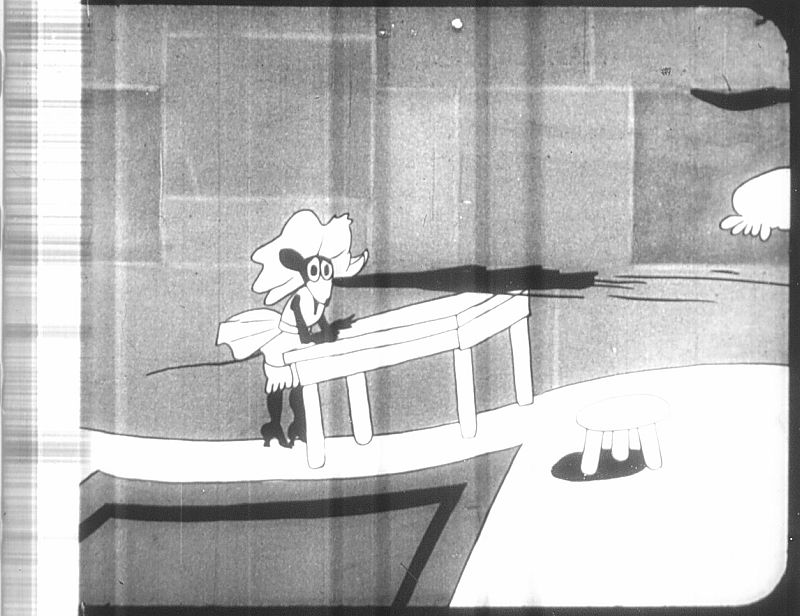 The Girl Mouse hallucinates from her contact with ectoplasmic phenomena and the floor and furniture come to life.
 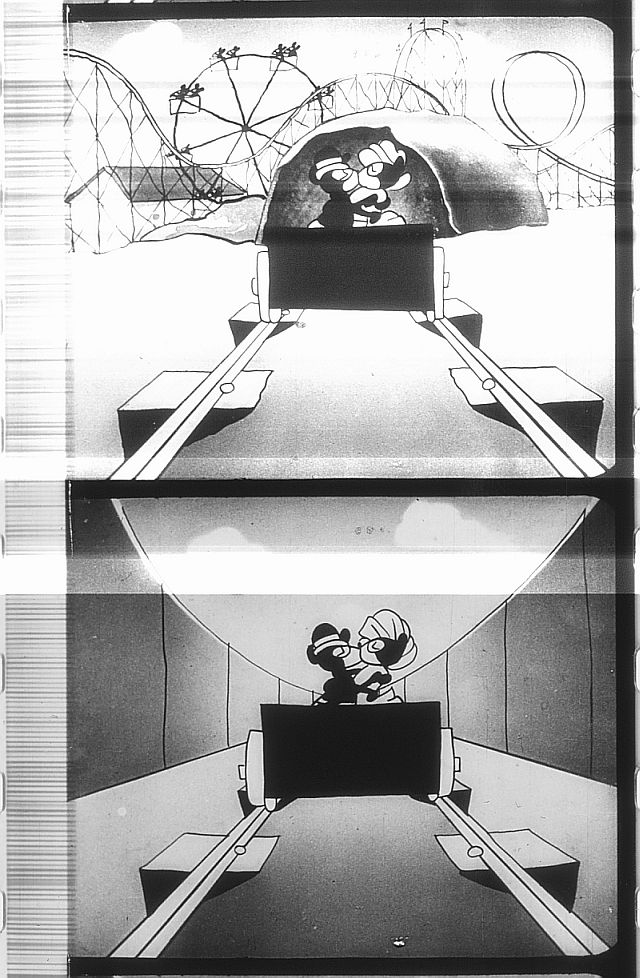 Â Here is an early layout/editing technique that the Terrytoons studio used quite a bit. Popping a completely different background behind the characters while the characters continue to move in the same picture plane as if the change had not occurred. This was a great money saver and time saver. The backgrounds and layouts didn’t have to be conformed to live-action style cut aways at all, just pop ’em on! In this example, the tracks and the mice animate, but rather than try to animate the background with the roller coaster tracks back to the horizon, a simple wall design is substituted, which animates in perspective. The “cut” to a different background works because we are watching the characters. The early Terrytoons were very lazy about the character’s feet slipping on pans in slow walks, so they had a lot of chases, where the slipping isn’t as apparent.
 Here is an early layout/editing technique that the Terrytoons studio used quite a bit. Popping a completely different background behind the characters while the characters continue to move in the same picture plane as if the change had not occurred. This was a great money saver and time saver. The backgrounds and layouts didn’t have to be conformed to live-action style cut aways at all, just pop ’em on! In this example, the tracks and the mice animate, but rather than try to animate the background with the roller coaster tracks back to the horizon, a simple wall design is substituted, which animates in perspective. The “cut” to a different background works because we are watching the characters. The early Terrytoons were very lazy about the character’s feet slipping on pans in slow walks, so they had a lot of chases, where the slipping isn’t as apparent.
It’s wonderful to see these early Terrytoons, even in British prints, which sometimes have their OWN censorship problems. How different our image of Terrytoons might be today, if we could see them with all the strange and terrifying images restored. I have a feeling we might make more comparisons between Terrytoons and Fleischer if we could see more of the uncut Terrytoons. When Network Television (CBS) got involved in marketing the Terrytoons of the 1930s, an historic decision was made. “Cartoons are for Kids”. The heavy editorial hand descended and any gags remotely appealing to the Moms and Dads, especially the Dads, were out. The early walls of the cell in which cartoons are forever imprisoned were being constructed. Let’s hope that the original 35mm negatives, now entrusted to the UCLA Film Archive, contain all the gags and ideas that CBS wouldn’t allow us to see in 1956.


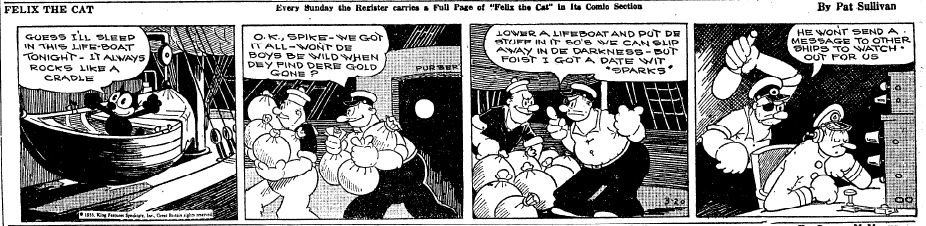

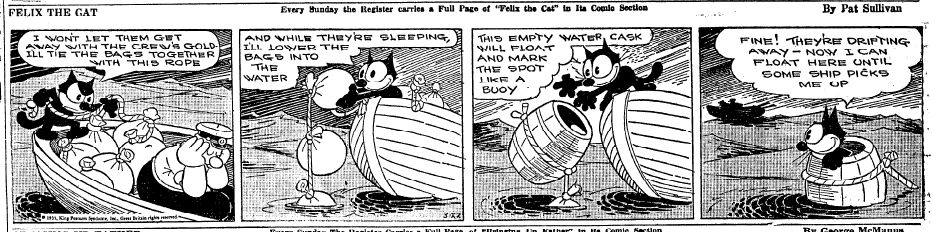
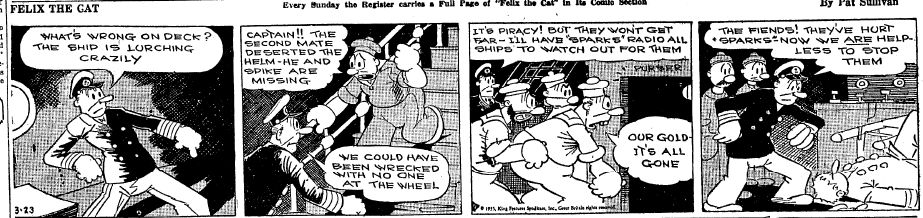
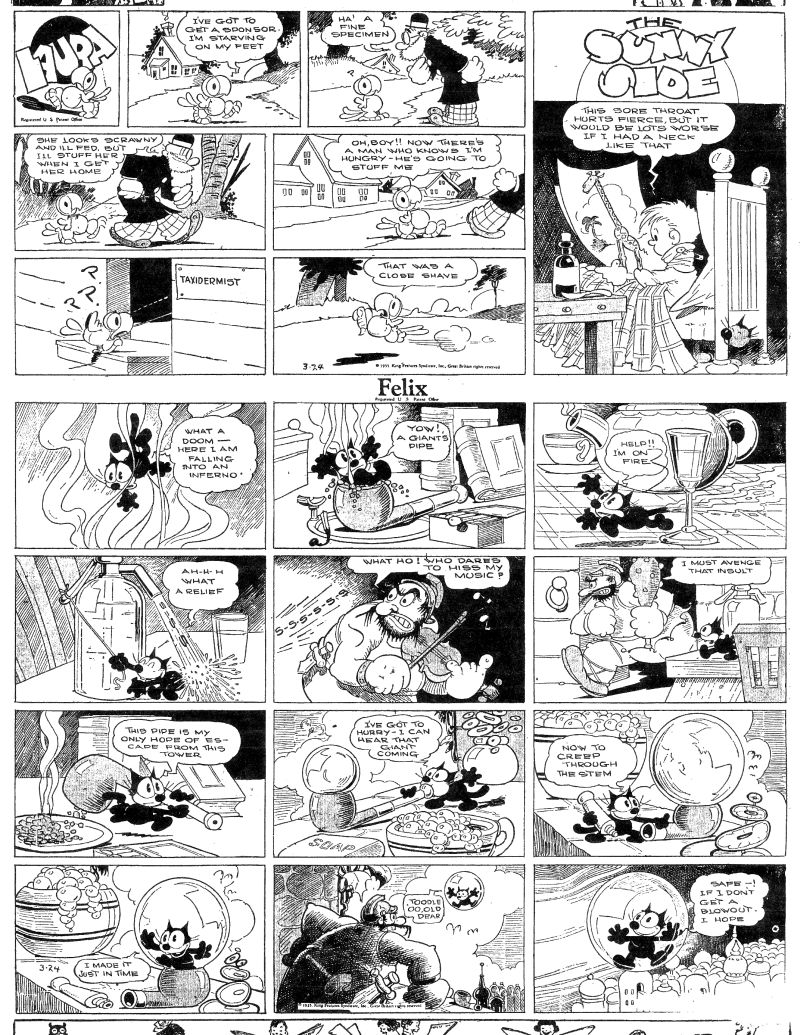
Felix (3/18 to 3/24/1935) continues his adventures at sea. Patch and Spike, greedy sailors, want all the gold for themselves and store it on a lifeboat. They try to escape with the goods, but fortunately for the crew, Felix, their lucky mascot, is asleep on board the lifeboat. I love the second panel in the 3-21 strip. The staging is so crowded that it looks like Spike’s nose is sniffing Patch’s hand. The Sunday continues Felix’s adventures in Dreamland. He uses the Giant’s pipe to blow a bubble that will carry him into next Sunday’s strip.
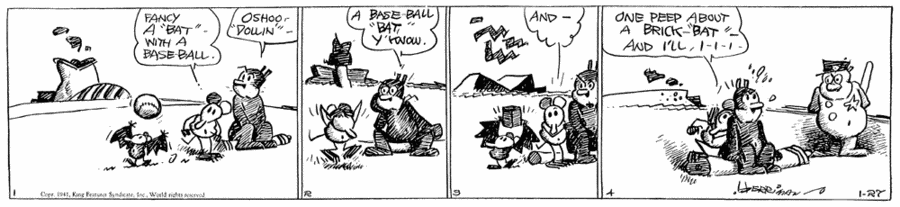

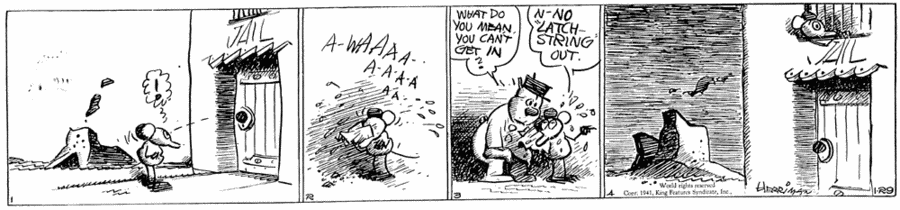
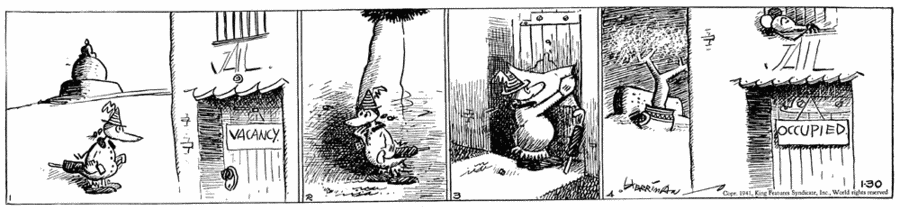
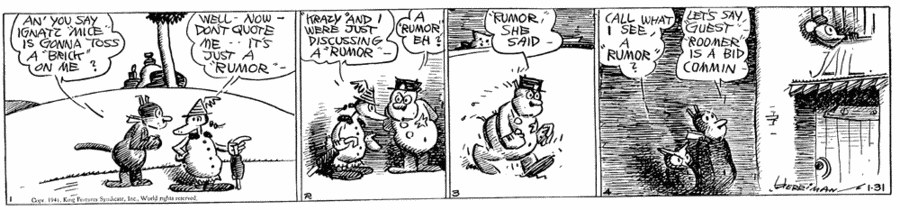
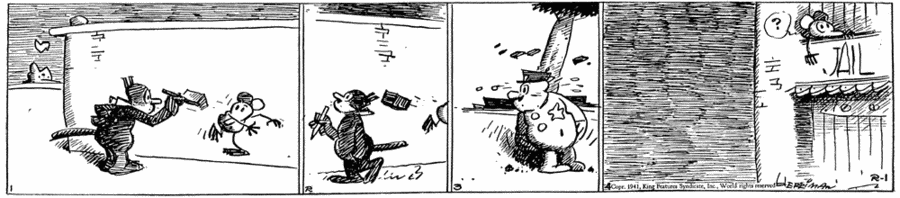
Krazy (1-27 to 2-1-1942) centers around Offissa Pupp’s Jail for most of the week. I love Krazy’s Owl friend in the 1-31. Herriman drew owls very well, this one would have made a good continuing character.
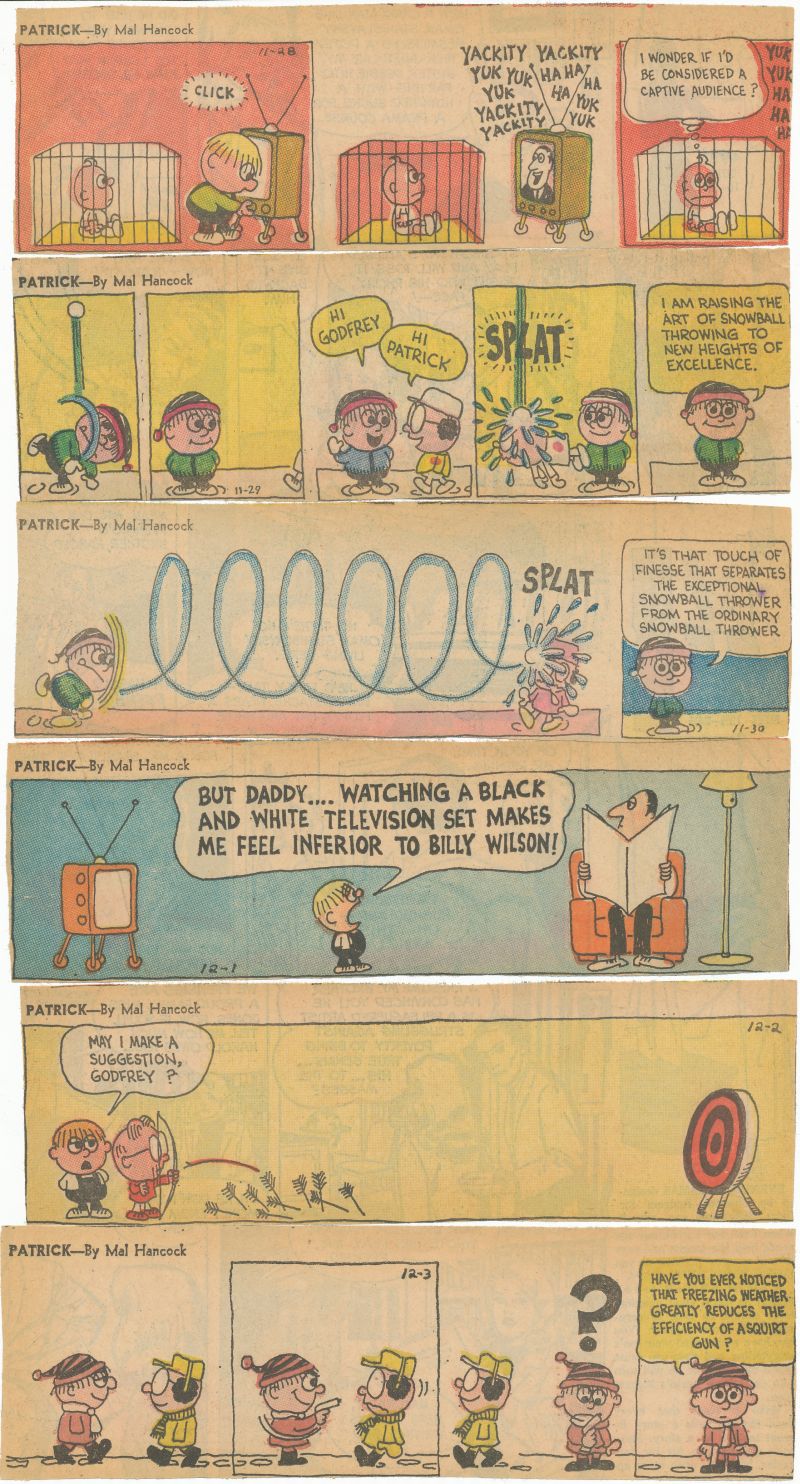
Patrick (11-28 to 12-3-1966) has a lot of winter time jokes involving snowballs and squirt guns. Patrick’s dad appears in the 12-1, and his brother Nathan in the 11-28. Mal Hancock used the single panel daily a few years before it’s use became wide-spread. Now two panel and one panel dailies are common-place given the tight space that newspapers allow comics, but Mal was using them when they stood out from the crowd a little more. They looked “modern” and eye-catching.
More Yowpin’
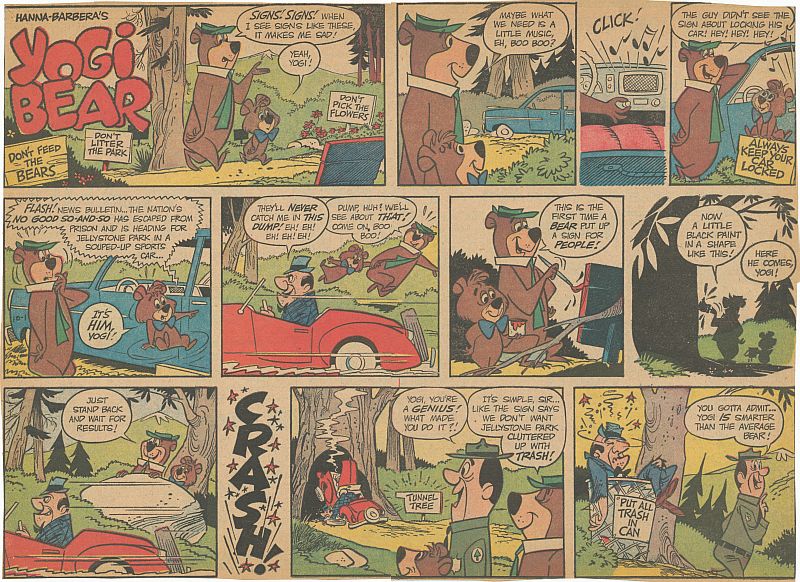


Here, as an adjunct to Yowp’s latest post, are the half-page, color versions of the Yogi Bear Sundays from October, 1961-all FIVE of them, whew! It seems to be controversial whether Harvey Eisenberg actually drew these or not, a lot of the poses and especially the title lettering look like Harvey’s work to me. Some of the incidental humans could be Gene Hazelton’s designs, don’t know for sure. Remember to click on the thumbnails to see them at full size. Even though this is not a “regular” post, I’m going to quickly put up my regular comics:

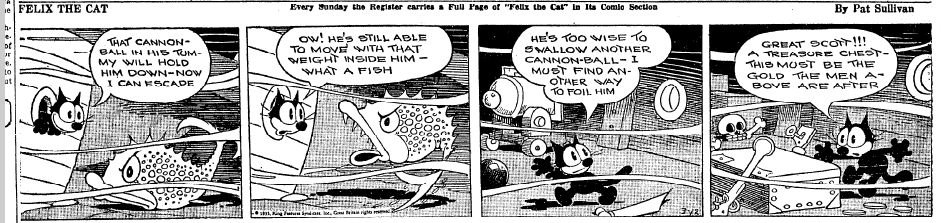
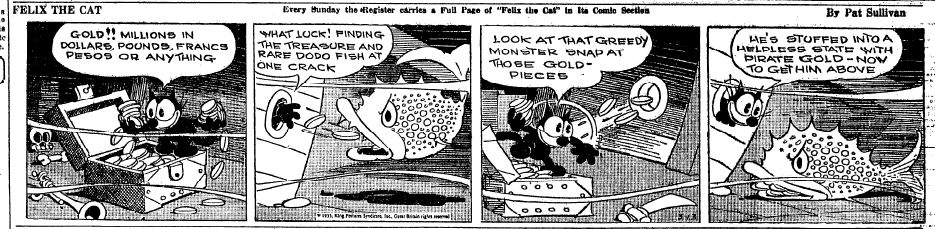
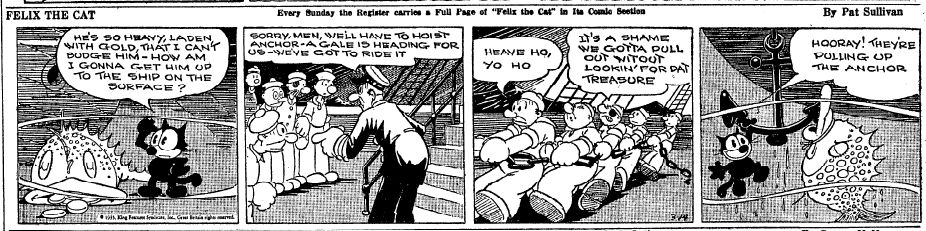
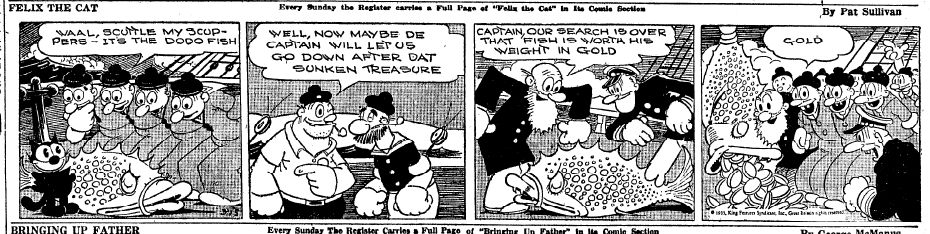
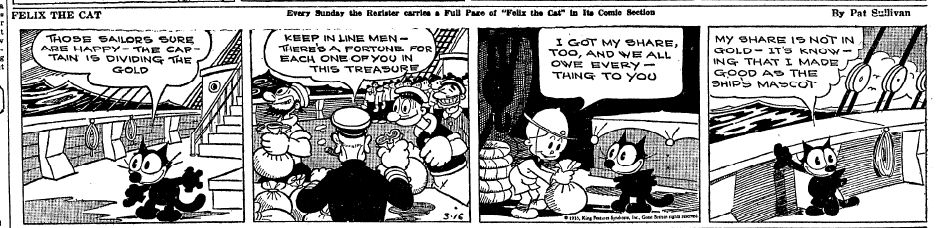

Felix (3/11/1935 to 3/17) gets the gold and the prize Dodo fish all in one swoop. I love the last panel of the 3/16, as Felix ruminates on his “Prize”, making good as the ship’s mascot. The little guy really appeals to the heart, not a greedy bone in his body. In the Sunday, Felix sums up his life in the 6th panel, “Life is just one jam after another, for me.”


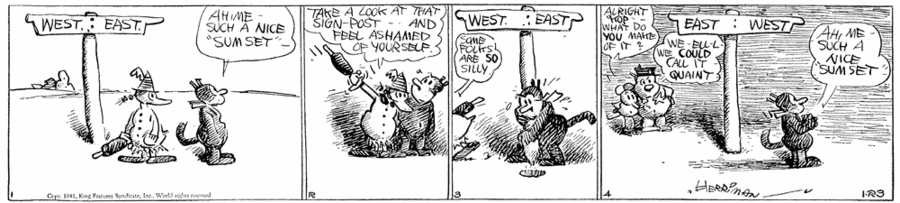
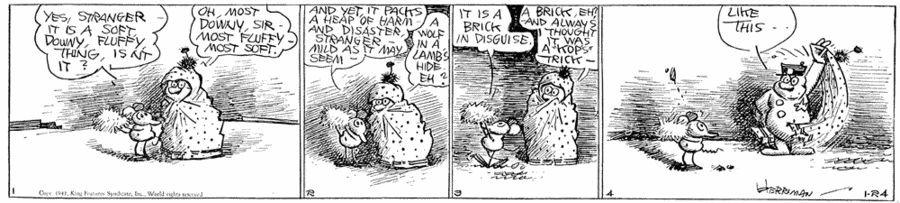
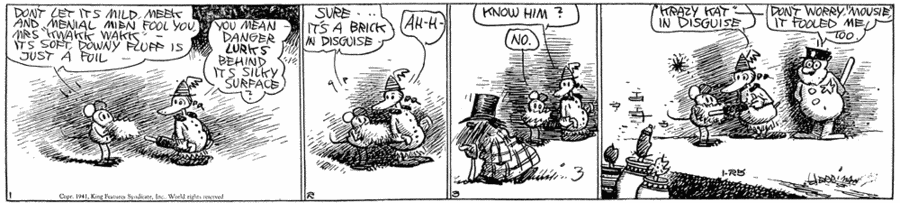
Krazy (from 1-20-1941 to 1-25) has the usual alarms and excursions, including Garge’s penchant for disguising his characters. This time, along with Offissa Pupp and Krazy (1-24 and 1-25) even the BRICK is in disguise.
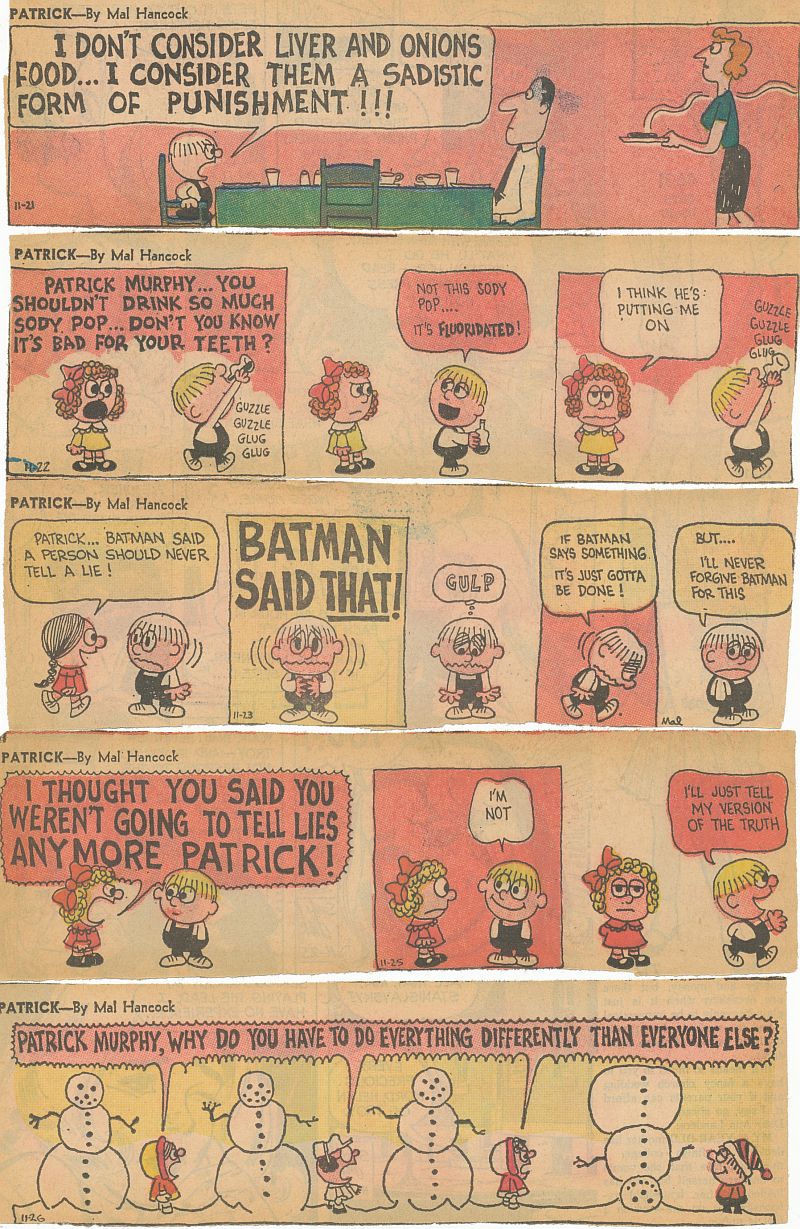
In Patrick (11/21/1966 to 11/26), Patrick declares liver and onions to be a “sadistic punishment” in the 11/21. I used to have a theory that liver and onions were a cure for the common cold. Every time I felt a cold coming on, I would drop down to the local Astro’s coffee shop for a plate of punishment. Invariably, I would wake up the next morning feeling fine. In the 11/23, Patrick’s hero, Batman, disappoints him. You will notice that the 11/24 is missing, the Post-Dispatch did not publish on Thanksgiving that year. See you next time with a little bit more fleshed-out post.
A Book Review
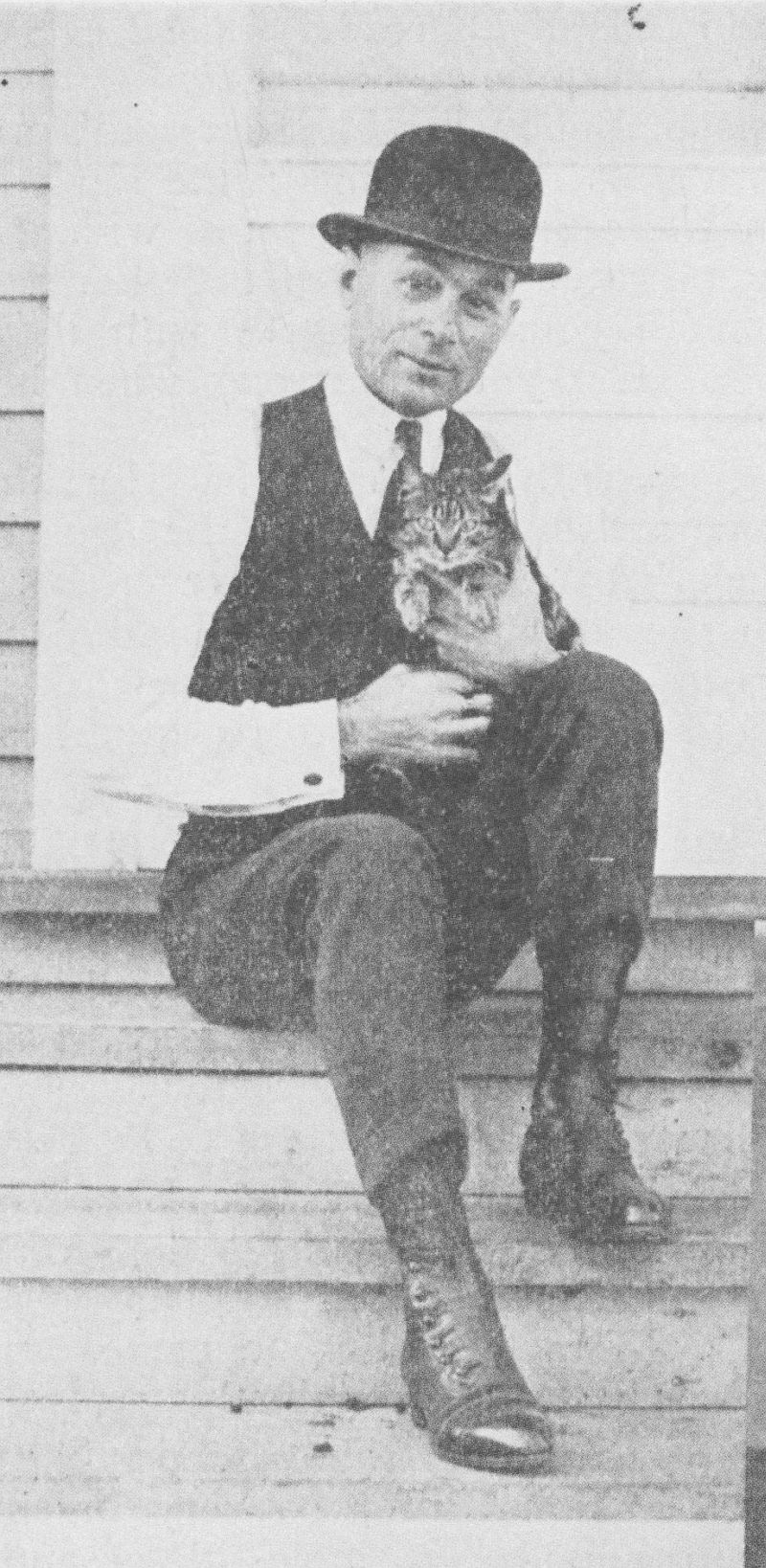  This photo is the main reason to buy “Krazy Kat & The Art of George Herriman: A Celebration” by Craig Yoe, published by Abrams Comicarts, New York in 2011. It is on page 160, and is a portrait of Garge with the family cat: “Kat Herriman”, one of the most charming pictures I’ve ever seen of the maestro. There are many things the book has to offer: the classic writings on Herriman and Krazy Kat by Gilbert Seldes, E. E. Cummings and Tad Dorgan. Newer essays by Bill Watterson, Craig Yoe, Craig McCracken, Richard Thompson and Jay Cantor, among others. Many beautiful color illustrations from the Krazy Kat strip, including some of Herriman’s hand-colored originals, several examples of “The Family Upstairs” strip which weren’t in the “Complete” Family Upstairs book edited by Bill Blackbeard some years ago. Craig has reprinted the rare DUST JACKETS from Don Marquis’ Archy and Mehitabel books which Garge illustrated. There are many photos of George Herriman (with and without his hat), and even the last two Krazy Kat strips found on his art table after George passed away in 1944. I tried to decipher Garge’s handwriting on the strips:
   (click to enlarge) 1.: Pupp: “Two ones, who threw them?” Krazy: “Ignatz” 2.: Pupp: “They call them snake eyes-” Krazy: “No” 3.: Krazy: “Smoke eye” Pupp: “Baf”. Note how Garge turned Pupp’s exit direction in the third picture to panel right, the original pencil shows him exiting panel left.
   This is the second unfinished strip found on Garge’s drawing board: 1.: Krazy: “Hotty Kulcher” 2: Krazy: “A azzaler, (Krazy’s way of saying “azalea”) I’d say-” 3: Krazy: “No” Ignatz: (as he closes the flower pot lid) “Of Course Not-“. That’s as close as I can come to decoding Garge’s handwriting. There is even a photo of the house that Garge designed on Marravilla Drive as it looked before all the mansions clustered around it: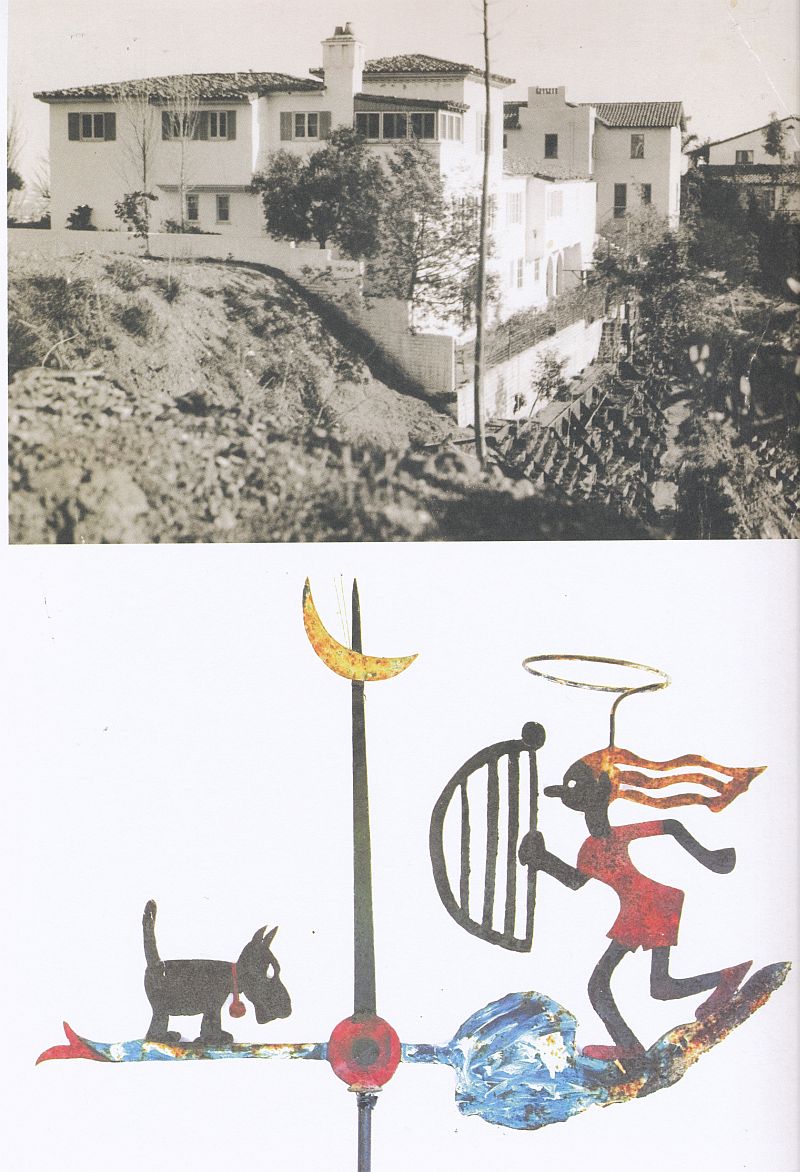
This book is highly recommended for those who don’t have many of the previous Krazy Kat collections. Much of the material in this book is reprinted from Patrick McDonnell’s “Krazy Kat: The Comic Art of George Herriman”, published by Abrams in 1986, and various volumes of “Krazy and Ignatz: The Complete Full Page Comic Strips”, published by Fantagraphics between 2002 and 2010. If you only get one book on Krazy, you could do worse than this one. The only really negative thing I could say about this Craig Yoe/Abrams effort, is that is was printed and bound in CHINA. For a book about an American icon, Krazy Kat, to be printed in China, in these times of few jobs for American citizens, is a crying shame. Surely there are a few companies left in the United States that could do a high quality color printing job on a book like this, much better than Chinese printers can do. With jobs so scarce, the costs should be negotiable. Craig Yoe is a dedicated devotee of old American strip cartoonists, he has also done a fine book on Milt Gross’s comic book work, which was printed in KOREA by IDW publishing in 2009. With a little more digging, I’m sure that Mr. Yoe could have found an American printer for this book as well. I hope he will change his production model in the future, so that I can recommend his books without any reservations. 

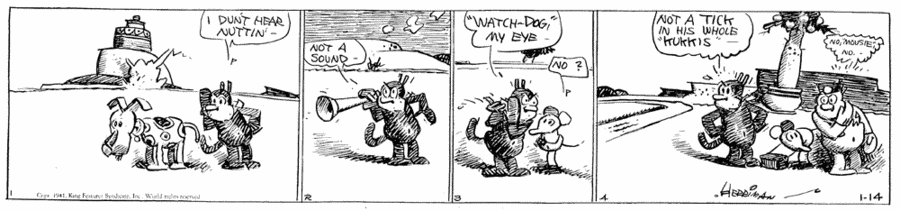

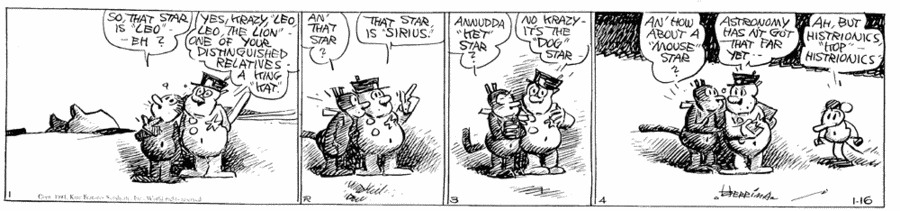
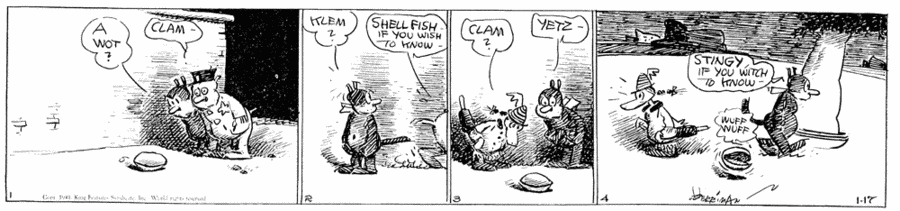
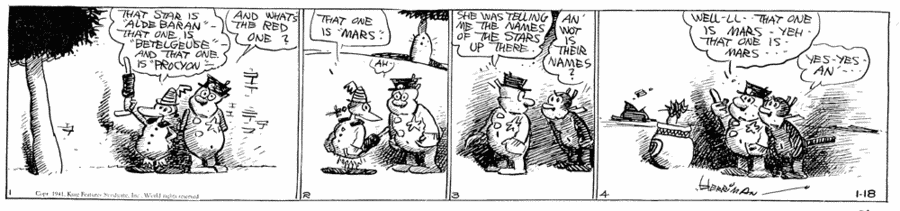
Speaking of KK, let’s look at this week’s batch from 1-13 to 1-18-1941. In the 1/14 strip, you will note a joke similar to the one that Frank Tashlin used in his “Porky’s Spring Planting” animated cartoon in 1938, q.v. “I’m called a watchdog, cause I’m fulla ticks.” In the 1/15, Ignatz is given a very appropriate conveyence to the jailhouse, a hod (for carrying bricks, see “Bringing Up Father” if you don’t know how they are used). There are star gazing gags in the 1/16 and 1/18 strips, and Krazy makes another brick-worthy pun in the 1/17 involving “shell fish”.
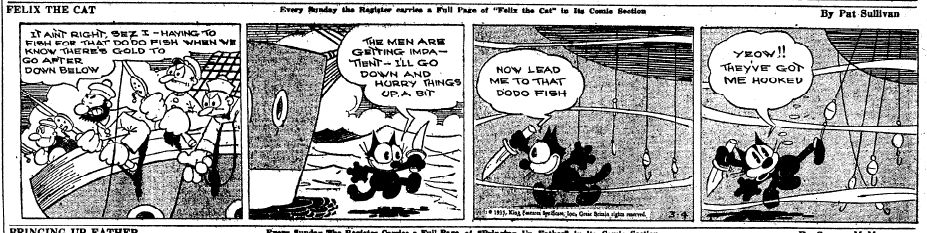
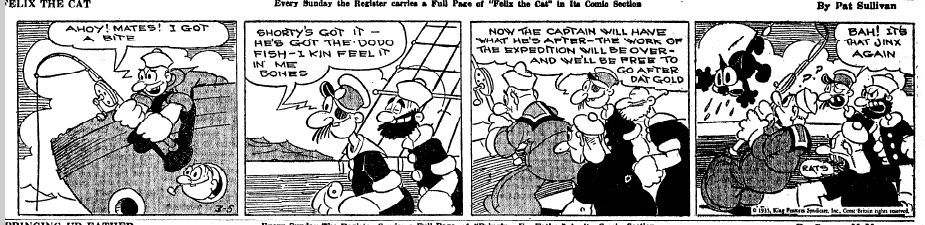

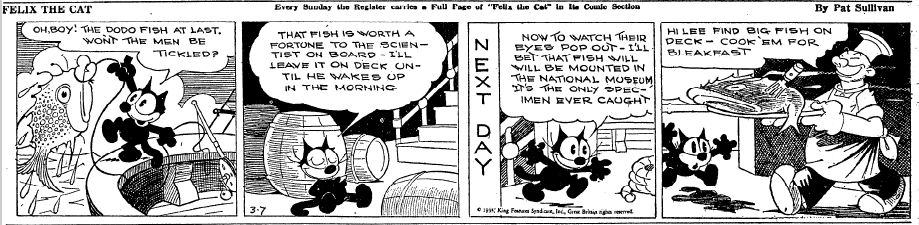
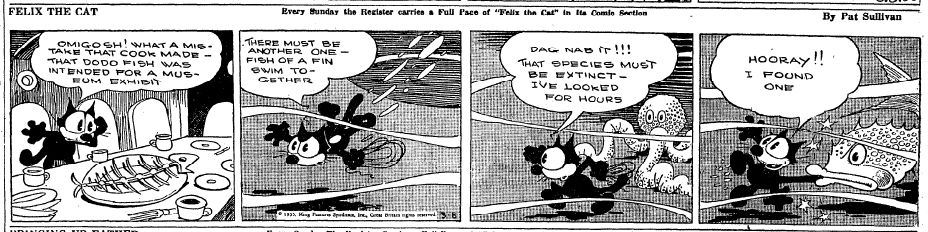
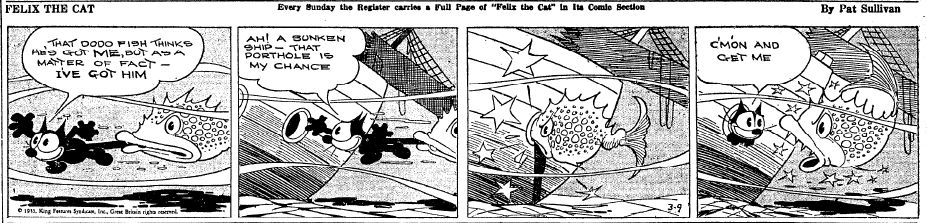
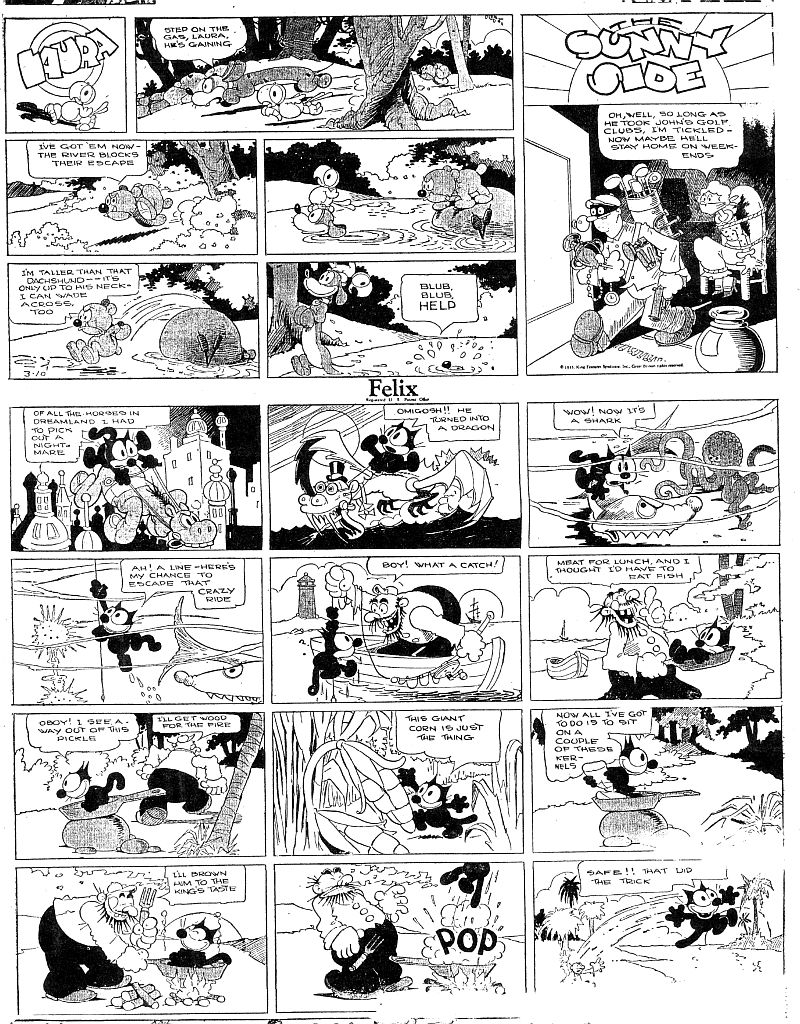
Felix is from 3/4 to 3/10/1935 this time. Felix tries to assist the crew in their hunt for the rare Dodo fish, but he is called a jinx by the sailors, then Felix’s catch of a prize Dodo fish is broiled by the Chinese cook. Felix then finds another Dodo fish as he holds his breath for a couple of days undersea! In the Sunday page, Felix continues his adventures in Dreamland, riding on the Nightmare. It turns into a very funny dragon wearing a top hat, and a shark, putting Felix undersea again. Felix is caught by a fisherman who wants to cook the cat for the King. Felix gets out of that situation with two kernels of giant popcorn.
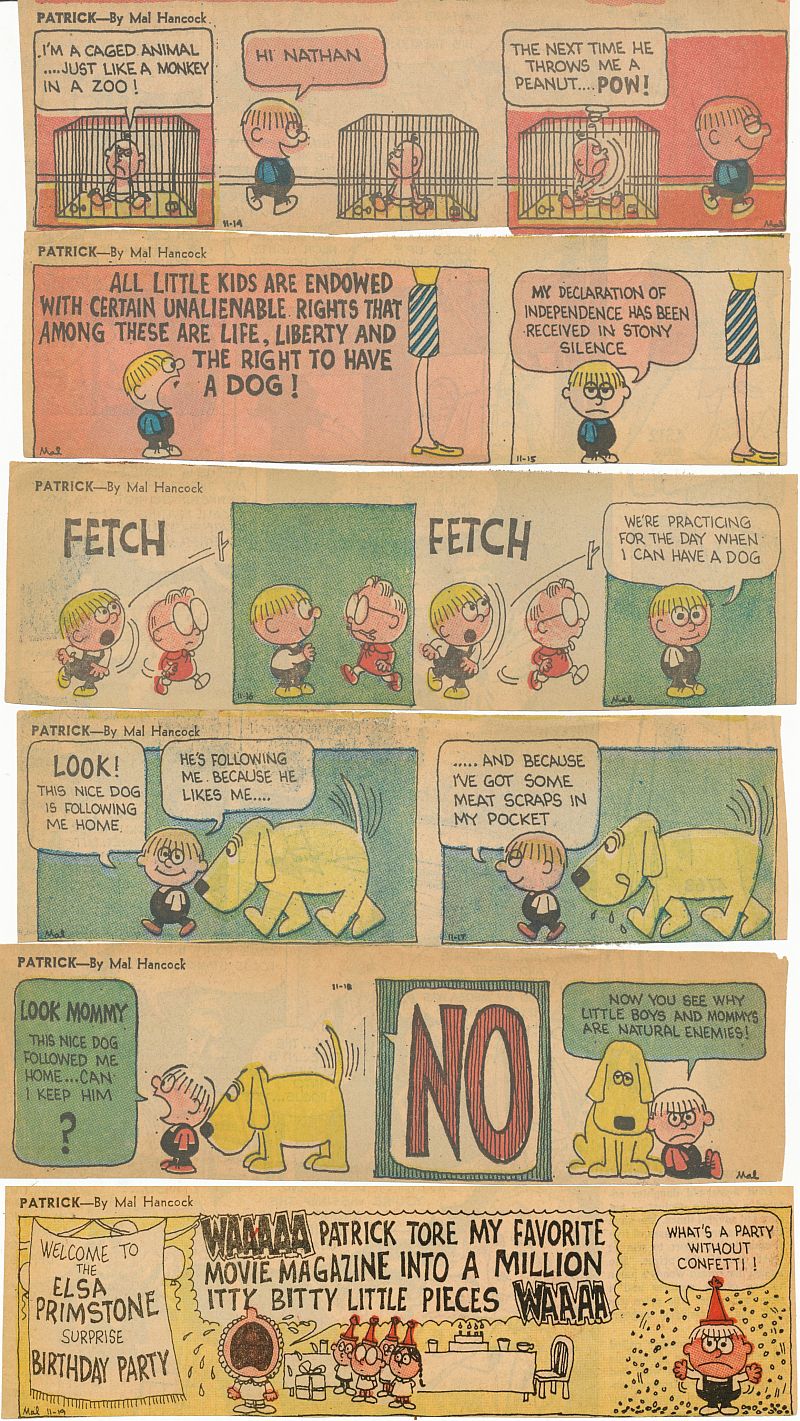
Patrick is from 11-14 to 11-19-1966. Patrick’s crib-bound little brother is named in the 11/14 (“Nathan”, reminds me of Fanny Brice’s hit, “Oy, How I Hate That Fellow, Nathan”) and Patrick and his Mommy are at daggers drawn over his need for a dog. In the 11/19, Partick rips Elsa’s favorite movie magazine to shreds at her birthday party, what a guy! We’ll see y’all next time.
Norm, I hardly knew ya
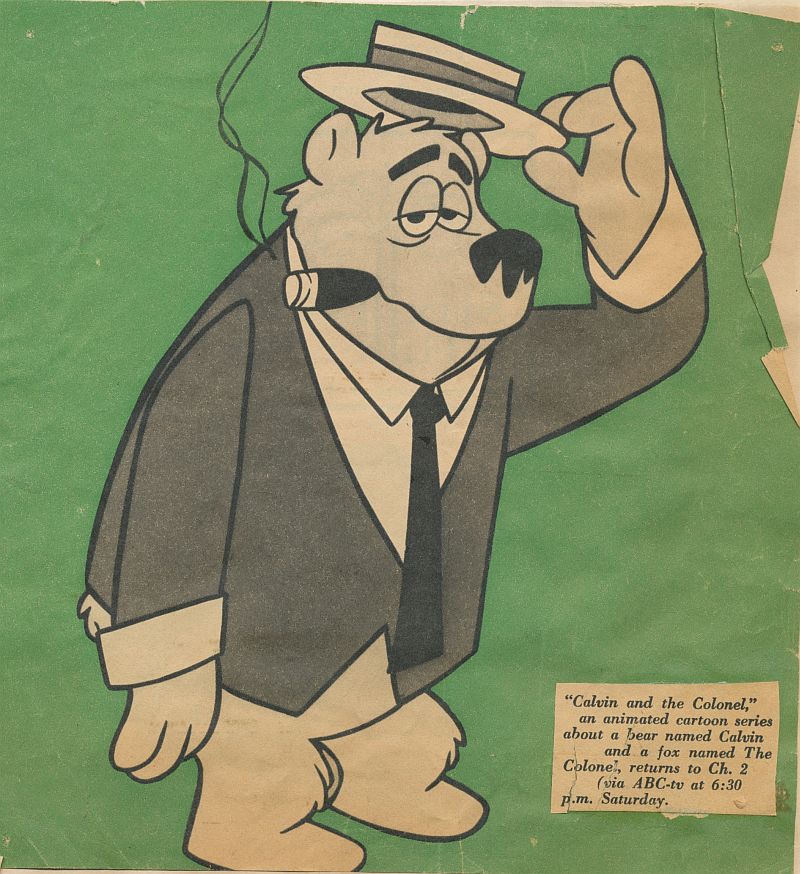 Norm Gottfredson, who had the upstairs office when he was part owner of Fred Calvert Productions
  , earned my awe and respect. I didn’t realize until later that he was Floyd Gottfredson’s son, or I would have been even MORE impressed with him. You see, I lived at Fred Calvert’s studio for a couple of months in the summer of 1968, when his studio was in North Hollywood. I talked to Norm about animation a little bit, and I’m sure he saw how starry-eyed I was about the business. Norm wouldn’t let me talk very long to him, and indicated that time was money, he was doing layout on some sub-contracted George of the Jungle episodes, and they needed to be done quickly. Norm’s office was beautifully decorated with many storyboard drawings, character roughs, and colorful paintings, that made me want to stay and browse! Fred Calvert Productions was a non-union shop in the midst of union studios, which sub-contracted a lot of work from Hanna-Barbera, Jay Ward and the Children’s Television Workshop. Fred’s wife, Kimi, also had an office there and worked very diligently and hard for the studio. Floyd Gottfredson, in an interview with Malcolm Willits in the early 1970s, said this about his son: “My oldest son is an art director, artist, and part owner of Fred Calvert Productions, in Los Angeles. They produce industrial films, commercials, and animation entertainment films, among which are some sub-contracted Bullwinkle cartoons. (Actually, Floyd assumed that working for Jay Ward meant Bullwinkle, but by then George of the Jungle was the going series.)” This is the only mention I have in print of Norm’s career by his famous dad. If I had been a little bit more bold, I would have asked Norm if Floyd approved of his going into the animation business, how they got along when Norm was a kid, and whether Floyd got Norm any summer jobs at the Disney studio. (Maybe one of my readers will know the answers.) Norm had quite a long resume, evidently starting at TV Spots, Inc. in 1951 as an art director! He evidently started at the top. He art directed King Leonardo and His Short Subjects in 1960, Calvin and the Colonel in 1962, both for TV Spots. By 1963, he was doing layout on the Funny Company series where he probably worked with John Sparey, and in 1966 did storyboard and layout on the “Super 6” series for Depatie-Freleng, their first TV cartoon. By the time I met him when he was partners with Fred Calvert, Norm was doing layout on anything that Fred rounded up, George of the Jungle, Wacky Races, Three Musketeers, etc. Norm was an all-around artist who could draw practically anything and did! One of the last series he worked on with Fred was Emergency Plus-4, where he did layout, with Kimi Calvert doing the art direction. After 1973, Norm worked on an odd series called Drawing Power, a strange live-action/animation combination show, produced by Kim and Gifford in New York. Norm was an animator on the show, in which an actor named Bob Kaliban played “Pop”, an old animator who entertains children with his magical drawing board, and thus encourages youngsters to draw. It had very crude, chroma-key special effects, but was a novel-toon series. Norm when on to work as a timing director on Disney’s Adventures of the Gummi Bears in 1985, Galaxy High School in 1986, Denver, the Last Dinosaur in 1989 and Widget the World Watcher for Bill Kroyer in 1991, where he was animation director. In addition, Norm did layout and design on many TV commercials for all sorts of clients, including of course, the Kellogg’s Leo Burnett stable, Green Giant, etc. Norm, Kimi, Iwao Takamoto and Fred Calvert were all very serious-minded people to whom animation was a nuts-and-bolts kind of business, in which a Sally Sargent, Emergency Plus-4, I Am The Greatest or George of the Jungle, were all pretty much the same thing. Just get ’em out, get ’em done and do ’em non-Union so we don’t have to pay benefits or health and welfare. When I met Duane Crowther at Fred’s studio, he was just the opposite of all the rest of the studio. Duane seemed to have a good time with his animation, and was easy to talk to.
I wish I could have talked to Norm Gottfredson a lot more, but being a real neophyte at the time, I was not encouraged to “take up his time”. He was a real talent, and admired by many people, but became part of the faceless army of TV animation enablers. As a timing director and animation director, he no doubt greased the wheels for the ultimate non-Union production, “overseas”. Norm, I hardly knew ya, but I was saddened to read of your passing on July 16th, in the Union paper. It’s interesting that The Pegboard only printed your activity with Union shops for the most part, never mentioning Fred Calvert.
I noticed that Joan-Ellen “Joanie” Gerber passed away on August 22. Joanie was a voice-over actor who did some of the “Lady Bugs of the Evening” voices on “Shinbone Alley” back in 1969, the feature film where I got my first scene of professional animation to do. She did voices on a lot of the same shows that Norm Gottfredson worked on, such as “Super 6”. One of her first jobs was on the TV cartoon version of “Beany and Cecil” for Bob Clampett in 1959. She did voices on “Heidi’s Song”, for Hanna-Barbera, the “Jokebook” show for H-B, Tex Avery’s “Kwicky Koala” for H-B, the revived Chipmunks series in 1984 and many many more. Read her career listing on IMDB. Her most recent credit was for Tony Cervone and Spike Brandt’s “Duck Dodgers” series. I never had the chance to work closely with Joanie, but she must have been in demand, she worked a long time in one of the few animation jobs that can’t be out-sourced, the voices! She did a lot of baby voices, old lady voices and teenage girls as well. Maybe she will get a longer obit later on. This one: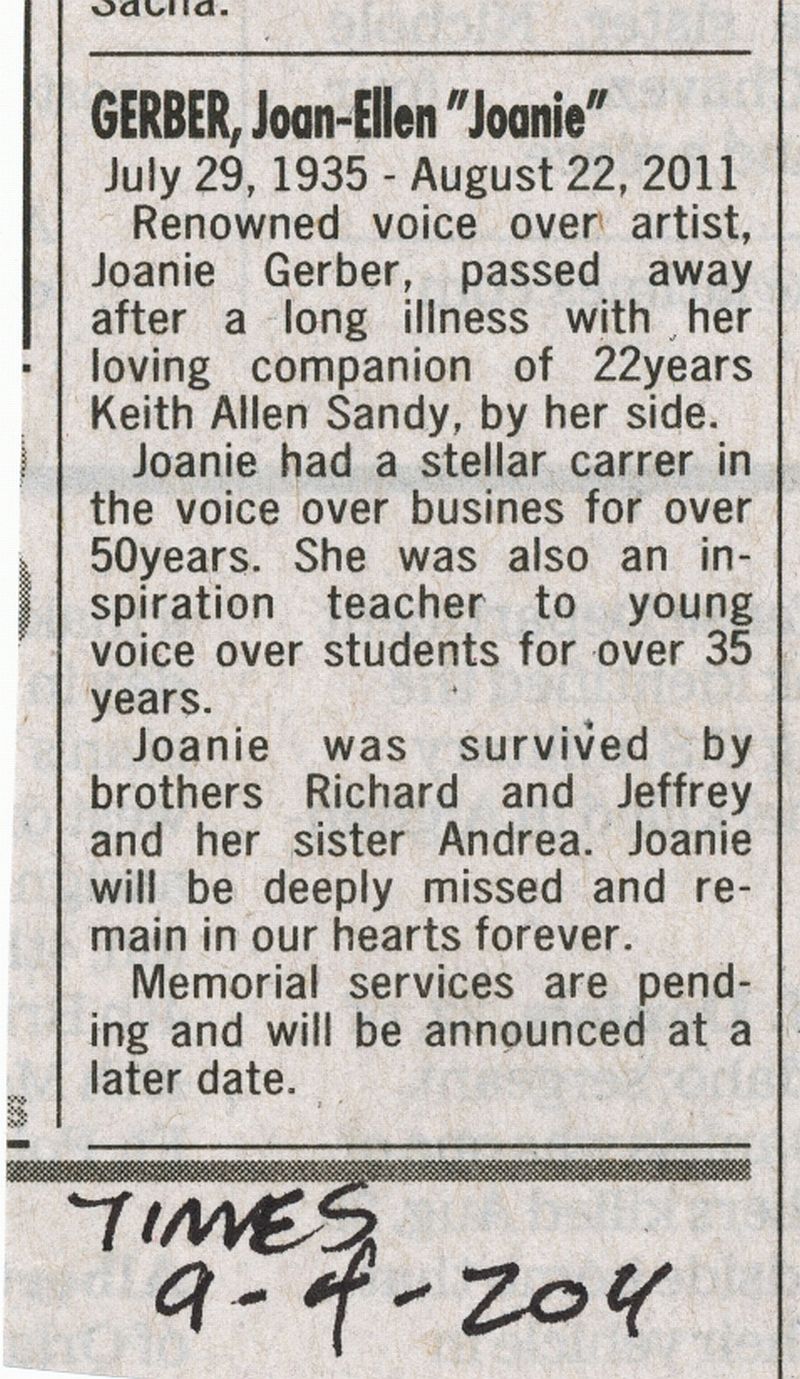 seems so puny.
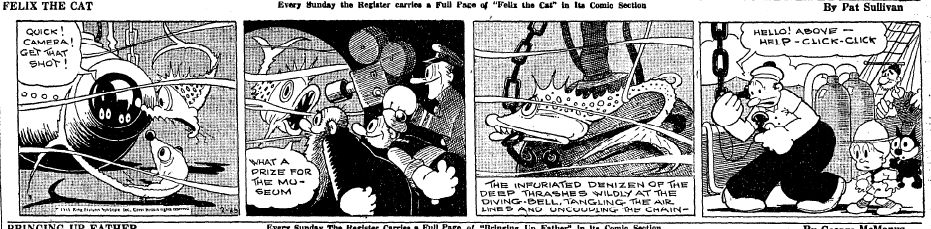
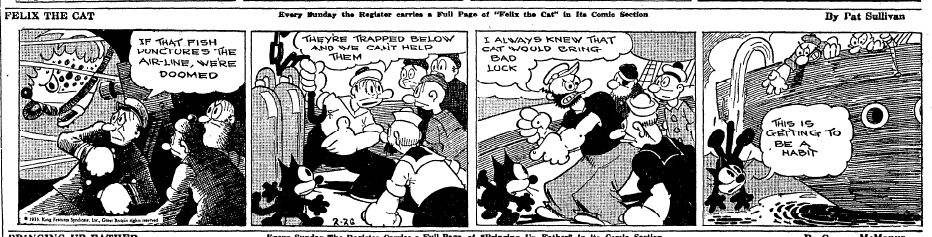
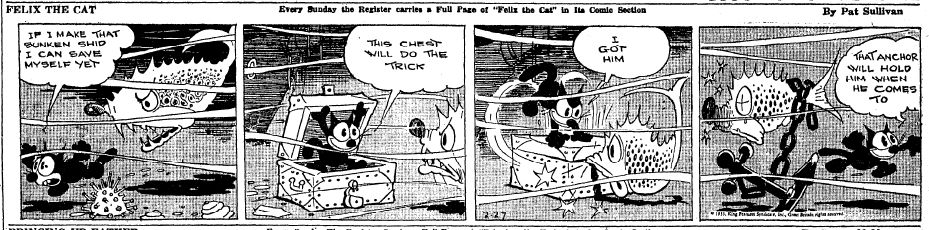
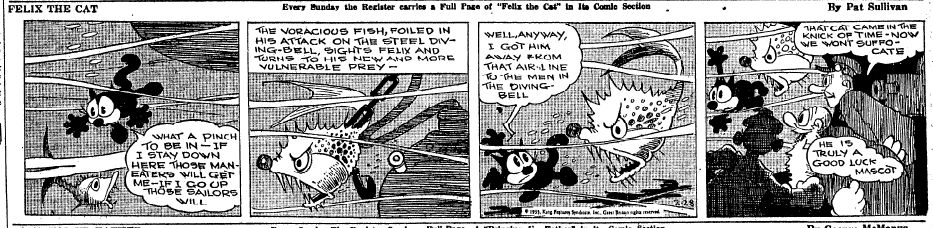
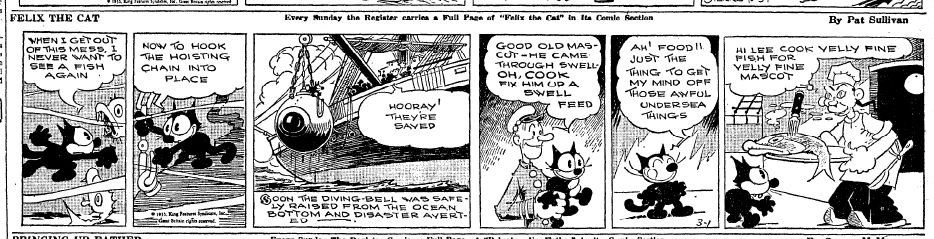
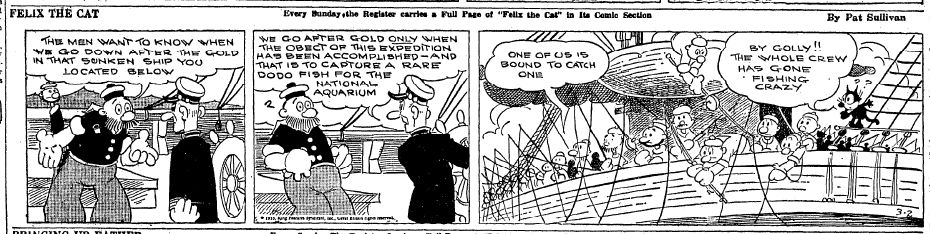

Felix from 2-25 to 3-3-1935, has Felix once more defending his reputation as a good luck mascot by rescuing the sailors from their marooned diving-bell under the ocean. After fighting off monster fish for days, Felix is presented with still ANOTHER fish for his dinner! In the Sunday, Felix is still in Dreamland, and in another Winsor McCay swipe, rides away on a “Night-mare”!
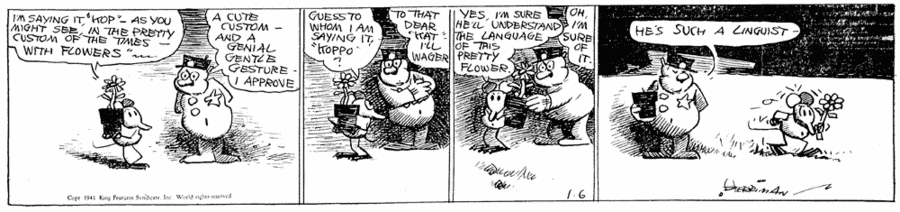
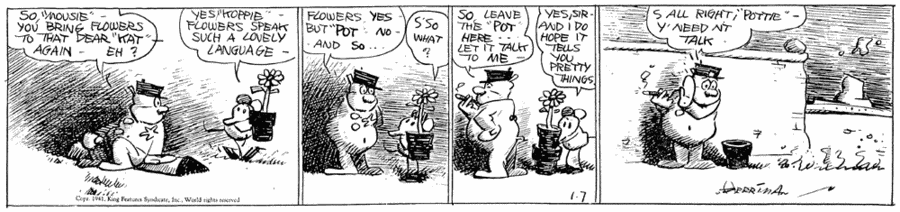
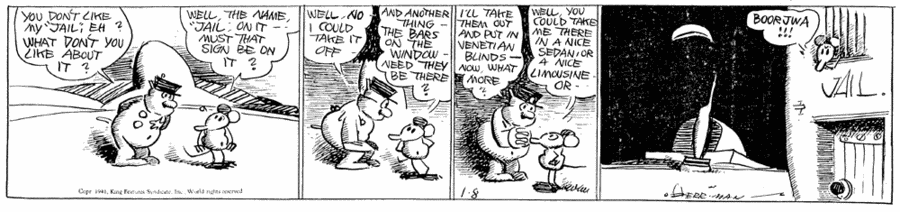

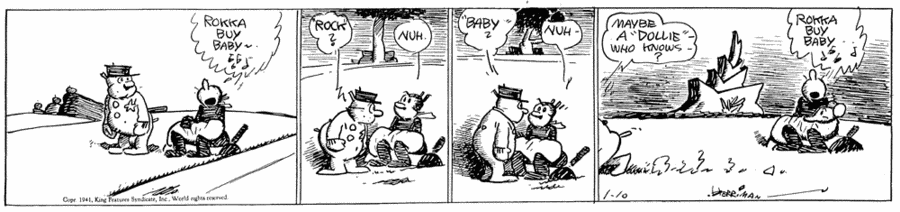
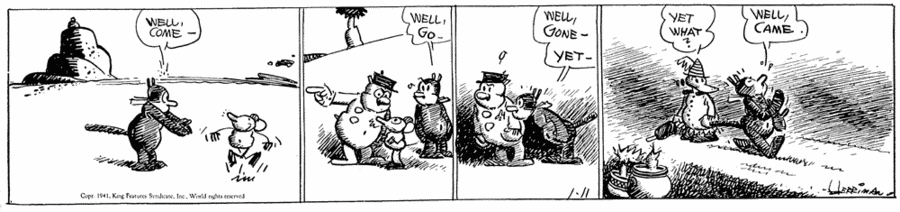
Krazy is from 1-6 to 1-11-1941 this time. Ignatz tries to take a flower in a pot to Krazy a coupla times, but the Pupp manages to keep the pot. In the 11-8, Ignatz suggests improvements to the “Jail”, which he is imprisoned for suggesting. “Boorjwa”, exclaims Ignatz, one of my Grandma’s favorite words. Mrs. Kwakk-Wakk figures in the strips for the rest of the week, nearly getting caught in her own web of gossip.
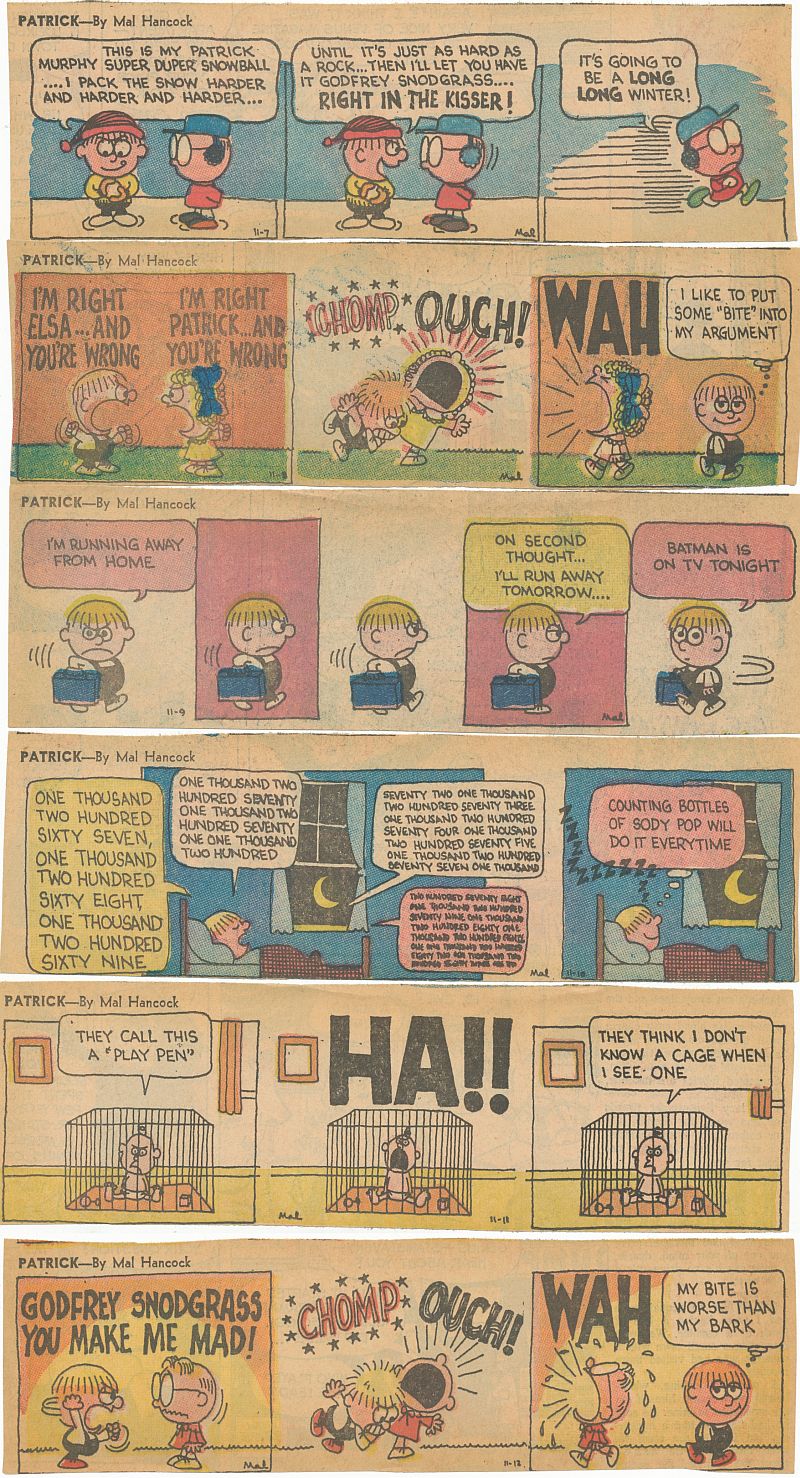
Patrick is clearly labelled this time, from 11-7 to 11-12-1966. Patrick is quite a “biter” this week, sinking his teeth into Elsa and Godfrey. The 11-11 strip features the debut of Patrick’s new little brother in his playpen. He will make several more appearances in the strips to come, always confined to the pen. Watch for him! Soon!
Special Post to “Yowp”
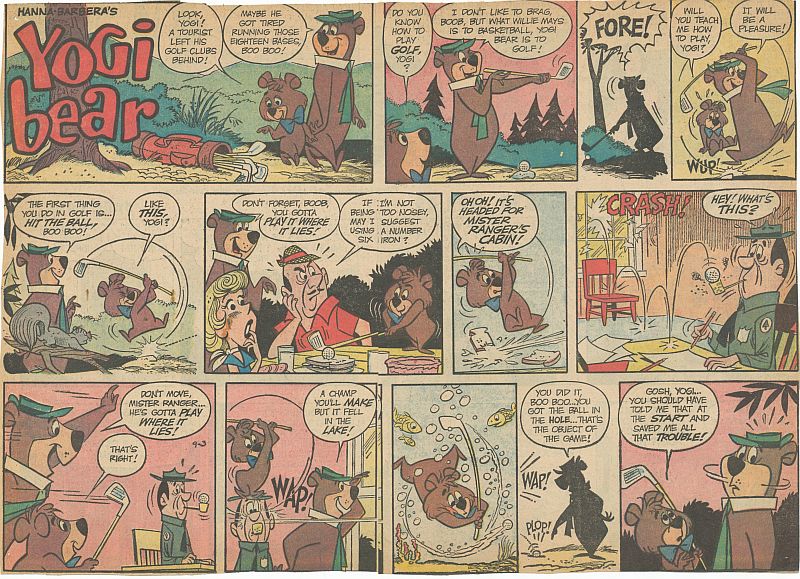
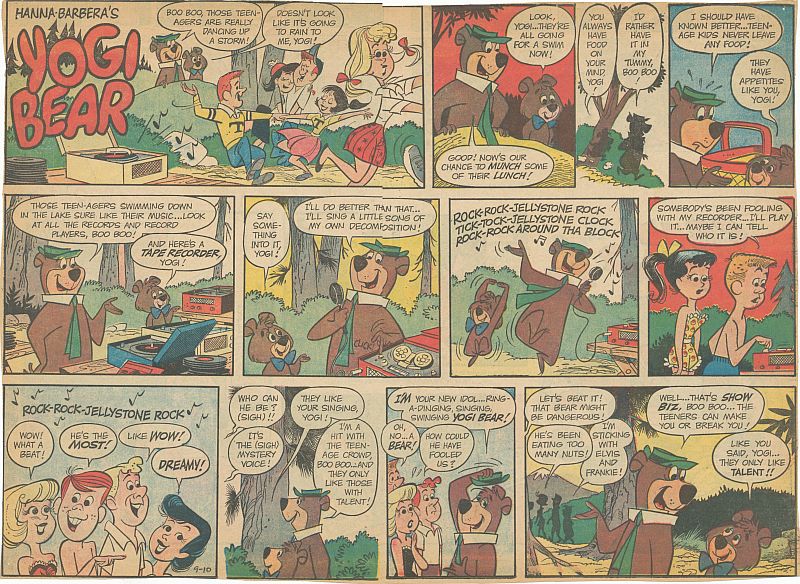

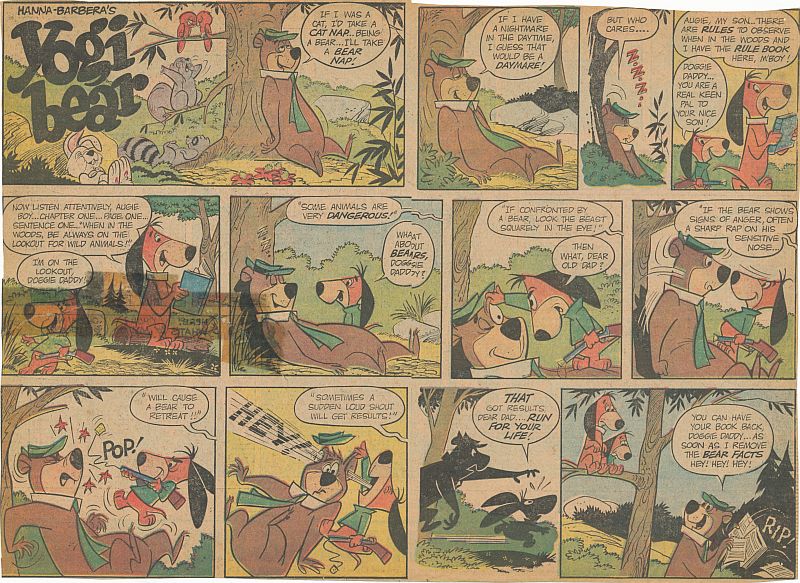
If you click on the link to Yowp’s blog on the right hand side of the screen, you will see that the cartoon dog has posted the September, 1961 Yogi Bear Sunday comic strips, all drawn by Harvey Eisenberg. His scans lack color and the top tier, since these were all originally half-page strips. I delved into the old clipping files and came up with the same strips, clipped from the St. Louis Post-Dispatch fifty years ago. They were published on Sept. 3rd, 10th, 17th and 24th, 1961. Please click on the thumbnails above to see them at larger sizes. Please excuse the slightly mismatched halves of the strips. These were pretty large, so I had to scan them in two parts and piece them together, sometimes I don’t get it perfect. The strip from 9-24 with Augie Doggie has some masking tape stains in the 5th panel. That’s a good tip for all you strip collectors, don’t repair your strips with highly acid tapes like Scotch cellophane or masking tape, they will discolor the material they are holding together. If you like the early Hanna-Barbera characters, you will enjoy Yowp’s blog. Yowp has some good background comments on these strips, so go over there and read them. If any visitors from Yowp’s blog are reading this, stick around! Go through the archives and enjoy some old strips, as well as some articles on animated cartoons of the past. I hope to be back soon with a “regular” post.
Strips
February 17, 2012
Uncategorized
No Comments
Mark